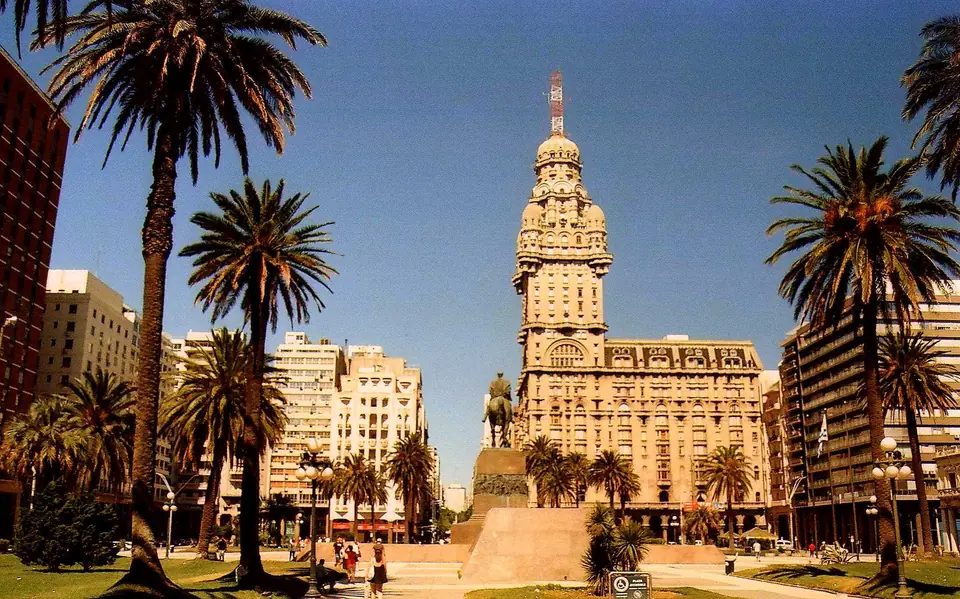
Plaza Independencia, Palacio Salvo and Teatro Solis Guide
Plan your walk through Montevideo's Plaza Independencia, exploring Palacio Salvo, the underground Artigas Mausoleum and the historic neoclassical Teatro Solis.
Conceived in 1837 by Italian neoclassical architect Carlo Zucchi after the demolition of the colonial citadel walls, Plaza Independencia forms the civic fulcrum of Montevideo. The square bridges the historic peninsula of Ciudad Vieja to the west and the broad boulevard of Avenida 18 de Julio to the east. Multiple architectural eras converge around its colonnaded perimeter, spanning eighteenth-century military fortifications, neoclassical civic halls, and early twentieth-century high-rise towers. It acts as an anchor point within any 3-day Montevideo itinerary.
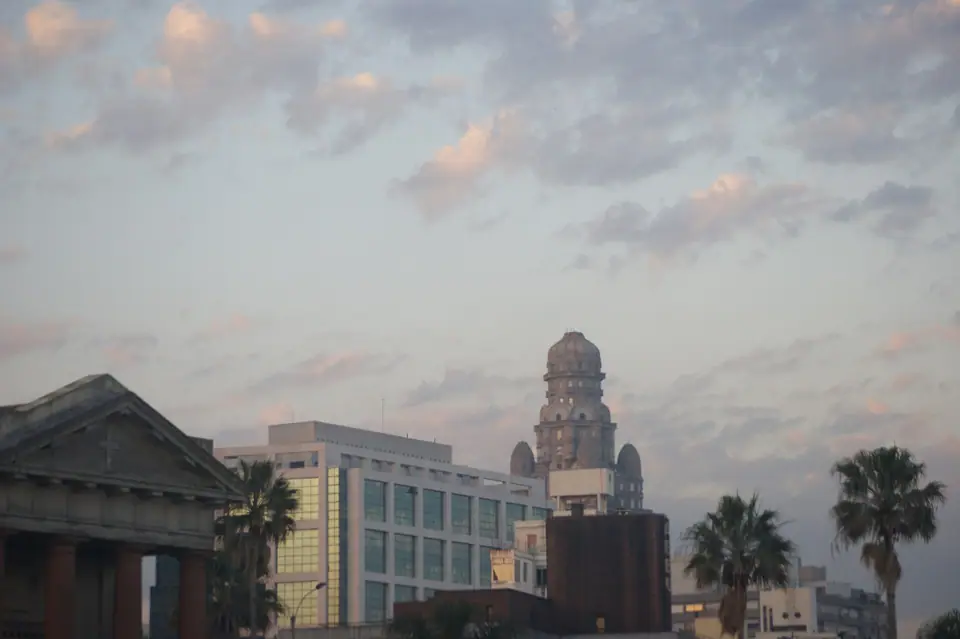
Palacio Salvo and the Tangos of Confiteria La Giralda
Rising 27 storeys and 105 metres above the eastern edge of Plaza Independencia, Palacio Salvo remains one of the most recognizable structures on the Rio de la Plata. Commissioned by textile entrepreneurs Angel, Jose, and Lorenzo Salvo, the building was inaugurated in October 1928. It was designed by Italian architect Mario Palanti, who constructed its architectural sibling, Palacio Barolo, across the river in Buenos Aires. Palanti combined reinforced concrete with eclectic Gothic flourishes, Renaissance arcades, and marine-inspired Art Deco carvings, finishing the tower with an ornamental beacon dome. When finished, it stood as the tallest building in South America.
The tower occupies the site of the former Confiteria La Giralda cafe. In 1917, twenty-year-old student Gerardo Matos Rodriguez premiered the composition La Cumparsita inside the cafe, establishing what became the world's most enduring tango melody. Today, the ground floor hosts the Museo del Tango, dedicated to this musical heritage. Guided ascents lead through the upper balconies, offering panoramic views across the port and downtown avenues. Visitors planning to ascend the tower should verify current tour departures and operating schedules directly on the official booking portal, as ascent times vary across seasons.
Monumento and Mausoleo de Artigas
At the exact centre of Plaza Independencia stands the massive equestrian monument honouring General Jose Gervasio Artigas, the father of Uruguayan independence. Sculpted by Italian artist Angelo Zanelli and unveiled in 1923, the monument features a 17-metre, 30-tonne bronze sculpture elevated above a granite base adorned with detailed bronze bas-reliefs. The reliefs depict citizens following Artigas during the heroic Exodus of the Western People in 1811.
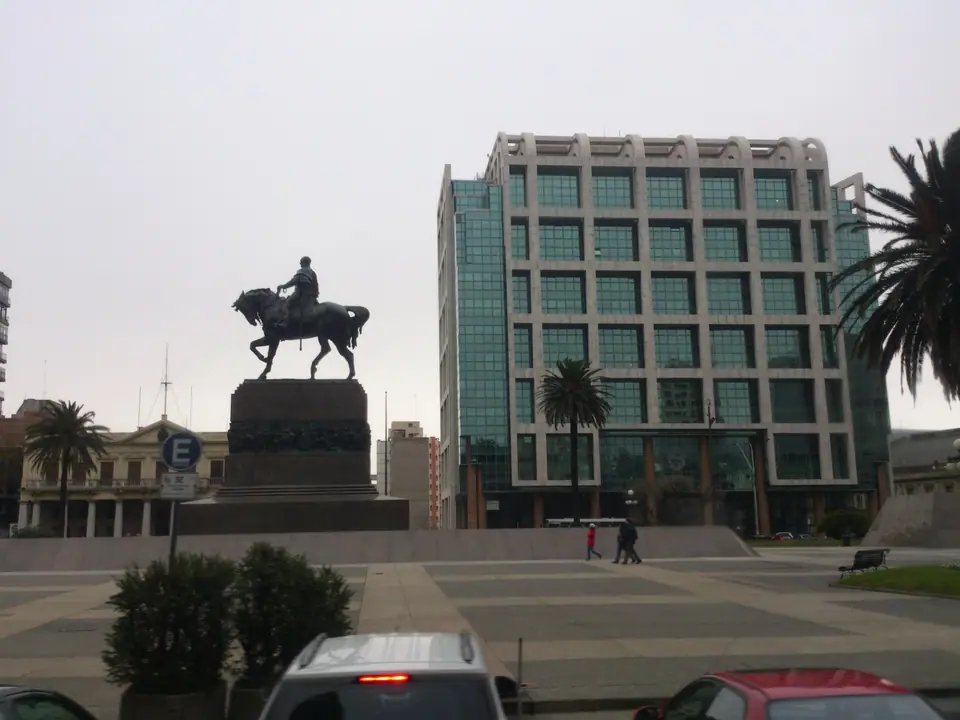
Broad granite stairways descend below the bronze statue into the underground Mausoleo de Artigas, added in 1977. The subterranean crypt houses the patriot's remains inside an urn made of solid stone. Natural daylight filters through roof slits cut flush into the pavement above, illuminating polished granite walls inscribed with key milestones of the national struggle. Soldiers from the Blandengues de Artigas cavalry regiment keep permanent ceremonial watch beside the crypt in traditional dress uniform. Visitors are expected to observe quiet decorum while descending the stairs. Entry requirements and public access schedules can fluctuate for national holidays and official state ceremonies, so check local municipal notices before descending.
Puerta de la Ciudadela and Executive Power Landmarks
The western gateway of the plaza features the Puerta de la Ciudadela, constructed in 1741. This weathered stone portal represents the principal surviving remnant of the Spanish fortifications that enclosed colonial Montevideo until 1829. Passing under its heavy arch leads directly into the pedestrianised Calle Sarandi, connecting visitors to the rest of the old town's museums, churches, and historic plazas.
Opposite the stone portal, the perimeter displays Uruguay's transition into modern governance. Palacio Estevez, constructed in the nineteenth century with Italianate neoclassical pediments, served as the presidential office for decades and now houses a government museum. Directly next door stands the sleek Executive Tower, completed in the early twenty-first century, which serves as the current working seat of the President of Uruguay. This juxtaposition creates a direct line of sight between colonial military defence, nineteenth-century republic institutions, and contemporary state administration.
Teatro Solis: Performance Heritage and Restoration Architecture
Just off the southwest corner of the square stands Teatro Solis, Uruguay's premier historic opera house. Designed by Carlo Zucchi and opened on 25 August 1856 with a performance of Giuseppe Verdi's Ernani, the theatre features an imposing neoclassical facade with fluted Corinthian columns modelled after Rome's Teatro Carlo Felice. The main hall displays a traditional horseshoe design beneath a painted ceiling fresco by artists Eduardo de Martino and Juan Manuel Blanes.
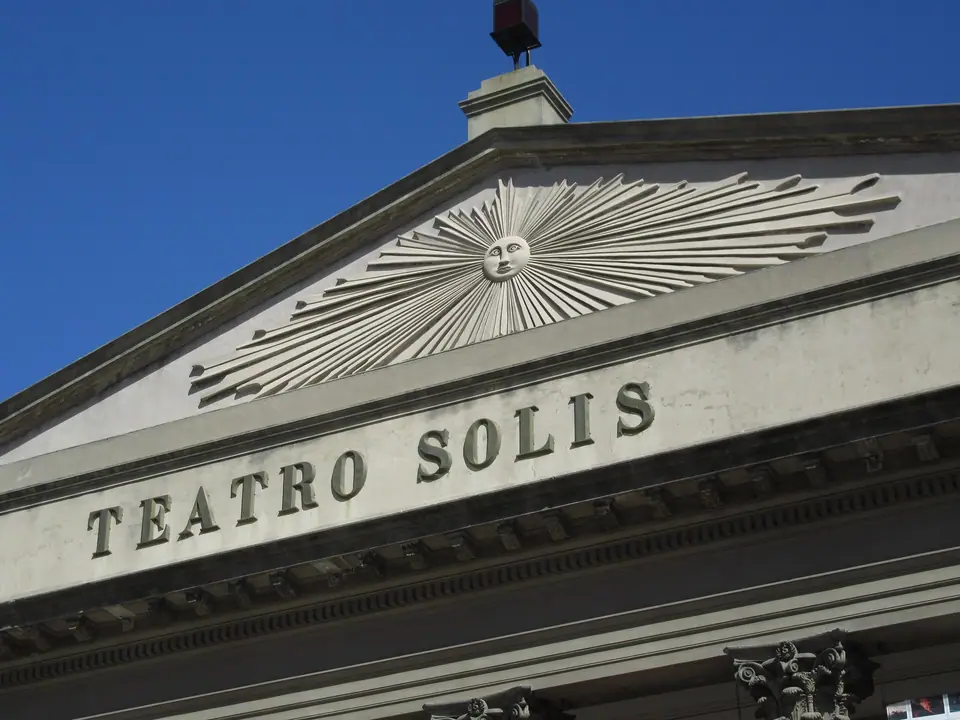
Between 1998 and 2004, the theatre underwent a thorough restoration to rebuild damaged structural wings and modernize interior acoustics. Specialist firm Avel Acoustique revamped the main auditorium's sound performance, while French designer Philippe Starck introduced two columns inside the auxiliary public spaces. Guided walking tours run regularly, taking travellers backstage, through the presidential box, and behind the velvet seating rows. Tour schedules and evening concert programmes change weekly, so visitors should check the Teatro Solis box office website to confirm current availability before purchasing admission.
Architectural Landmarks Around Plaza Independencia
| Landmark | Primary Architecture Style | Construction Date | Historical Significance |
|---|---|---|---|
| Puerta de la Ciudadela | Spanish Colonial Military | 1741 | Main surviving stone gate of the original defensive fortress wall |
| Teatro Solis | Neoclassical Italianate | 1856 | Oldest operational theatre in Uruguay, designed by Carlo Zucchi |
| Monumento a Artigas | Bronze Beaux-Arts Sculpture | 1923 | Equestrian statue above the 1977 underground national mausoleum |
| Palacio Salvo | Eclectic Art Deco-Gothic | 1928 | Former tallest tower in South America and birthplace of La Cumparsita |
| Palacio Estevez | Neoclassical Doric | 1873 | Former executive office of the President, now a government museum |
Navigating the Plaza and Connecting Routes
Plaza Independencia is completely pedestrian friendly and easy to traverse on foot. The paved pathways are broad, flat, and shaded by Canary Island date palms. Exploring the monuments, the underground crypt, the theatre exterior, and the arcade of Palacio Salvo takes between two and three hours at a relaxed pace.
The square serves as an ideal geographical orientation marker for urban walking routes. Walking west through the Puerta de la Ciudadela takes you deeper into the historic quarters toward the iron market halls of Mercado del Puerto. Strolling east leads along the shops, cafes, and historic bank buildings lining Avenida 18 de Julio. If you walk south past Teatro Solis along Calle Juncal or Calle Bartolome Mitre, you reach the coastline within ten minutes, connecting directly to La Rambla where waterfront promenades stretch along the Rio de la Plata.
Seasonal Weather Patterns for Walking Montevideo
Montevideo enjoys a temperate coastal climate governed by the open waters of the Rio de la Plata. Summer afternoons between December and February average warm daily highs of 26.4°C to 27.8°C with pleasant lows around 17.1°C to 18.8°C. These months bring six rainy days per month and roughly 42 mm of precipitation, making summer mornings comfortable for strolling the square before midday heat peaks.
Autumn conditions from March to May provide moderate walking weather. Highs settle around 25.3°C in March, dropping to 18.5°C in May. Rainfall averages between 42 mm and 49 mm per month over six to seven wet days. Winter from June to August introduces maritime breezes, with highs ranging from 14.7°C to 16.7°C and cooler overnight lows of 7.3°C to 8.5°C. Springtime between September and November warms steadily from 17.9°C to 23.7°C. Pack a light windbreaker regardless of the season, as coastal air currents funnel rapidly across the open perimeter of the plaza.
Where it is
- 1Plaza Independencia, Palacio Salvo and Teatro Solis
- Carrasco General Cesáreo L. Berisso International Airport (MVD) · about 18 km from here in a straight line
- Directions in Google Maps
Stations and taxi ranks: OpenStreetMap. Airports: OurAirports. Distances are in a straight line.
Traveller tips
Real advice from people who have been to Montevideo. Every tip is read by our team before it goes live.
No tips yet. Been here? Yours could be the first.
Thank you! Your tip will appear here after a quick review.
More in Montevideo
Continue exploring Montevideo with related neighbourhood, food, and planning guides
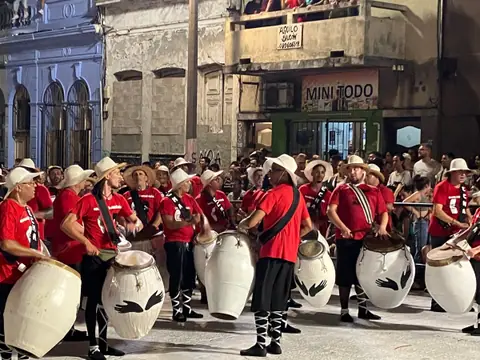
La Rambla, Barrio Sur, Palermo and Afro-Uruguayan Candombe Culture
Montevideo, Uruguay
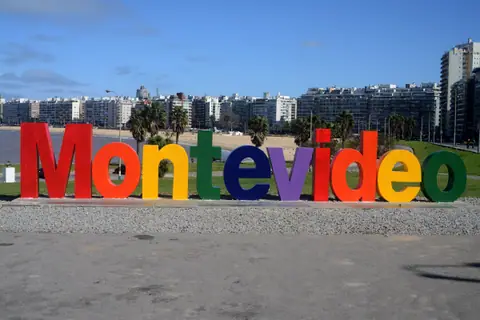
Parque Rodo, Punta Carretas Lighthouse and Playa de los Pocitos
Montevideo, Uruguay
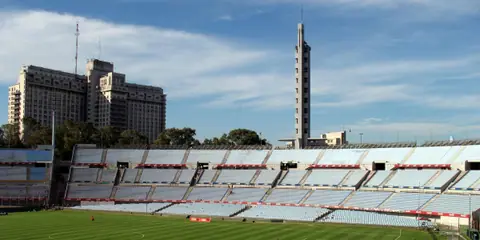
Estadio Centenario, Parque Batlle and the Historic Prado District
Montevideo, Uruguay
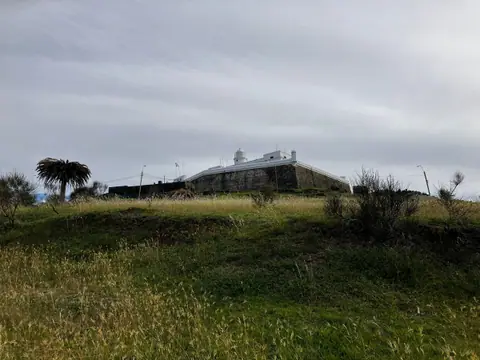
Fortaleza del Cerro (134 m) and Montevideo's Tannat Wine Bodegas
Montevideo, Uruguay
