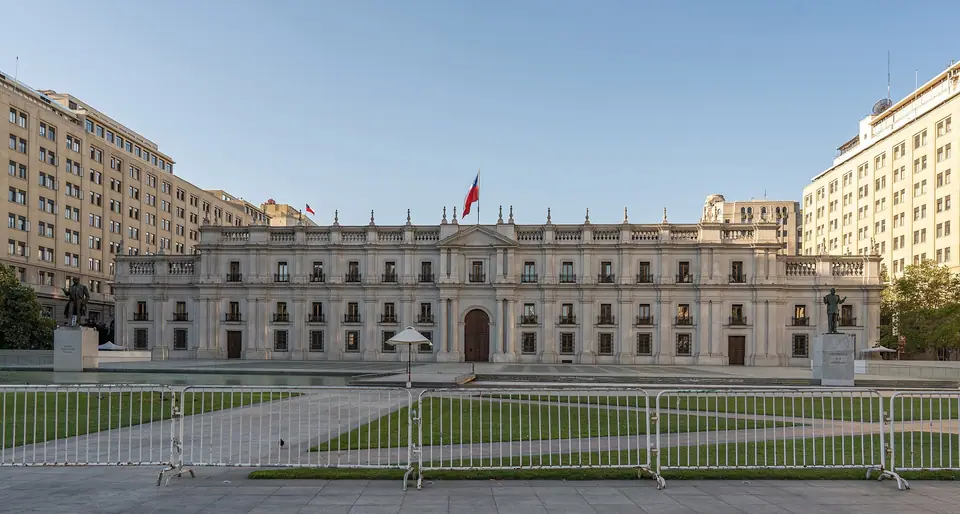
Photo: Rjcastillo · CC BY-SA 4.0
Palacio de La Moneda, Barrio Cívico and Barrio París-Londres Guide
Discover Santiago's Palacio de La Moneda and Barrio Cívico with architectural insights, courtyard access details, urban context, and seasonal climate patterns.
Five blocks southwest of Plaza de Armas along Calle Morandé or Paseo Bandera, Santiago's colonial grid opens into the stone symmetries of the Barrio Cívico. At its centre stands the neoclassical facade of Palacio de La Moneda. Commissioned at the end of the eighteenth century as the Royal Mint of the Spanish Empire, the complex has served as the official seat of the President of the Republic of Chile since the mid-nineteenth century.
Joaquín Toesca's Royal Mint and Republic History
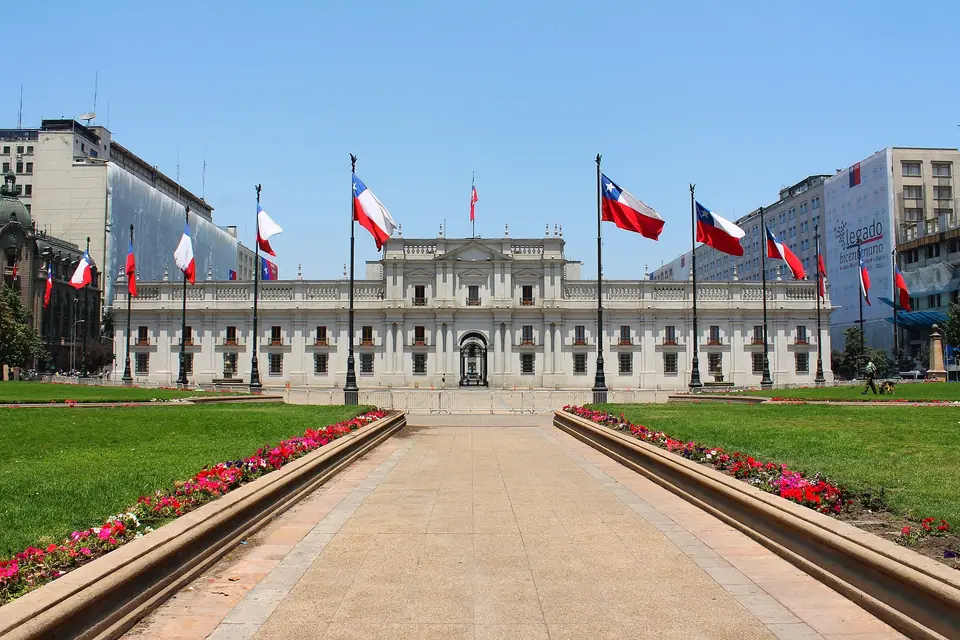
Born in Rome and trained in Madrid under Francesco Sabatini, architect Joaquín Toesca began work on the Royal Mint in 1784. The site previously belonged to the Jesuit Colegio Máximo de San Miguel. Construction required thick lime-mortared brick walls, stone pilasters from Cerro San Cristóbal, and iron grilles imported from Biscay. Inaugurated in 1805, the building became the seat of government under President Manuel Bulnes in 1846 while maintaining its mint operations until 1929.
The palace suffered catastrophic damage during the military coup of 11 September 1973, when aerial bombardment and artillery targeted the complex and President Salvador Allende died inside. Following extensive reconstruction, authorities restored the historic Morandé 80 door in 2003. When open for official public access, visitors can view the Patio de los Cañones with its colonial artillery pieces and the Patio de los Naranjos, lined with mature citrus trees.
Plazas and the Centro Cultural La Moneda
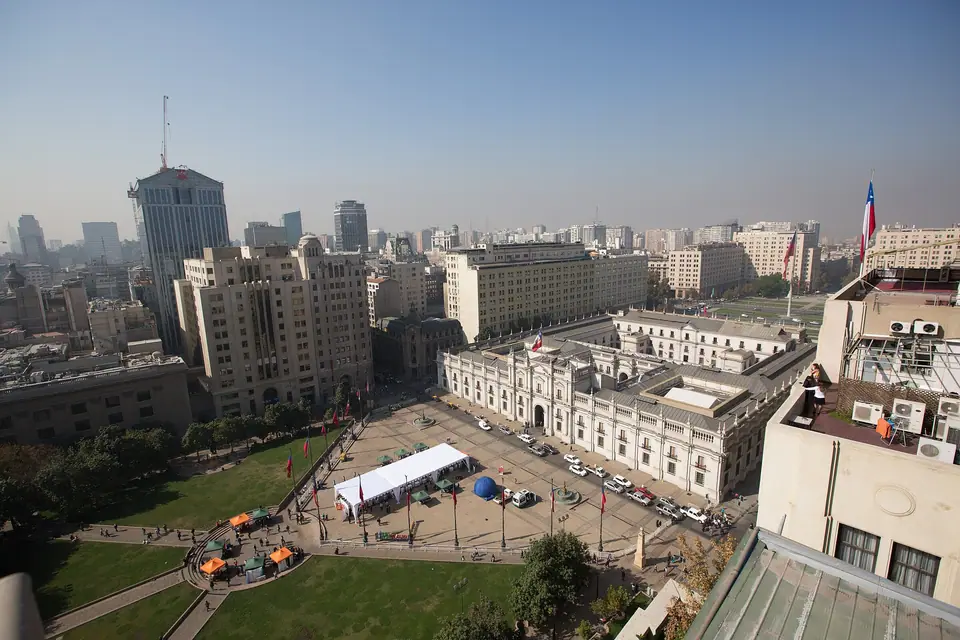
Palacio de La Moneda occupies an entire city block bounded by Calle Moneda, Morandé, Teatinos, and the Alameda. To the north lies Plaza de la Constitución, framed by ministerial offices and statues commemorating former Chilean heads of state. These bronze figures include Jorge Alessandri, Eduardo Frei Montalva, Patricio Aylwin, and Salvador Allende. The square also hosts the mounted Changing of the Guard ceremony conducted by the Carabineros de Chile every other morning.
To the south across the Alameda stretches Plaza de la Ciudadanía. Directly underneath this stone esplanade sits the Centro Cultural La Moneda, which opened in January 2006. Spanning 7,200 square metres, the subterranean cultural institution contains large visual art galleries and the Cineteca Nacional, which preserves and screens Chilean cinematic heritage. Because exhibition schedules and operating policies vary throughout the year, visitors should review the official cultural centre website before arrival.
Urban Planning in Barrio Cívico and Barrio París-Londres
The monumental character of the surrounding Barrio Cívico stems from the 1930s urban designs of Austrian planner Karl Brunner. His master plan established uniform building heights, grey granite arcades, and axial views framing the presidential palace. Brunner created a cohesive governmental quarter that contrasts sharply with the smaller commercial grid nearby.
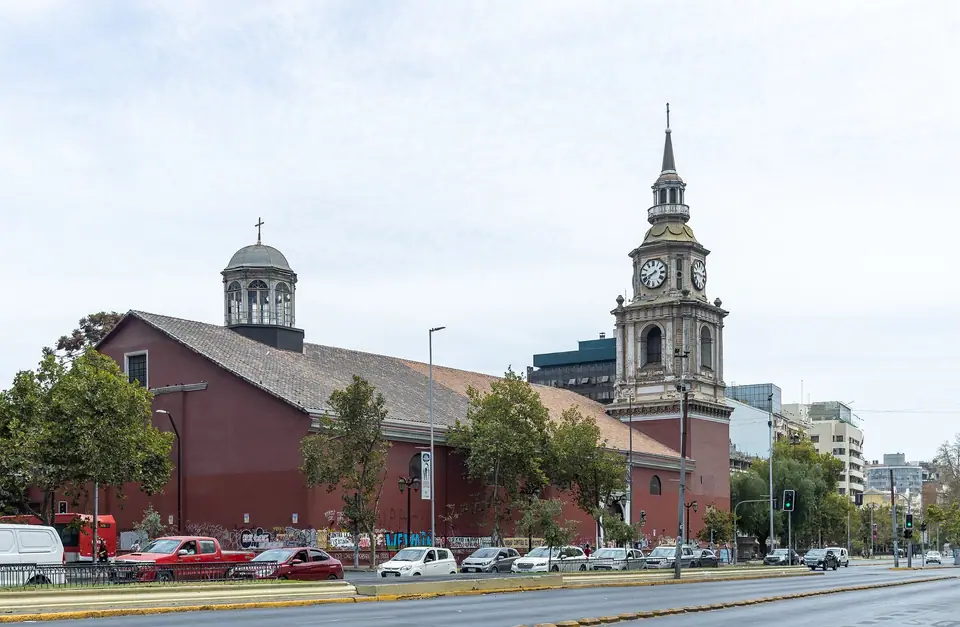
Two blocks east along the Alameda, the urban texture shifts dramatically into Barrio París-Londres. Built during the 1920s across the former agricultural grounds of the Franciscan order, this enclave features winding cobblestone lanes, wrought-iron balconies, and European residential architecture. At the edge of the quarter stands the Iglesia de San Francisco. Begun in 1586, it remains the oldest surviving colonial building in Santiago and has withstood multiple major earthquakes across four centuries.
Navigating Barrio Cívico and Nearby Sectors
| District Element | Primary Focus | Key Landmark or Feature | Walking Connection |
|---|---|---|---|
| Palacio de La Moneda | Executive Government | Patio de los Naranjos and Morandé 80 | North side of the Alameda axis |
| Plaza de la Constitución | Civic Monuments | Statues of former Chilean presidents | Immediate northern frontage of La Moneda |
| Centro Cultural La Moneda | Visual Arts and Film | Cineteca Nacional screening vaults | Subterranean level under Plaza de la Ciudadanía |
| Barrio París-Londres | Residential Architecture | 1920s cobbled streets and European facades | Two blocks east across the Alameda |
| Iglesia de San Francisco | Colonial Heritage | Surviving stone church dating to 1586 | Corner of Calle Londres and the Alameda |
Walking between these public spaces is straightforward because the central core is flat and pedestrian friendly. Travelers following a structured Santiago 3-day itinerary can easily combine the government quarter with adjacent historic monuments. Plaza de Armas and the Santiago Pre-Columbian Art Museum lie within five blocks to the north, allowing a logical walking route through civic history.
Seasonal Planning and Weather Considerations
Exploring the outdoor plazas of Barrio Cívico requires planning around Santiago's Mediterranean climate. Summer months bring intense solar radiation and dry conditions. January records high temperatures averaging 30.4°C with 0 millimetres of rainfall, while December reaches 29.0°C with zero wet days. The stone paving on Plaza de la Constitución and Plaza de la Ciudadanía absorbs considerable heat by midday, making early morning visits more comfortable.
Winter offers cooler temperatures suited for walking tours of the governmental avenues. July records daytime highs of 15.7°C and overnight lows of 3.8°C, with 28 millimetres of rain over four wet days. June averages 16.0°C with 35 millimetres across five precipitation days. Rain washes urban dust from the air, frequently revealing crisp views of the snow-covered Andes over ministerial rooftops. Travellers planning architectural photography or full walking days should check daily meteorological forecasts before heading out.
Where it is
- 1Palacio de La Moneda, Barrio Cívico and Barrio París-Londres
- Comodoro Arturo Merino Benítez International Airport (SCL) · about 13 km from here in a straight line
- Directions in Google Maps
Stations and taxi ranks: OpenStreetMap. Airports: OurAirports. Distances are in a straight line.
Traveller tips
Real advice from people who have been to Santiago. Every tip is read by our team before it goes live.
No tips yet. Been here? Yours could be the first.
Thank you! Your tip will appear here after a quick review.
More in Santiago
Continue exploring Santiago with related neighbourhood, food, and planning guides
Where to Stay in Santiago: Best Areas and Communes Compared
Santiago, Chile
Santiago 3-Day Itinerary: Historic Plazas, Hilltop Parks and the Andes
Santiago, Chile
What to Eat in Santiago: Classic Dishes, Seafood and Counter Dining
Santiago, Chile
Plaza de Armas, Metropolitan Cathedral and the Pre-Columbian Art Museum
Santiago, Chile
