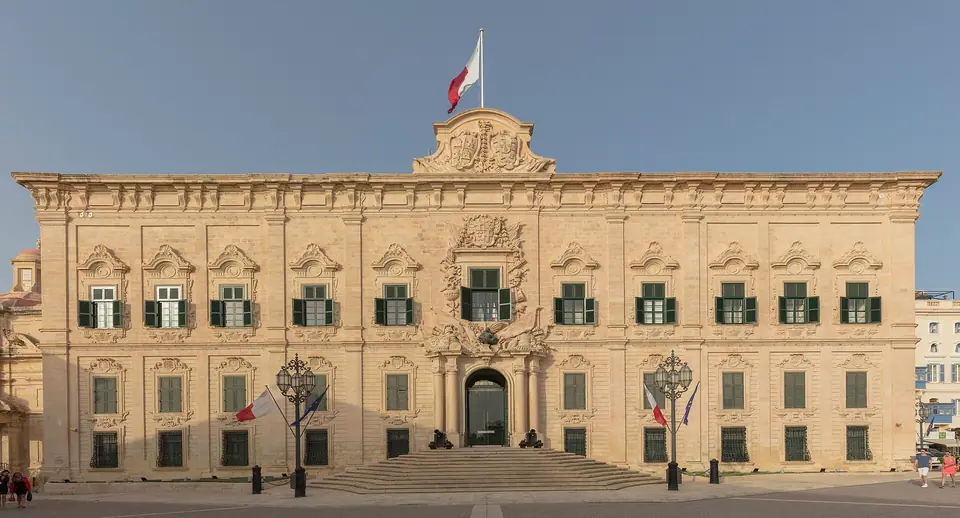
Photo: Diego Delso · CC BY-SA 4.0
Grand Master's Palace, Armoury, Casa Rocca Piccola & Knights' Auberges Guide
Step inside the secular palaces of the Knights of Malta: the restored Grand Master's Palace and Armoury, noble life at Casa Rocca Piccola, and surviving Auberges.
While St John's Co-Cathedral was the sacred heart of the Order of St John, the political, military, and aristocratic power of Valletta was exercised inside three distinct building types. These were the Grand Master's Palace on St George's Square, the monumental Auberges (Inns of the Langues) where the young knights lived and dined by nationality, and private aristocratic palazzi such as Casa Rocca Piccola. Pair this palace guide with our top things to do in Valletta and our Valletta travel guide.
| Palace / Auberge Monument | Admission | Access | What You See Inside |
|---|---|---|---|
| Grand Master's Palace & Armoury. | Check the official site (or Heritage Malta membership). | Open regularly; check the official site. | Supreme Council Hall frescoes, Gobelins tapestries and the Knights' Armoury collection. |
| Casa Rocca Piccola (Republic Street). | Check the official site for tour tickets. | Guided tours operate; check the official site. | Furnished rooms of the Marquis de Piro, garden and a wartime rock-cut shelter. |
| MUŻA at Auberge d'Italie (Merchants Street). | Check the official site (or Heritage Malta membership). | Open regularly; check the official site. | Malta's National Community Art Museum inside the historic Italian Knights' Inn. |
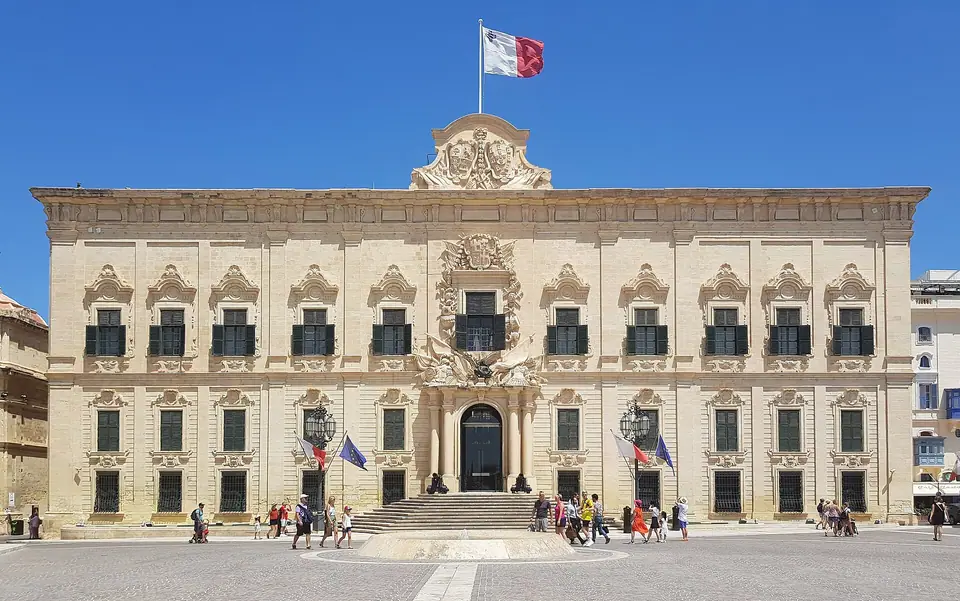
| Auberge de Castille (Castille Place). | Exterior viewing only (Office of the Prime Minister). | Best photographed in morning light or floodlit at night. | Valletta's grand High Baroque facade remodelled by Andrea Belli. |
The Restored Grand Master's Palace and the Palace Armoury
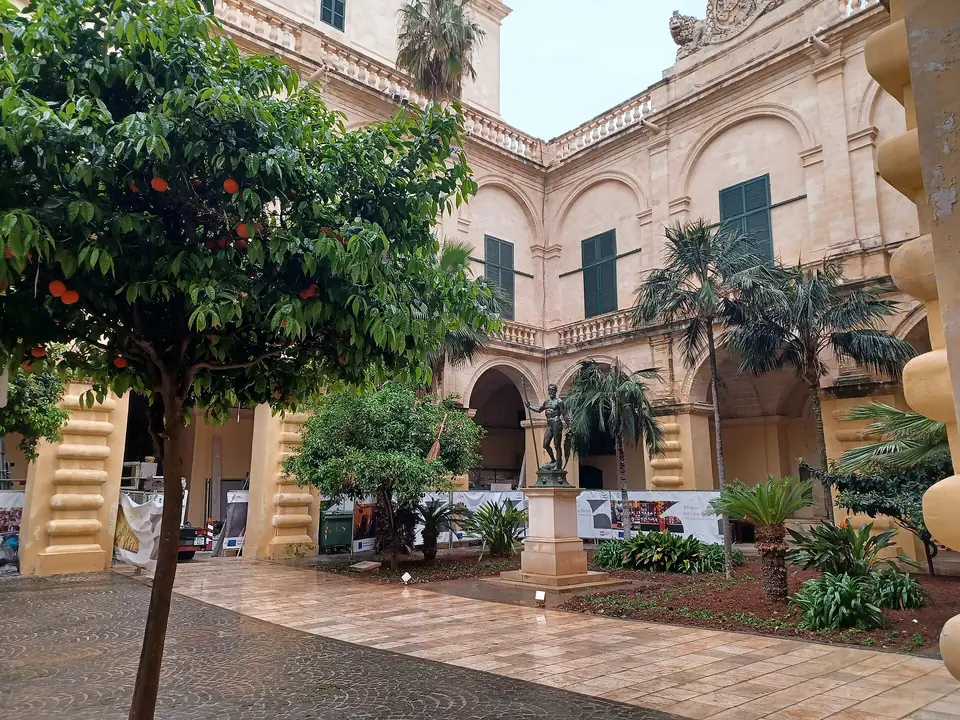
The Grand Master's Palace occupies an entire city block facing St George's Square. Built by Girolamo Cassar around Neptune's Courtyard and the Pinto Clock Tower Courtyard. For over two centuries, it served as the seat of the Grand Masters of the Order of St John, and later as the British Governor's Palace. It previously housed Malta's Parliament, and today it serves as the official seat of the President of Malta.
Following a major restoration project led by Heritage Malta, visitors can walk a full circuit through the Piano Nobile State Rooms and the Palace Armoury:
- The Piano Nobile Corridors and State Halls: Walk along the Prince of Wales and Uccelliera marble corridors lined with full suits of tournament armour beneath illusionistic ceiling frescoes by Nicolau Nasoni. Above the walls, lunettes depict the naval victories of the Order's galleys. Step into the Hall of the Supreme Council (Hall of St Michael and St George), crowned by a continuous frieze painted by Matteo Perez d'Aleccio. A pupil of Michelangelo, d'Aleccio recorded the day-by-day battles of the Great Siege. Next door lies the Woven Hanging Chamber, hung with French Gobelins "Tentures des Indes" tapestries depicting exotic flora and fauna of Brazil and the Caribbean.
- The Palace Armoury: A famous collection of arms and armour housed in its original building. Highlights include full Italian and German steel plate harnesses worn during the Great Siege. Intricate damascened parade shields, Ottoman janissary scimitars and helmets, and early rifled matchlock muskets.
Casa Rocca Piccola: Living Aristocratic History and a WWII Air-Raid Shelter
While the Grand Master's Palace shows the ceremonial scale of the Order, casa Rocca Piccola on Republic Street offers a look inside a private noble home. Guided tours run regularly, so check the official site for current schedules. It was built for Admiral Don Pietro La Rocca and is still lived in today by Nicholas de Piro, the Marquis de Piro, the palazzo opens more than a dozen rooms filled with historic Maltese lace, silver surgical instruments from the Knights' hospital, and a cabinet-sized portable chapel. Outside lies a walled courtyard garden where Kiku the resident macaw greets guests. At the end of the tour, you descend a deep rock-cut staircase into the family's private World War II subterranean air-raid shelters, carved out of an ancient freshwater cistern deep underground. Here over a hundred neighbours sheltered during Axis bombing raids.
How to Spot Valletta's Surviving Knights' Auberges
Several original Auberges (residences of the national Langues) built across Valletta survive today, while others were lost during wartime air raids:
- Auberge de Castille (Castille Place, beside Upper Barrakka): Built for the Knights of Castile, León, and Portugal and sumptuously remodelled under Grand Master Manuel Pinto da Fonseca. Its two-storey facade crowned by marble trophies of arms and Pinto's bronze bust is an outstanding example of Maltese secular Baroque.
- Auberge d'Italie (Merchants Street, now MUŻA). Home to the Italian Knights. Close by stands redesigned with a striking marble trophy of arms above the portal. It now houses MUŻA, Malta's National Community Art Museum.
- Auberge de Provence (Republic Street): This palazzo houses the National Museum of Archaeology, including its ornate upstairs Gran Salon where the Knights dined in silence while listening to scripture.
- Auberge d'Aragon (Independence Square). An early surviving unaltered Cassar auberge, painted pale salmon-pink opposite St Paul's Pro-Cathedral.
- Auberge de Bavière (St Sebastian Street, Lower Valletta). This auberge overlooks Marsamxett Harbour near the English Curtain.
Aristocratic palaces and administrative auberges built for the knightly order still anchor the civic heart of the capital. Courtyards planted with citrus and shaded by stone arcades provided cool air and ceremonial grandeur inside the dense grid. Upstairs state corridors display painted friezes, heraldic ceilings, and ceremonial portraits that chronicle centuries of Mediterranean diplomacy. In the adjoining armoury halls, rows of breastplates, helmets, and pikes illustrate the military engineering of the garrison.
A short walk down Republic Street leads to lived-in noble residences where family heirlooms, libraries, and chapel alcoves remain intact. Guided house tours offer an intimate look at domestic Maltese architecture, courtyard cisterns, and rock-cut wartime shelters. Pairing the grand ceremonial state rooms with a lived-in patrician house gives visitors a complete picture of noble life.
As you walk between palaces, look up at the sculpted doorways and corner pilasters of the surviving knightly auberges. Check the official site for current state-room access whenever parliamentary or presidential events take place.
Exploring both the official state palace and a lived-in noble residence highlights the public and private sides of aristocratic life in the capital. Grand ceremonial corridors lined with portraits and painted friezes show how the order projected power to visiting European envoys. Downstairs and in the armoury wings, curated displays of tournament armour, ceremonial weapons, and artillery trace the evolution of siege warfare. Shaded central courtyards offer a quiet pause to admire the classical proportions of the limestone facades.
Further down the street, domestic rooms filled with family silver, archive documents, and period furniture bring everyday noble customs into focus. Descending into the rock-cut underground shelters beneath the garden shows how residents adapted historic cellars during twentieth-century air raids. Walking past the surviving auberges of Castille, Provence, and Italy afterwards completes an architectural tour of the order's administrative quarters.
Taking time to admire the exterior stonework of the surviving knightly auberges shows how military engineers blended defence with Renaissance proportion. Massive rusticated cornerstones, sculpted portals, and high cornices give each historic administrative palace its own architectural presence along the grid. Inside the state rooms and noble residences, cool stone floors and high timber ceilings reflect centuries of adaptation to the Mediterranean climate. Pairing these aristocratic interiors with a walk along the nearby harbour ramparts rounds out a full day of sixteenth- and seventeenth-century history.
Strolling along Merchants Street and Republic Street after your palace tour reveals additional baroque doorways, shaded courtyards, and historic civic buildings.
Where it is
- 1Grand Master's Palace, Armoury, Casa Rocca Piccola & Knights' Auberges
- Malta International Airport (MLA) · about 6 km from here in a straight line
- Directions in Google Maps
Stations and taxi ranks: OpenStreetMap. Airports: OurAirports. Distances are in a straight line.
Traveller tips
Real advice from people who have been to Valletta. Every tip is read by our team before it goes live.
No tips yet. Been here? Yours could be the first.
Thank you! Your tip will appear here after a quick review.
More in Valletta
Continue exploring Valletta with related neighbourhood, food, and planning guides
Best Things to Do in Valletta: Baroque Sights, Harbours & Forts
Valletta, Malta
How to Get to Valletta: Airport Buses, Harbour Ferries & Taxis
Valletta, Malta
Best Time to Visit Valletta: Sunny Days, Festas, Baroque Festival & Weather
Valletta, Malta
What to Wear in Valletta: Church Dress Rules & Limestone Steps
Valletta, Malta
