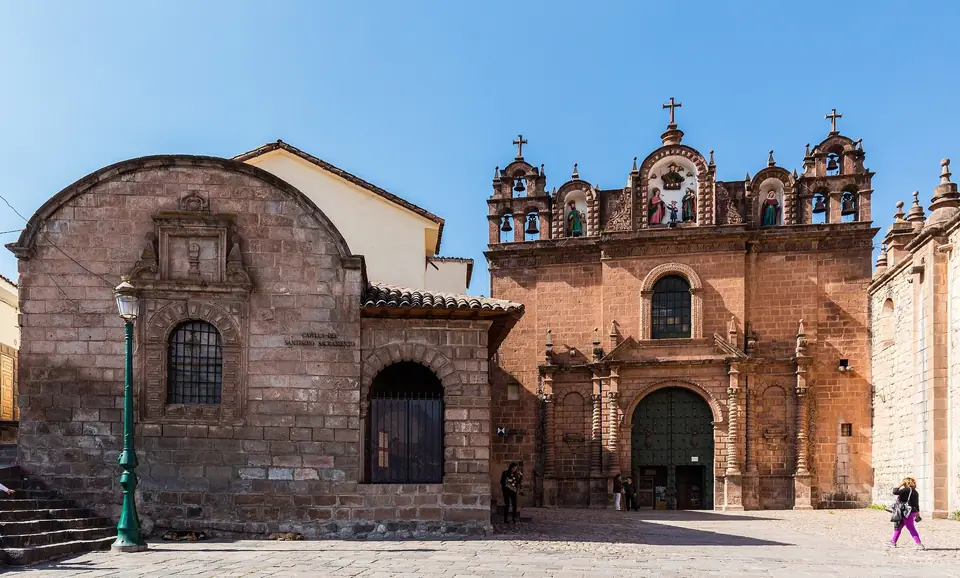
Plaza de Armas, Cusco Cathedral and Iglesia de la Compañía de Jesús
A detailed visitor guide to Cusco's Plaza de Armas, the Viracocha palace cathedral complex, and the Jesuit Baroque architecture of Iglesia de la Compañía de Jesús.
Long before Spanish conquistadors arrived in 1534, the vast central clearing of Cusco functioned as the administrative and ceremonial axis of the Inca Empire. Known in Quechua as Huacaypata or Aucaypata, this sweeping ceremonial terrace emerged after Inca engineers drained an alluvial marshland and redirected the Saphy River through underground stone conduits. Imperial residences bordered the open ground, including the estates of Pachacuti, Tupac Inca Yupanqui, Huayna Capac, and Viracocha. During imperial festivals, thousands of subjects gathered across the stones to observe military triumphs, royal funerary rites, and state solstices. Following the conquest, European settlers reduced the monumental open ground by constructing two-storey stone arcades straight through its western sector. That architectural partition separated modern Plaza de Armas from Plaza Regocijo and cleared ground for monumental Catholic foundations directly above ancient palace walls. In 1781, indigenous resistance leader Túpac Amaru II was executed on the flagstones of this central square, which earned formal recognition as the core of Cusco's UNESCO World Heritage zone in 1983.
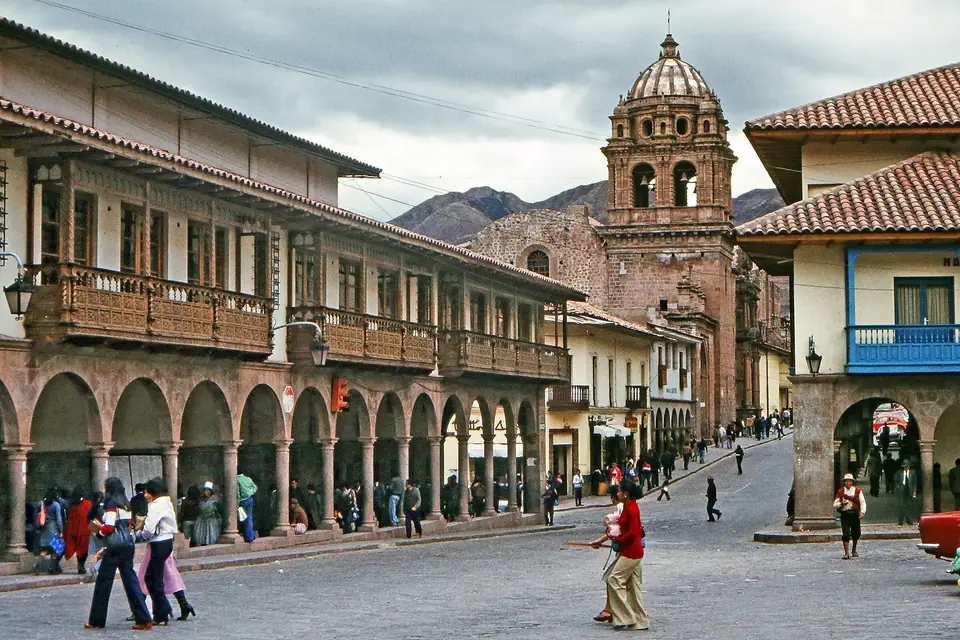
Imperial Foundations and the Spanish Reconfiguration of Huacaypata
When walking between the arched portals today, we see physical layers from two political eras superimposed upon each other. Inca builders quarried granite and diorite with extraordinary precision, interlocking irregular blocks without mortar to survive frequent Andean tremors. The Spanish colonists dismantled these palatial compounds to harvest ready-dressed masonry for their own monuments. Colonial builders added overhanging timber balconies painted in uniform blue tones, supported by sturdy stone colonnades known as portales. These sheltered arcades wrap around the perimeter, shielding pedestrians from sudden torrential cloudbursts while maintaining continuous lines of sight across the flagstone plaza. If you plan to map your orientation across the wider historical layout, consult our Cusco Travel Guide for altitude acclimation strategies and neighbourhood connections.
Cusco Cathedral and the Three Interconnected Sanctuaries
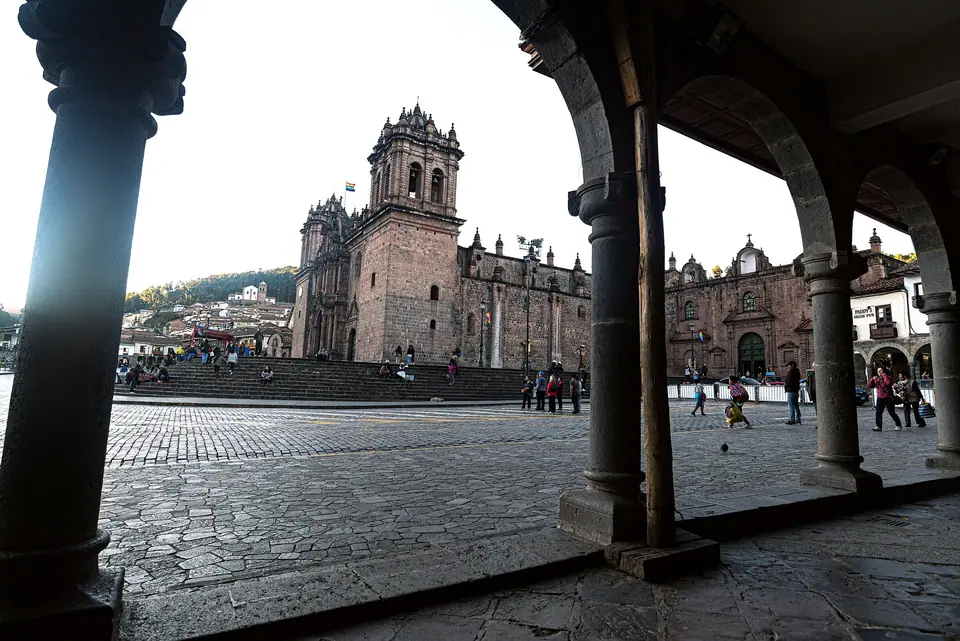
Dominating the northeastern flank of the plaza stands the Cathedral Complex, formally designated as the Catedral Basílica de la Virgen de la Asunción. The site covers 3,920 square metres over the foundations of Kiswarkancha, the ancestral palace of the eighth Inca ruler Viracocha, and Suntur Wasi, an ancient hall for state emblems. Work commenced in 1560 under master masons who hauled red andesite blocks downhill from Sacsayhuamán. Construction spanned nearly a century before consecration in 1654. The exterior displays late Gothic structural vaults integrated with Renaissance geometry and a heavily carved stone facade flanked by twin bell towers.
Two auxiliary churches flank the central basilica to complete the complex. On the eastern wing stands Iglesia del Triunfo, established in 1539 as the first Christian church raised in Cusco. It protects the venerated dark-wood crucifix known as the Señor de los Temblores, patron of the city during catastrophic tremors. On the western wing sits Iglesia de la Sagrada Familia, built between 1723 and 1735 with Baroque stone reliefs. Inside the central basilica, visitors encounter sweeping cedar choir stalls hand-carved with forty-two saints, a massive silver altar, and hundreds of regional colonial paintings. Chief among these works is Marcos Zapata's 1753 depiction of the Last Supper, where Christ and his disciples gather around a platter serving roasted Andean guinea pig.
Iglesia de la Compañía de Jesús and Andean Baroque Craft
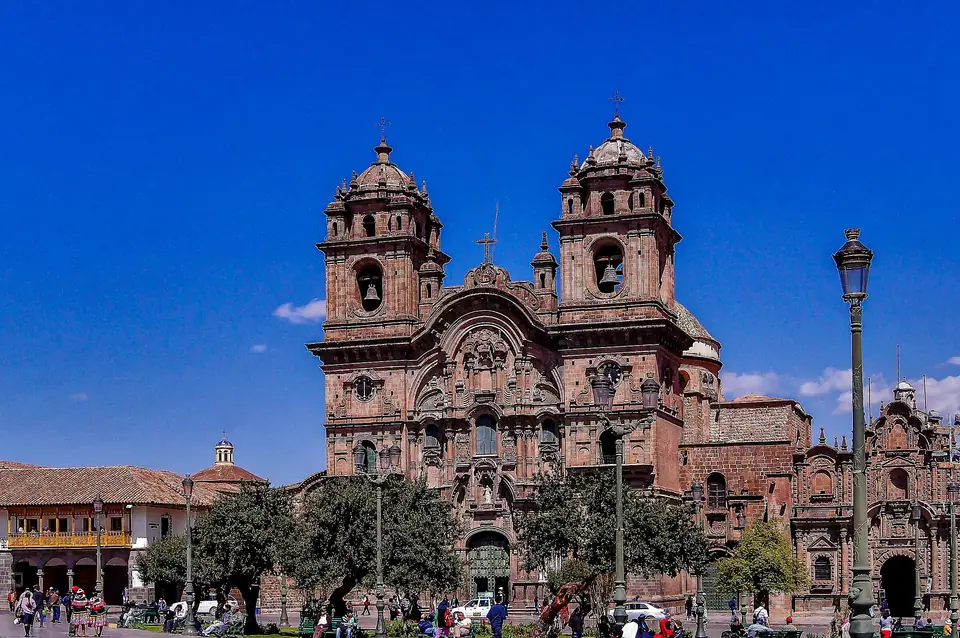
Directly across the southeastern side of the square rises the Iglesia de la Compañía de Jesús. Jesuit architects initiated the project over Amarucancha, the palace of eleventh Inca emperor Huayna Capac. After the catastrophic 1650 earthquake destroyed an earlier structure, craftsmen rebuilt the current edifice between 1651 and 1668. Their ambitious plans provoked fierce opposition from the local bishop, who feared the Jesuit temple would outshine the main cathedral in scale and ornamentation. Although royal arbitration ordered the Jesuits to scale down their design, the building emerged as a masterpiece of Andean Baroque craftsmanship.
The facade presents a towering screen of intricately chiselled andesite, framed by dynamic twin towers and decorative stone niches. Inside, a single nave opens toward a colossal gilded cedar retable that soars three storeys into the apse. Sweeping colonial canvases hang beneath the high choir, including historic wedding portraits that illustrate diplomatic alliances between Spanish noble families and descendants of Inca royalty. A winding stone staircase ascends into the western bell tower, providing elevated views over the terracotta roofscapes of the historic district. Many visitors combine this temple visit with nearby sites such as Qorikancha and Santo Domingo to study complementary styles of Inca and colonial masonry.
Architectural and Historical Comparison of the Plaza Sanctuaries
| Sanctuary Component | Inca Foundation Complex | Primary Construction Era | Distinctive Architectural Feature |
|---|---|---|---|
| Cusco Cathedral Main Nave | Kiswarkancha (Palace of Viracocha) | 1560 to 1654 | Red andesite masonry with Gothic rib vaults and carved cedar stalls |
| Iglesia del Triunfo | Suntur Wasi (Inca ceremonial hall) | Founded 1539, rebuilt 1664 | Ancient colonial walls sheltering the revered Señor de los Temblores |
| Iglesia de la Sagrada Familia | Palace grounds of Viracocha | 1723 to 1735 | Symmetrical Baroque frontage with twin stone bell turrets |
| Iglesia de la Compañía de Jesús | Amarucancha (Palace of Huayna Capac) | 1651 to 1668 | Ornate Baroque portal, three-tiered gilded retable, and elevated choir |
Seasonal Weather Patterns and Touring Tactics on Plaza de Armas
Cusco sits at an elevation of 3,399 metres, meaning solar radiation remains intense throughout the middle of the day while temperatures plunge after dark. Open-Meteo climate data spanning 2015 to 2024 reveals distinct seasonal patterns across the valley. The southern hemisphere winter brings dry, clear skies. June, July, and August register low monthly precipitation of seven to fourteen millimetres across one or two wet days per month, accompanied by crisp overnight lows between 1.2 and 2.8°C. Daytime maximums during these winter months hover between 20.6 and 21.5°C under strong sunlight. The rainy summer season peaks from December through March. January records 140 millimetres of rainfall across twenty wet days, with daytime highs around 20.5°C and overnight lows of eight°C.
To navigate these climatic fluctuations comfortably, structure your walking tour around indoor visits during midday hours or passing showers. Entrance requirements and seasonal schedules for the Cathedral Complex and Compañía de Jesús change periodically, so check official operator portals or cathedral ticketing desks on arrival for current passes. Modest attire covering shoulders and knees is mandatory inside every operating sanctuary, and photography is strictly forbidden within the cathedral galleries. Step softly across the flagstones, stay hydrated, and pause beneath the sheltered colonial portales between site visits to accommodate the high mountain altitude.
Where it is
- 1Plaza de Armas, Cusco Cathedral and Iglesia de la Compañía de Jesús
- Alejandro Velasco Astete International Airport (CUZ) · about 5 km from here in a straight line
- Directions in Google Maps
Stations and taxi ranks: OpenStreetMap. Airports: OurAirports. Distances are in a straight line.
Traveller tips
Real advice from people who have been to Cusco. Every tip is read by our team before it goes live.
No tips yet. Been here? Yours could be the first.
Thank you! Your tip will appear here after a quick review.
More in Cusco
Continue exploring Cusco with related neighbourhood, food, and planning guides
Best Time to Visit Cusco: Dry Andean Winters, Inti Raymi and Rainy Months
Cusco, Peru
Where to Stay in Cusco: Historic Centre, San Blas and the Sacred Valley
Cusco, Peru
Cusco 3-Day Itinerary: Historic Core, Sacsayhuamán and the Sacred Valley
Cusco, Peru
What to Eat in Cusco: Traditional Andean Dishes, Chiri Uchu and Market Specialities
Cusco, Peru
