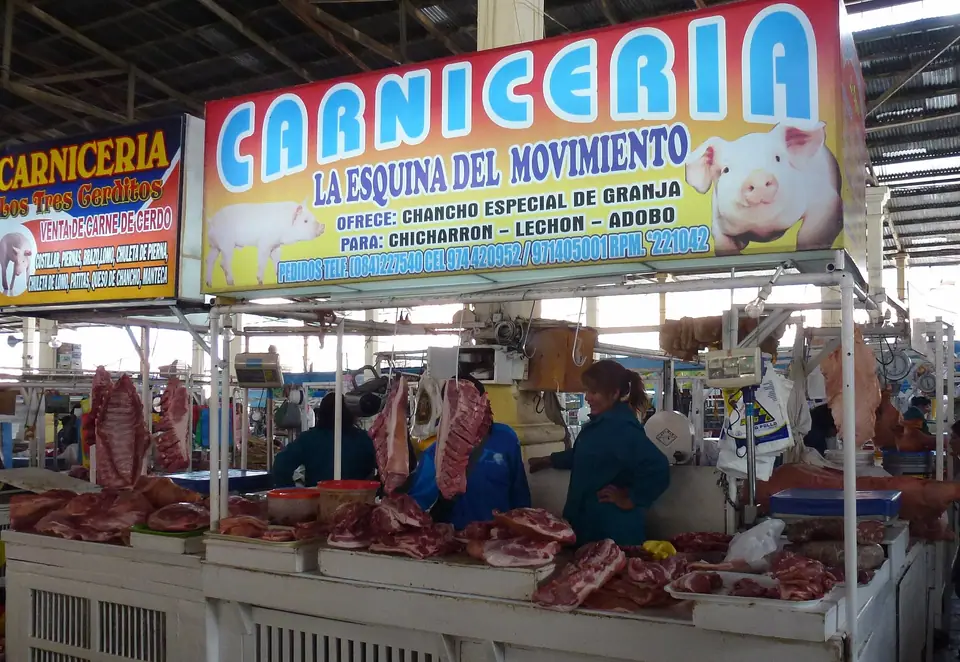
San Pedro Market, Santa Clara Arch and Plaza San Francisco
Navigate Cusco's market corridor connecting Plaza San Francisco, the 1835 Santa Clara Arch, and the 1925 covered iron food stalls of Mercado Central de San Pedro.
While the streets northeast of the historic core ascend towards steep masonry lanes, the urban spine running southwest along Calle Marqués and Calle Santa Clara forms Cusco's primary commercial corridor. Following a level ten-minute route through three connected colonial squares, this pedestrian-friendly route links the native botanical plantings of Plaza San Francisco and the neoclassical Santa Clara Arch with Mercado Central de San Pedro, the city's primary covered food hall since 1925.
Walking this corridor reveals the everyday mercantile rhythm of the imperial city. It connects seventeenth-century monastic architecture with early twentieth-century iron market construction, offering an essential introduction to local urban geography before embarking on excursions such as the Sacred Valley Day Trip: Pisac Terraces and Ollantaytambo Fortress.
Plaza Regocijo, Plaza San Francisco and Botanical Plantings
Departing the western side of the main cathedral plaza near Plaza de Armas, Cusco Cathedral and Iglesia de la Compañía de Jesús along Calle del Medio, walkers immediately enter Plazoleta Regocijo, historically known as Kusipata. In the Inca era, this space formed the western half of the great ceremonial esplanade before Spanish colonisers constructed stone arcades that split the civic zone into separate public squares.
Continuing westward along the stone paving of Calle Marqués leads into Plaza San Francisco. This expansive public space features landscaped flowerbeds planted exclusively with native Andean botanical species. Visitors can examine q’euña paper trees with peeling reddish bark, hardy kiswar shrubs, and lively red tubular blossoms of cantuta, revered as the sacred ceremonial flower of the Incas.
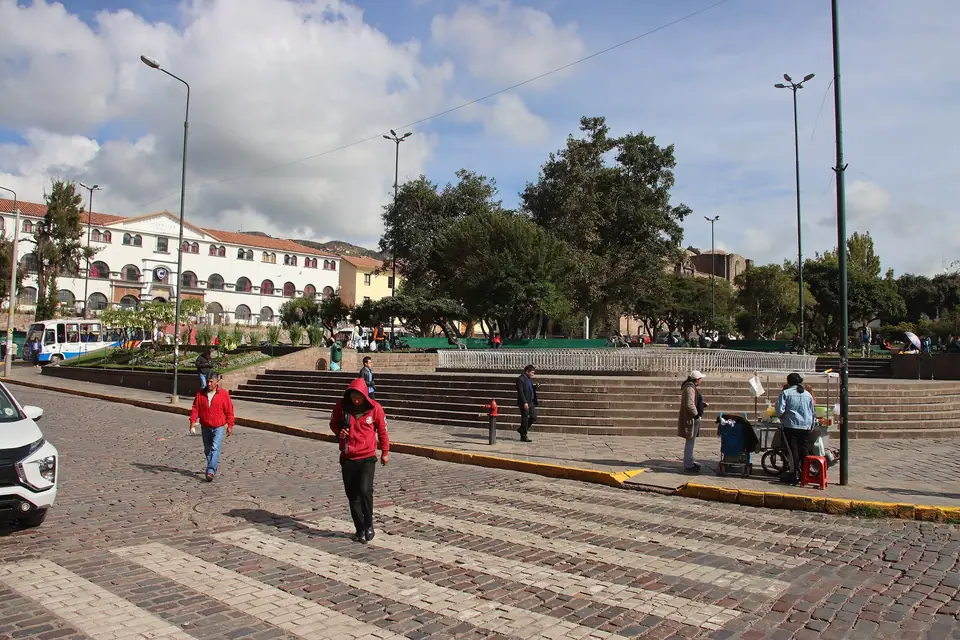
The southern edge of the square is dominated by the stone facade of the Church and Convent of San Francisco, rebuilt in 1645 following earthquake damage. Within its cloisters lie subterranean crypts, hand-carved cedar choir stalls, and a monumental twelve-by-nine-metre canvas displaying the genealogy of the Franciscan Order. Directly north of the church stands the historic Colegio Nacional de Ciencias, an educational institution housed in historic premises framing the civic plaza.
Neoclassical Architecture of the 1835 Arco de Santa Clara
At the western exit of Plaza San Francisco, the route passes beneath the Arco de Santa Clara. Ordered by Prefect Anselmo Centeno in 1835, this neoclassical stone triumphal arch commemorates the short-lived Peru-Bolivia Confederation. The structure features fine ashlar masonry, balanced classical pilasters, and carved patriotic reliefs, serving as a formal gateway between the colonial civic centre and the commercial market district beyond.
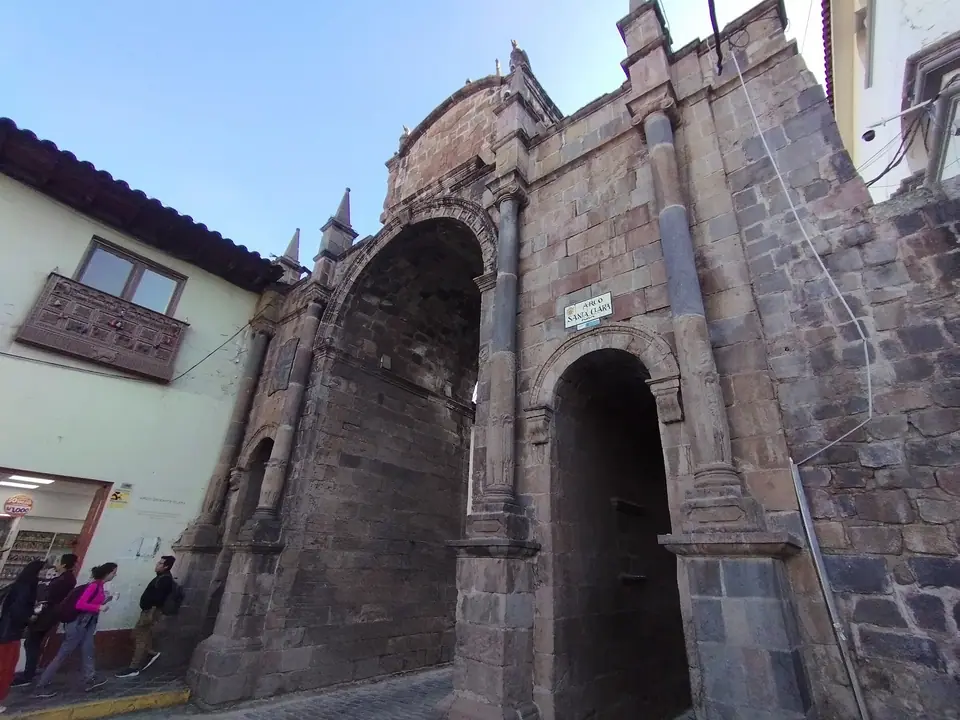
Standing immediately beside the triumphal monument is the church of the Convent of Santa Clara, established in the sixteenth century for the Order of Poor Clares. Its stone exterior mirrors the defensive simplicity of early Andean colonial architecture. The narrow lane here fills with local pedestrians carrying daily shopping bags, offering a marked contrast to the tourist-heavy avenues that ascend towards the San Blas Artisan Quarter, Hatun Rumiyoc and Cristo Blanco Viewpoint.
Mercado Central de San Pedro Interior Layout and Produce Aisles
Passing beneath the Santa Clara Arch and walking westward along Calle Santa Clara brings you to Mercado Central de San Pedro, inaugurated in 1925. The market occupies a massive covered iron-frame pavilion that transformed municipal trade in twentieth-century Cusco. The interior is arranged in long parallel rows of concrete stalls, categorised strictly by product type to facilitate commercial regulation and rapid daily trade.
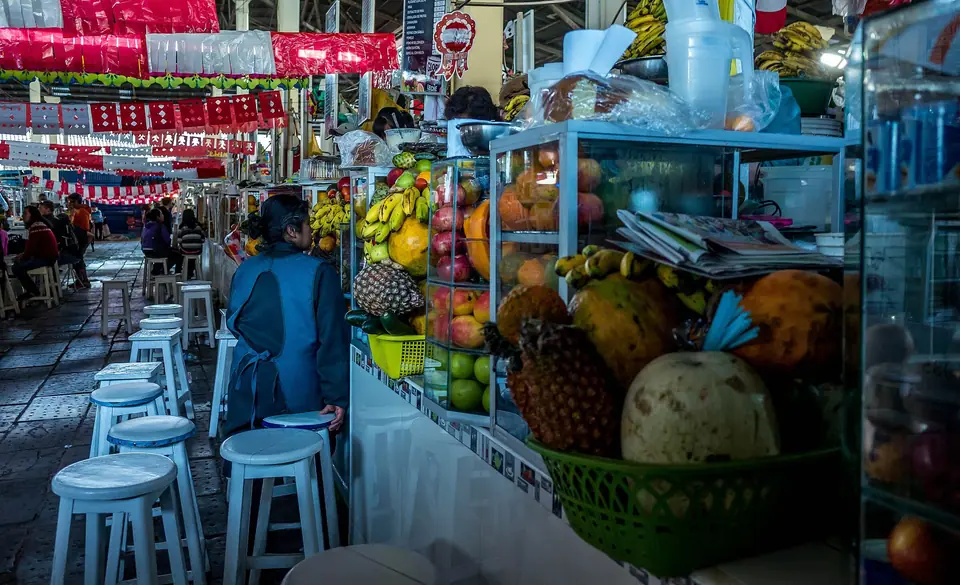
Upon entering the main portal, visitors encounter towering stacks of round, aniseed-flavoured pan chuta baked in Oropesa, beside traditional sourdough loaves. The central aisles display an immense variety of native agricultural goods, including purple corn, diverse Andean quinoa strains, and dozens of potato varieties ranging from small yellow tubers to desiccated white chuño. Peripheral stalls feature circular Andean cheeses from Paruro and Anta, medicinal herbs, and hand-woven wool textiles.
Further inside, designated culinary aisles serve freshly blended fruit juices containing lucuma, cherimoya, and passion fruit, as well as communal wooden benches serving hot Andean soups such as caldo de gallina. Exploring these market stalls provides direct context for the culinary traditions outlined in What to Eat in Cusco: Traditional Andean Dishes, Chiri Uchu and Market Specialities.
Corridor Waypoints Between Plaza de Armas and San Pedro
| Waypoint | Primary Architecture | Key Characteristic | Walking Surface |
|---|---|---|---|
| Plaza Regocijo (Kusipata) | Colonial stone arcades | Historic western half of Inca ceremonial square | Flat stone flagstones |
| Plaza San Francisco | Seventeenth-century convent and church | Gardens planted with native Andean trees and cantuta | Paved pedestrian plaza |
| Arco de Santa Clara | 1835 neoclassical stone triumphal arch | Commemorative gateway to market district | Cobblestone street crossing |
| Mercado Central de San Pedro | 1925 covered iron-framework pavilion | Main municipal produce and dining hall | Level concrete interior aisles |
Seasonal Weather and Walking Planning
Navigating this urban corridor requires attention to Cusco's distinct climatic patterns. Open-Meteo ten-year climate data shows that the dry winter months between May and August provide the clearest weather for walking between squares. June experiences an average high of 20.8°C, a low of 1.9°C, and just 7mm of rain across 1 wet day, while July records an average low of 1.2°C with 7mm of rain. August maintains mild daytime highs of 21.5°C and night lows of 2.8°C.
During the rainy summer season from December to March, the route demands waterproof clothing and cautious footwork on slick stone paving. January brings 140mm of precipitation over 20 wet days with highs of 20.5°C and lows of 8°C. February averages 119mm across 17 wet days, and March sees 112mm over 16 wet days. When heavy downpours strike, the covered iron roof of Mercado Central de San Pedro provides substantial shelter for browsing regional agricultural produce.
Because the market operates on an active municipal schedule for regional farmers and neighbourhood residents, produce selection peaks earlier in the day. Travellers should check local announcements for seasonal market opening adjustments. Keep personal belongings secure in the crowded narrow aisles, carry small denominations of Peruvian Soles for cash purchases, and respect stallholders when photographing produce displays.
Where it is
- 1Cusco
- Alejandro Velasco Astete International Airport (CUZ) · about 5 km from Cusco in a straight line
- Directions in Google Maps
Stations and taxi ranks: OpenStreetMap. Airports: OurAirports. Distances are in a straight line.
Traveller tips
Real advice from people who have been to Cusco. Every tip is read by our team before it goes live.
No tips yet. Been here? Yours could be the first.
Thank you! Your tip will appear here after a quick review.
More in Cusco
Continue exploring Cusco with related neighbourhood, food, and planning guides
Best Time to Visit Cusco: Dry Andean Winters, Inti Raymi and Rainy Months
Cusco, Peru
Where to Stay in Cusco: Historic Centre, San Blas and the Sacred Valley
Cusco, Peru
Cusco 3-Day Itinerary: Historic Core, Sacsayhuamán and the Sacred Valley
Cusco, Peru
What to Eat in Cusco: Traditional Andean Dishes, Chiri Uchu and Market Specialities
Cusco, Peru
