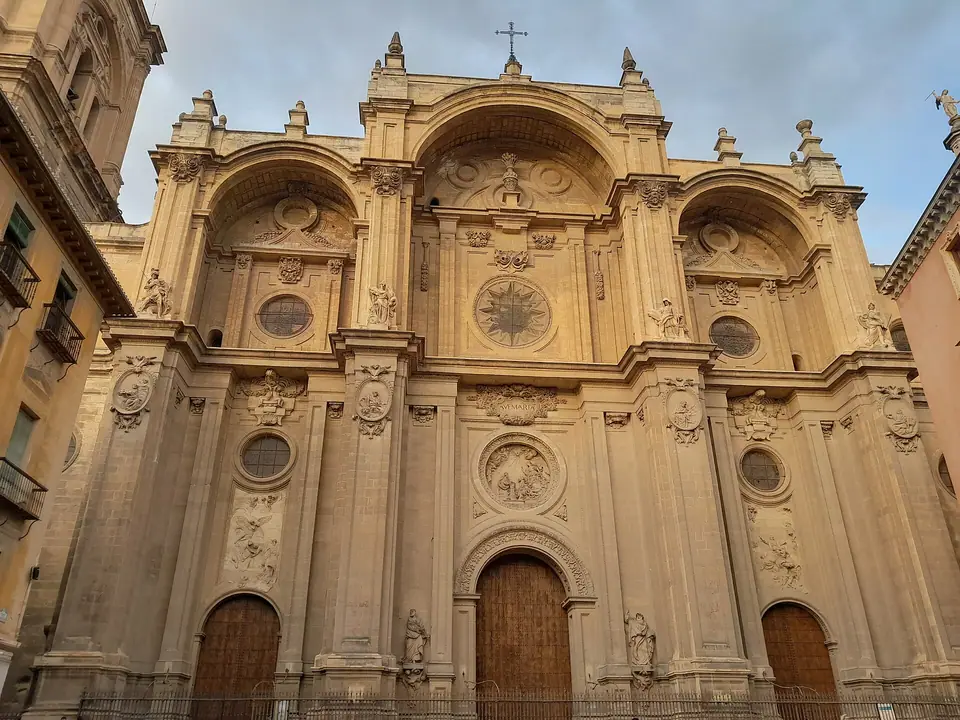
Photo: David suárez Benítez 2 · CC BY-SA 4.0
Granada Cathedral & Royal Chapel Guide: Alcaicería & Corral del Carbón
Tour Granada's monumental lower centre, including the tombs of Isabella and Ferdinand in the Royal Chapel, Diego de Siloé's Renaissance Cathedral, La Madraza, and the Alcaicería.
Following the surrender of Nasrid Granada, Queen Isabella I and King Ferdinand II reshaped the lower city around the former Great Mosque. Within a compact area around Plaza Bib-Rambla, you can walk from the Gothic burial chapel of the Catholic Monarchs into Granada's cathedral. Nearby stand an Islamic university building, a reconstructed silk bazaar, and an intact Nasrid caravanserai. Use this walking guide together with our Dobla de Oro monuments guide and our Granada Cathedral dress code tips.
| Monument | Entrance Street | Key Masterpiece Inside |
|---|---|---|
| Royal Chapel (Capilla Real) | Calle Oficios | Carrara marble tombs of Isabella & Ferdinand, royal crypt lead coffins, and Flemish paintings |
| Granada Cathedral (Catedral de la Encarnación) | Plaza de las Pasiegas | Circular Capilla Mayor rotunda, stained glass windows, and Alonso Cano facade |
| Palacio de la Madraza | Calle Oficios | Nasrid prayer hall (mihrab) and Baroque Knights' Hall wooden dome |
| Alcaicería Silk Bazaar & Plaza Bib-Rambla | Calle Reyes Católicos / Calle Oficios | Horseshoe arcades, Fajalauza ceramics, and marquetry (taracea) workshops |
| Corral del Carbón (Alhóndiga Gidida) | Calle Mariana Pineda | Nasrid brick muqarnas gateway and merchant courtyard |
The Royal Chapel (Capilla Real): Tombs of the Catholic Monarchs
Although Isabella and Ferdinand ruled from itinerant courts across Spain, they established this resting place by royal warrant in 1504. Commissioned to Enrique Egas in 1506, the Capilla Real showcases Isabelline Gothic star vaults. Visitors enter from Calle Oficios, where a strict no-photography rule applies inside. Master builders Egas and García de Pradas arrived in Granada in 1510 to advance the construction of the building. The mortal remains of Philip I were brought to Granada in 1515 as work progressed. A new doorway leading from the chapel to Calle Oficios was built in 1527. Emperor Charles I issued the constitutions for the Royal Chapel of Granada in 1528.
Passing through the gilded wrought-iron screen (reja), you stand before twin Carrara marble cenotaphs. The main grille of the Royal Chapel was installed in 1519 to secure the chancel space. Maestre Bartolomé crafted a plateresque grille for one of the side chapels of the Royal Chapel in 1523. On the right rests the mausoleum of Ferdinand and Isabella, installed in 1518, where Isabella's head sinks slightly deeper into the marble cushion. The remains of the Catholic Monarchs were brought to the Royal Chapel in 1521. On the left stands the carved marble mausoleum for their daughter Queen Joanna I and King Philip I. A short flight of steps leads down into the stone Royal Crypt. Here lead coffins marked with the crowned initials hold the actual remains of the monarchs. Before exiting, visit the Sacristy-Museum housing Isabella's personal silver-gilt crown, sceptre, and Ferdinand's sword. Its galleries also display prized paintings by Flemish and Italian masters.
Granada Cathedral: Diego de Siloé's Renaissance rotunda
Stepping onto Plaza de las Pasiegas reveals the Baroque west facade of Granada Cathedral. Granadino master Alonso Cano took over the project as master builder in 1667. Begun in 1506 on an earlier design, construction of Granada Cathedral began with two architectural projects. The foundation trenches of Granada Cathedral are documented on March 24, 1523. Architect Diego de Siloe collaborated on the Granada Cathedral project starting around March or April 1528. A tier of the cathedral's tower was built around 1535 or 1536.
Inside, five broad naves rest on white stone piers topped by classical Corinthian capitals. Everything converges on the circular Capilla Mayor, a domed rotunda with stained glass windows in the ambulatory. Stained glass windows in the ambulatory of the Capilla Mayor were definitively installed in 1561. Ringed by gilded arches, it displays kneeling statues of the Catholic Monarchs, canvases by Alonso Cano, and pipe organs. On December 24, 1704, the completion of the central vault of the second transept of Granada Cathedral was announced. The monument is located at Calle Gran Vía de Colón, 5, with an entrance at Plaza de las Pasiegas.
Palacio de la Madraza and the Alcaicería silk market
Directly across Calle Oficios from the Royal Chapel stands the painted facade of the Palacio de la Madraza. The madrasa served as a seat of learning, teaching medicine, astronomy, and law. It was later adapted after royal reorganisation. Inside the courtyard survives the octagonal Nasrid Oratory with polychrome stucco calligraphy and a carved mihrab. Upstairs, the hall preserves a Mudéjar wooden artesonado ceiling.
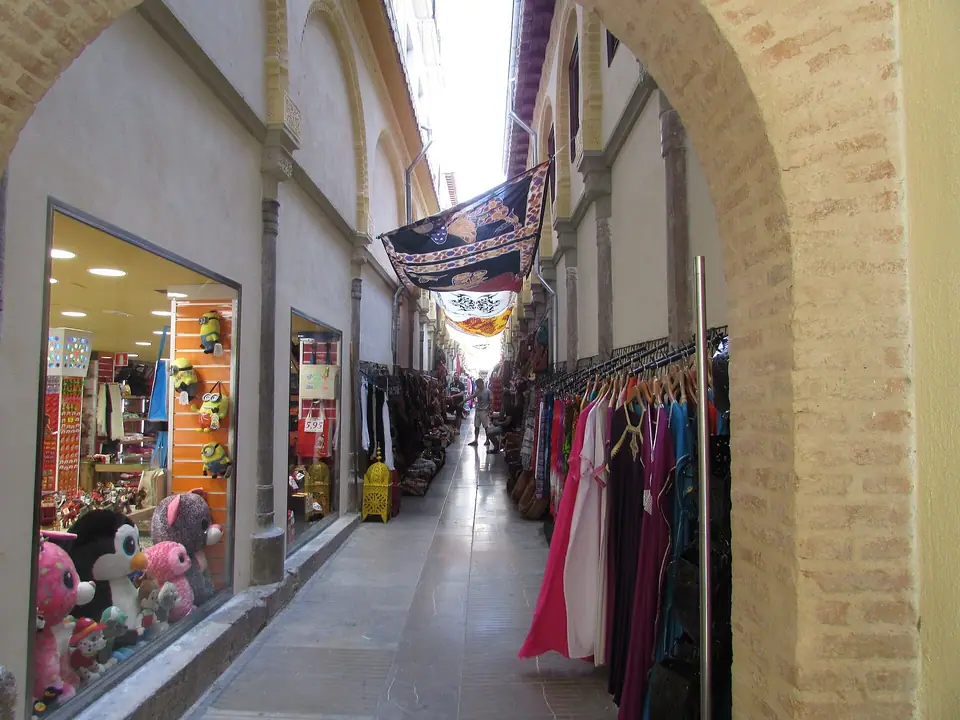
Immediately west of the Cathedral and Madraza extends the Alcaicería. During the Nasrid era, this walled quarter contained shops guarded by night-time gates where raw and woven silk was sold. Rebuilt on its miniature grid of narrow lanes with stucco horseshoe arches, it remains a central place to browse crafts. Today it is an easy stop near the Cathedral to browse Granada taracea marquetry boxes and green-and-blue Fajalauza ceramics.
Corral del Carbón: Nasrid caravanserai
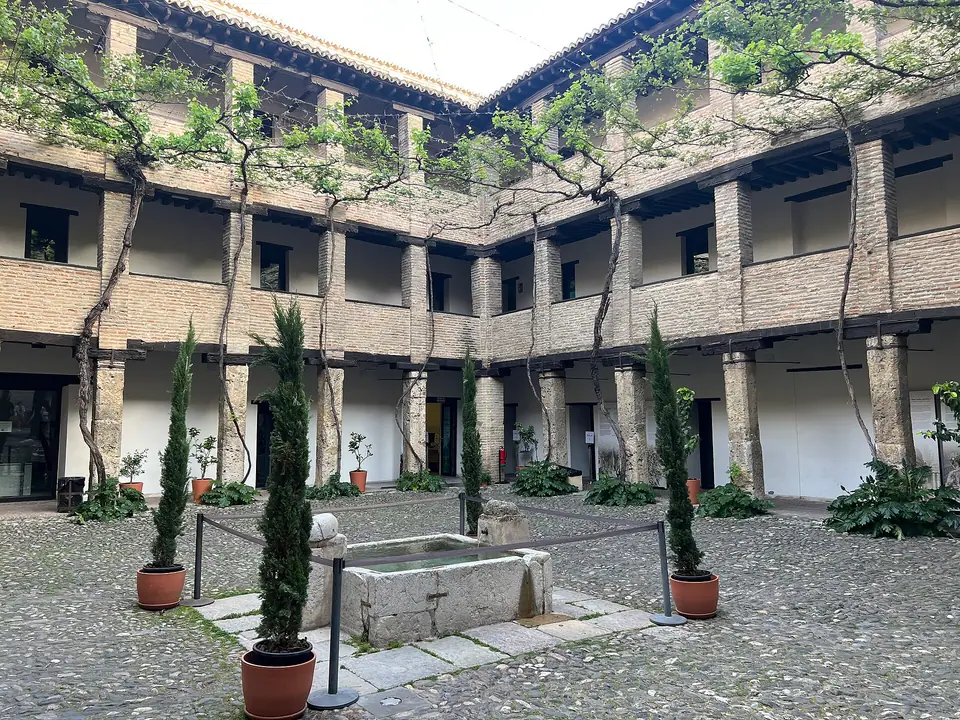
South of the Alcaicería, across Calle Reyes Católicos along Calle Mariana Pineda, stands the Corral del Carbón. Managed as an Andalusian monument by the Patronato de la Alhambra y Generalife, this former funduq preserves an intact merchant courtyard. Merchants tethered pack mules beside the central stone trough and used upper galleries for lodging. Its monumental gateway, framed by a double horseshoe arch and vaulted muqarnas plasterwork, survived through various municipal uses over centuries.
Traveller tips for the cathedral quarter
- Visit the Royal Chapel during quieter hours. Because the Royal Crypt is a narrow stone passageway, arriving early helps you view the tombs unhurriedly.
- How to spot genuine handmade taracea marquetry. In the Alcaicería and on nearby streets, inexpensive souvenir boxes use printed patterns that feel completely smooth. Authentic hand-inlaid Granada wood taracea shows subtle tactile grain variations between tiny pieces.
- Inspect the Church of the Sagrario. Attached to the Cathedral on Plaza de Alonso Cano stands the Iglesia del Sagrario. Next to it runs the carved arcade of the Lonja de Mercaderes (Merchants' Exchange).
- Combine your visit with the Monastery of San Jerónimo. Walk northwest along Calle San Jerónimo to see the Renaissance cloisters of the Real Monasterio de San Jerónimo. Designed with work by Diego de Siloé around a cloister, its church houses the burial pantheon of Gonzalo Fernández de Córdoba. Effigies flank a soaring Mannerist polychrome altarpiece.
- Hearing the Historic Cathedral Organs and Choral Mass: Granada Cathedral remains the active seat of the archdiocese. Attending choral services lets you hear the pipe organs resonate through the high vaulting.
- Relaxing in Plaza Bib-Rambla and the flower stalls. Just west of the Cathedral opens Plaza Bib-Rambla. Ringed by lampposts and flower stalls, it centres on the Fountain of the Gigantones. It provides a convenient resting point between your morning Cathedral visit and lunch.
- Audio guides for the Cathedral and Royal Chapel. Visits to Granada Cathedral include modern audio guides to navigate the chapels. The Royal Chapel offers cultural visit tickets online and audio interpretation through its visitor services.
- Visiting the historic Curia and Archbishop's Palace exterior. Facing the Cathedral across Plaza de Alonso Cano stands the Palacio Arzobispal, whose courtyard preserves Renaissance stone columns and traditional Granadino pebble paving.
- Coffee and churros on Plaza Bib-Rambla. Historic cafés around the square serve traditional hot chocolate paired with freshly fried morning churros.
- Public transport options across central Granada. Granada's light rail metro system includes stations such as Recogidas, Méndez Núñez, Caleta, and Estación Ferrocarril. These stops connect the wider city neighbourhoods with the rail station and northern districts, facilitating straightforward transfers before your historic centre walking tour.
Where it is
- 1Granada Cathedral & Royal Chapel
- Málaga-Costa del Sol Airport (AGP) · about 97 km from here in a straight line
- Directions in Google Maps
Stations and taxi ranks: OpenStreetMap. Airports: OurAirports. Distances are in a straight line.
Traveller tips
Real advice from people who have been to Granada. Every tip is read by our team before it goes live.
No tips yet. Been here? Yours could be the first.
Thank you! Your tip will appear here after a quick review.
More in Granada
Continue exploring Granada with related neighbourhood, food, and planning guides
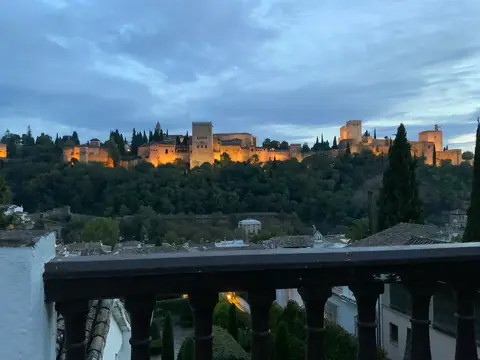
Granada 3-Day Itinerary: Alhambra, Albaicín, Sacromonte & Tapas Route
Granada, Spain
Alhambra & Nasrid Palaces Guide: Booking Tickets, Gates, Palaces & Timing
Granada, Spain
Generalife Gardens & Palace Guide: Patio de la Acequia & Silla del Moro
Granada, Spain
Albaicín & Carrera del Darro Guide: Mirador de San Nicolás & Carmenes
Granada, Spain
