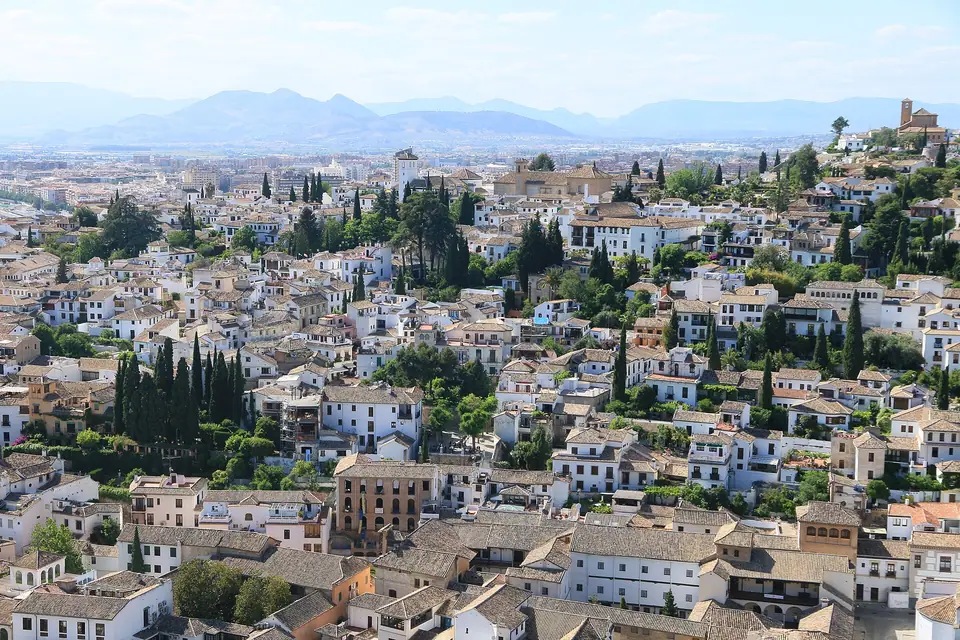
Photo: Øyvind Holmstad · CC BY-SA 4.0
Where to Stay in Granada: Best Neighbourhoods, Carmenes & Parking Tips
Compare Granada's accommodation zones by altitude, cobblestone terrain, taxi access, and walking convenience to the Alhambra, Cathedral, and tapas streets.
Booking a hotel in Granada without checking street topography and municipal camera-zone rules can cause real inconvenience. Many guesthouses advertise closeness to the monuments, yet reaching them often requires carrying bags up steep river-pebble steps where vehicles cannot stop. Below, we break down Granada's primary accommodation zones by luggage accessibility, noise level, and transit connections. Pair this breakdown with our how to get to Granada transport guide and our Granada 3-day itinerary.
| Neighbourhood / Zone | Elevation & Gradient | Taxi & Luggage Access | Best For & Key Trade-off |
|---|---|---|---|
| Centro Catedral, Plaza Nueva & Bib-Rambla | Flat paved plazas and avenues | Direct taxi drop-off to hotel doors; easy access to transit stops | Short stays and straightforward rail or airport transfers. Busy daytime streets |
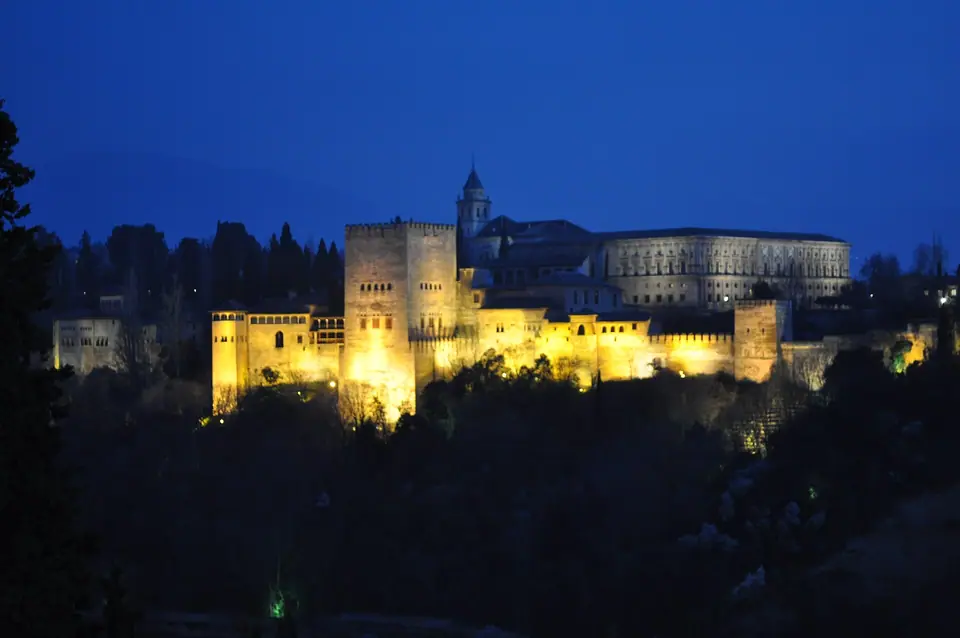
| Lower Carrera del Darro & Paseo de los Tristes | Gentle riverside cobblestone incline | Authorised taxis and local buses pass along the river lane | Romantic floodlit Alhambra views from the valley floor. Limited car parking |
| Middle & Upper Albaicín (San Nicolás / Plaza Larga) | Steep stepped pedestrian alleys | Taxis reach perimeter plazas; walking over cobbles required for interior alleys | Walled carmen courtyard gardens and iconic Alhambra panoramas. Hard with heavy bags or mobility limits |
| Realejo (Campo del Príncipe & Santa Ana) | Flat lower squares with uphill eastern lanes | Good taxi and bus access along main thoroughfares | Local residential atmosphere, relaxed terrace tapas bars, and routes toward the Alhambra |
| Sabika Hill (Alhambra Precinct & Cuesta de Gomérez) | Inside or immediately beside the Alhambra woods | Direct vehicle and minibus access to hotel entrances | Sleeping near the monument complex; downhill walk required for city-centre dining |
Centro Catedral, Plaza Nueva, and Plaza Bib-Rambla
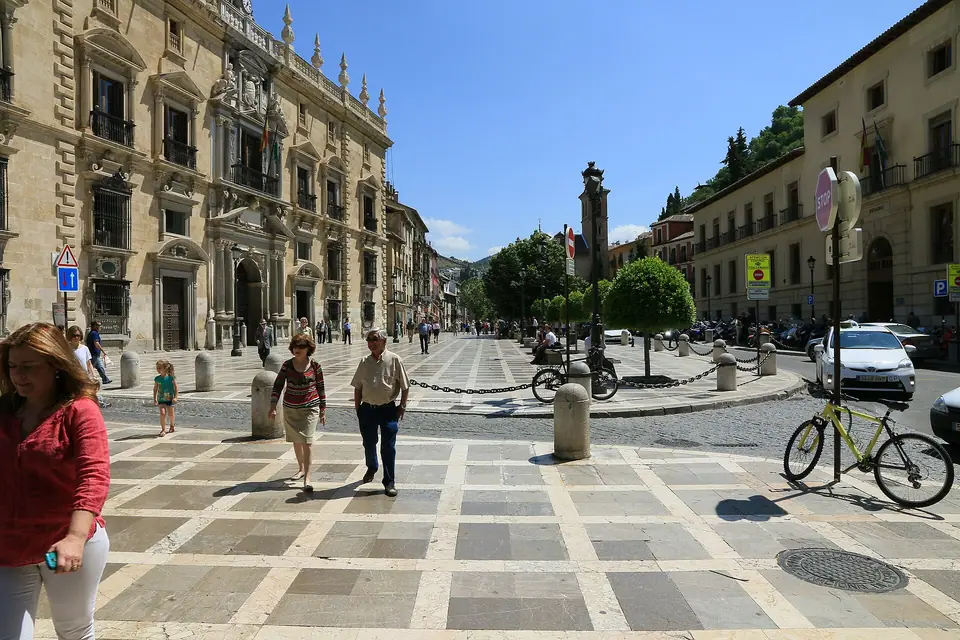
For a stay with effortless logistics and flat pavements for rolling bags, choose the lower historic centre. The triangle between Granada Cathedral, Plaza Bib-Rambla, and Plaza Nueva gives you immediate access to major monuments and bus lines. Granada Cathedral stands at Calle Gran Vía de Colón, 5, with its entrance at Plaza de las Pasiegas. The Royal Chapel sits at Calle Oficios s/n. Construction of the cathedral began in 1506. Staying nearby puts you right beside this major work of the Spanish Renaissance. The foundation trenches of the cathedral were noted on 24 March 1523, with the foundation stone placed the following day. Its initial tower section was constructed around 1535 to 1536.
Plaza Isabel la Católica serves as a major departure point for local minibuses heading uphill. The central avenues offer quick links to public transit connecting outward toward Estación Ferrocarril and Estación Autobuses on the Metro de Granada network. Look here for historic converted buildings such as Palacio de Santa Paula along Gran Vía, or boutique hotels around Plaza Bib-Rambla. If you are sensitive to late-night street noise, request an interior courtyard room (habitación interior hacia el patio) rather than a street-facing balcony.
Staying in the lower centre means you can wander on level ground to nearby sites. The historic Corral del Carbón, an Andalusian monument managed under the trust of the Patronato de la Alhambra y Generalife, lies a short stroll away. This location eliminates the uphill drag of heavy luggage while keeping evening dining spots within easy walking distance.
Lower Carrera del Darro and Paseo de los Tristes
Carrera del Darro and Paseo de los Tristes follow the river corridor east from Plaza Nueva into the valley between the hills. They offer an evocative riverside setting without requiring an immediate climb up steep stairways. Hotels along this strip occupy historic mansions and courtyard houses with views up to the stone ramparts above.
Although private cars face restrictions, licensed taxis and local minibuses can navigate along Carrera del Darro. A taxi can bring you and your luggage near properties along the riverside lane. From Paseo de los Tristes, stone paths lead up toward the monument slopes, while a stroll west brings you back to Plaza Nueva. Staying here places you close to ancient heritage landmarks such as El Bañuelo, another historic Andalusian monument managed under the public trust. The sound of running water from the river provides a natural backdrop that feels removed from motor traffic.
Travellers selecting this zone enjoy a balance between historic atmosphere and manageable access. You avoid the high climbs of the upper quarters, yet you remain immersed in old architecture. The riverside lane provides direct pedestrian routes into the lower alleys leading toward the Albaicín and the Realejo.
The Middle and Upper Albaicín: Carmen houses and views
Many travellers choose to stay in a traditional carmen featuring courtyard gardens, stone basins, and panoramic views of the monument across the ravine. The hillside Albaicín offers an evocative historic environment with sweeping vantage points from open terraces. This hillside quarter preserves historic homes such as Casa Horno de Oro and Palacio de Dar al-Horra.
Before booking in the Albaicín, check the precise street location on map tools. Verify whether your accommodation sits along a drivable route or inside a stepped pedestrian alley. If your lodging lies along a stepped stone path, travel with compact luggage and arrange in advance where transport can drop you. Cobblestone inclines can prove taxing when carrying heavy bags across uneven stone pavements.
The upper quarter offers a distinctly peaceful residential rhythm once evening crowds depart from the popular lookout terraces. Waking up to views across the valley remains one of Granada's classic experiences. However, guests should prepare for regular climbs when returning from central sightseeing excursions on foot.
Realejo and the Alhambra Hill
On the slope beneath the Alhambra woods lies the Realejo. It combines lower public squares around Campo del Príncipe with hillside paths rising toward the upper gardens. The quarter offers a relaxed residential atmosphere with local outdoor terraces and traditional taverns serving local fare. The neighbourhood provides a gentler incline than the Albaicín, making it an appealing alternative for travellers seeking character without extreme slopes.
Accommodations stand on the hill itself within or near the monument perimeter, including the Parador de Granada. This property occupies a historic convent complex established after the Catholic Monarchs took the city. The remains of Isabella I of Castile and Ferdinand V of Aragon were moved into the Royal Chapel in 1521. The mausoleum for Philip and Joanna inside the Royal Chapel was completed after the arrival of Philip's remains in Granada in 1515. The design of the Royal Chapel was originally commissioned to architect Egas in 1506. Because space inside the protected grounds of the Alhambra is restricted, reservations must be arranged well in advance.
Staying on the Sabika Hill allows guests to step directly into the wooded grounds surrounding the ancient palaces. Morning walks through the shaded parkland offer total quiet before daytime visitors arrive at the gates. Keep in mind that reaching the lower city for dinner requires either a steady descent on foot or a short minibus ride.
Traveller tips for accommodation
- Pre-register your vehicle plate. If your hotel offers garage access in a restricted zone, send your license plate to reception before arrival for municipal authorization.
- Check seasonal demand and lift access. Accommodation demand rises during spring festivals and autumn weekends, so reserve early on official hotel portals. Because converted courtyard mansions often lack elevators, confirm step-free or lift access if you need a ground-floor room.
- Use the Metro de Granada along flat avenues. Travellers staying near Camino de Ronda or Gran Vía can connect easily to the Metro de Granada light rail line. Trams serve Albolote, Maracena, Caleta, Estación Ferrocarril, Méndez Núñez, Recogidas, Alcázar Genil, and Armilla.
Where it is
- 1Granada
- Málaga-Costa del Sol Airport (AGP) · about 97 km from Granada in a straight line
- Directions in Google Maps
Stations and taxi ranks: OpenStreetMap. Airports: OurAirports. Distances are in a straight line.
Traveller tips
Real advice from people who have been to Granada. Every tip is read by our team before it goes live.
No tips yet. Been here? Yours could be the first.
Thank you! Your tip will appear here after a quick review.
More in Granada
Continue exploring Granada with related neighbourhood, food, and planning guides
Best Time to Visit Granada: Seasonal Weather, Festivals & Crowd Calendar
Granada, Spain
What to Wear in Granada: Cobblestone Footwear, Dress Codes & Seasons
Granada, Spain
Granada 3-Day Itinerary: Alhambra, Albaicín, Sacromonte & Tapas Route
Granada, Spain
Alhambra & Nasrid Palaces Guide: Booking Tickets, Gates, Palaces & Timing
Granada, Spain
