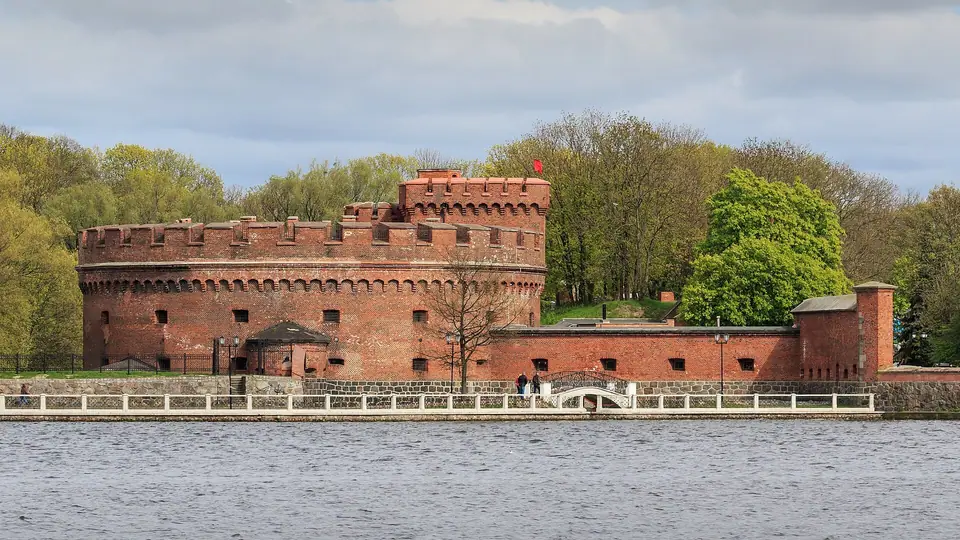
Photo: A.Savin · CC BY-SA 4.0
Amber Museum, Dohna Tower and Upper Pond: Fortress Casemates and Lakeside Promenades
Discover Kaliningrad Amber Museum in the 1853 Dohna Tower, view prehistoric inclusions and amber treasures, and walk the scenic shores of the historic Upper Pond.
Kaliningrad Oblast holds around ninety percent of the world's explored Baltic amber deposits, primarily extracted on the western coastal rim of the Sambian Peninsula. Within the regional capital, the focal point for this mineraloid heritage is the Kaliningrad Regional Amber Museum, located on Marshal Vasilevsky Square. The museum occupies the massive circular masonry of Dohna Tower, positioned where the nineteenth-century Prussian military cordon meets the southern edge of the Upper Pond. Incorporating fortress architecture and decorative arts, this district combines heavy defensive brickwork with relaxed lakeside paths that reveal centuries of urban change.
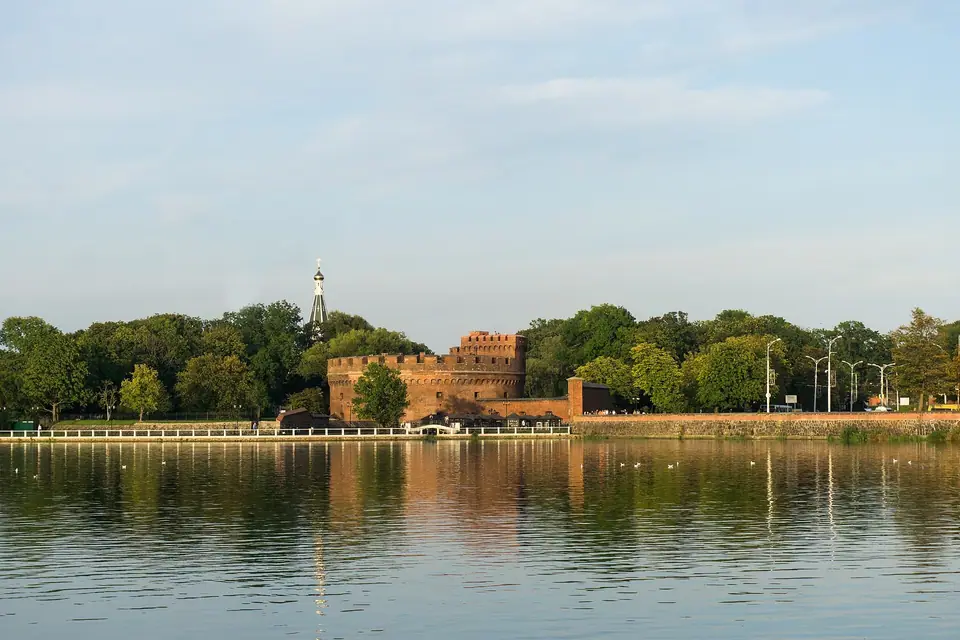
Dohna Tower Bastion and the Fortress Layout
Dohna Tower was completed in 1853 under the direction of fortification chief Ernst Ludwig von Aster, with engineering designs drawn by Julius Engelbrecht and von Heil. Named in honour of Prussian Field Marshal Karl Friedrich Emil zu Dohna-Schlobitten, the red-brick structure formed a crucial artillery bastion of the Second Defensive Belt. The circular redoubt measures 34 metres in diameter and 12 metres in height, reinforced with external brick walls that reach two metres in thickness. Its multi-tiered loop embrasures commanded the northern approaches across the water, providing defensive fields of fire towards Rossgarten Gate.
During the Battle of Königsberg towards the close of the Second World War, the fortified casemates served as an axis of resistance. German forces held out in the fortress until surrendering between 9 and 10 April 1945. Following comprehensive restoration work initiated in 1969, the bastion opened as the Kaliningrad Amber Museum on 29 December 1979, originally operating as an affiliated branch of the Regional Historical and Art Museum. Today, travellers touring regional defensive monuments beside our Kaliningrad City Gates and Fort No. 5 subguide will note Dohna Tower as one of the best-preserved urban strongpoints in the city.
Gallery Collections: Inclusions, Nuggets and the Amber Room
The museum displays roughly 14,000 catalogued items across 28 exhibition halls arranged over three levels, covering approximately 1,000 square metres of floor space. The exposition divides into five dedicated sections covering the natural origin of amber, historical archaeology, decorative pieces from the seventeenth and eighteenth centuries, the state production facility, and modern jewellery design. Naturalists can inspect dioramas of the ancient pine forests that generated Baltic succinite, as well as more than 3,000 fossilised organic inclusions trapping ancient flora, insects, and rare specimens such as a prehistoric lizard preserved in resin.
Among the raw mineraloid displays, the centrepiece is a massive specimen weighing 4.28 kilograms (4 kilograms 280 grams), ranking as the second-largest piece of amber preserved anywhere in the world. The historical galleries display archaeological finds from the fourth and fifth centuries AD and baroque masterpieces on loan from major Russian institutions. The museum is unique in preserving authentic reconstructed decorative panels and structural fragments of the lost Amber Room, created by master craftsmen who revived seventeenth-century carving techniques. Visitors can also view objects produced by the historic Staatliche Bernstein-Manufaktur Königsberg before 1945 and Soviet industrial items crafted after raw mining shifted to the coastal works described in our Zelenogradsk, Svetlogorsk and Yantarny guide. Always check the official museum website to confirm current opening schedules and entry conditions.
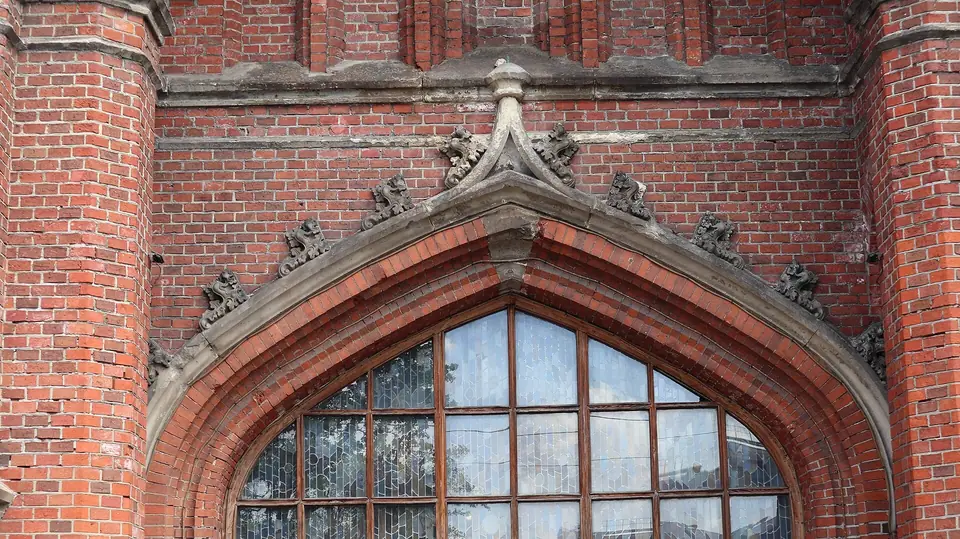
Rossgarten Gate and Prussian Architectural Details
Immediately adjoining Dohna Tower stands the neo-Gothic Rossgarten Gate, constructed between 1852 and 1855 to the design of royal architect Friedrich August Stüler. Built from dark red clinker brick, the portal features seven arched casemates flanking a grand central carriageway. The passage is crowned by an elevated parapet with decorative brick machicolations, octagonal turrets, and open-work embrasures that evoke mediaeval Teutonic styling while serving nineteenth-century defensive demands.
The outer facade of Rossgarten Gate retains sandstone portrait medallions sculpted by Wilhelm Ludwig Stürmer. These carvings depict Prussian military reformers General Gerhard von Scharnhorst and Field Marshal August Neidhardt von Gneisenau, both of whom played pivotal roles in restructuring the armed forces during the Napoleonic campaigns. The structural link between the gate and Dohna Tower forms an uninterrupted red-brick facade, offering a prime example of historical European military engineering integrated into a civic setting.
| Sector Feature | Construction Date | Architectural Character | Key Highlight |
|---|---|---|---|
| Dohna Tower | 1853 | Circular red-brick artillery redoubt | Holds 14,000 amber exhibits and 4.28 kg nugget |
| Rossgarten Gate | 1852 to 1855 | Neo-Gothic gateway with seven casemates | Medallions of von Scharnhorst and von Gneisenau |
| Upper Pond (Oberteich) | Created in 1270 | Artificial reservoir of 41.1 hectares | Promenade elevated 22 metres above the Pregolya |
| Animal Sculptures | 1913 | Limestone sea-creature statues | Carved by German sculptor Hermann Thiele |
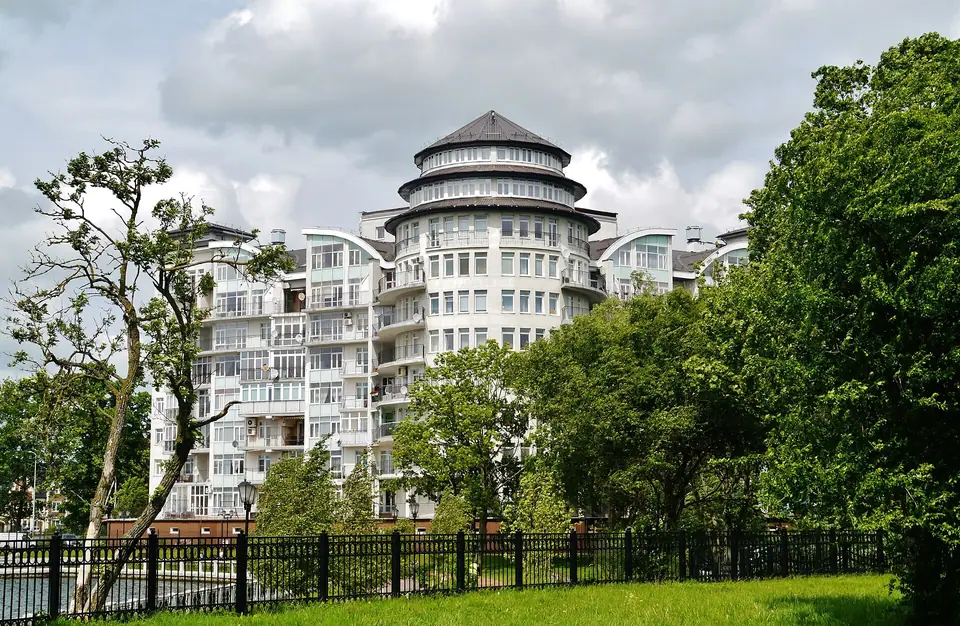
Upper Pond Promenades and Thiele Sculptures
Directly behind Dohna Tower lies the Upper Pond, known historically as the Oberteich. Established by the Teutonic Knights in 1270, the artificial reservoir was dammed to breed freshwater fish and feed the defensive moats around early Königsberg. Covering an expanse of 41.1 hectares, the lake surface sits 22 metres above the level of the Pregolya River, functioning as an expansive natural basin linked to the lower city waterways by hidden sluices.
The perimeter features landscaped walking trails and cycle paths that form one of the city's most pleasant outdoor circuits. On the western embankment, walkers encounter four limestone sea-animal sculptures completed in 1913 by German artist Hermann Thiele. The carved figures depict a sea lion, a walrus, a sea dog, and a pelican, standing as whimsical monuments from late imperial Königsberg. A stroll northward around the shore brings visitors into the quiet streets of Maraunenhof, an early twentieth-century residential quarter filled with historic gardens and private villas that can be combined with walks outlined in our Kaliningrad 3-Day Itinerary.
Seasonal Weather Patterns and Waterfront Planning
Lakeside walking and fortress exploration depend heavily on Baltic seasonal shifts. Long-term climate data from Open-Meteo between 2015 and 2024 indicates that winter conditions around Upper Pond remain crisp and cold. January records average daytime highs of 0.9°C with overnight lows of -3.5°C across 14 wet days, while February brings highs of 2.1°C and lows of -3.0°C. Heavy coats and slip-resistant footwear are necessary when frost coats the stone walkways along the water.
Spring brings rapid improvements, warming from a daytime high of 6.4°C in March to 13.3°C in April and 18.3°C in May, though rainfall remains consistent with 12 to 14 wet days per month. Summer offers the finest weather for combining a museum visit with outdoor strolls around the entire 41.1-hectare lake. June averages 21.2°C, July reaches 23.5°C with 91 millimetres of rainfall over 15 wet days, and August maintains 23.3°C. Autumn cools steadily from 18.0°C in September to 11.8°C in October and 6.0°C in November, accompanied by 17 to 18 damp days. Packing a compact umbrella and a light windproof jacket ensures an enjoyable visit regardless of sudden coastal showers.
Where it is
- 1Amber Museum, Dohna Tower and Upper Pond
- Khrabrovo Airport (KGD) · about 19 km from here in a straight line
- Directions in Google Maps
Stations and taxi ranks: OpenStreetMap. Airports: OurAirports. Distances are in a straight line.
Traveller tips
Real advice from people who have been to Kaliningrad. Every tip is read by our team before it goes live.
No tips yet. Been here? Yours could be the first.
Thank you! Your tip will appear here after a quick review.
More in Kaliningrad
Continue exploring Kaliningrad with related neighbourhood, food, and planning guides
Kaliningrad: Exclave Geography, Historic Districts and Seasonal Planning
Kaliningrad, Russia
Things to Do in Kaliningrad: Prussian Monuments, Historic Fleet and Baltic Coast
Kaliningrad, Russia
Kant Island and Königsberg Cathedral: Brick Gothic Architecture and Kant's Tomb
Kaliningrad, Russia
Fishing Village and Oktyabrsky Island: Quays, Synagogue and Bridges
Kaliningrad, Russia
