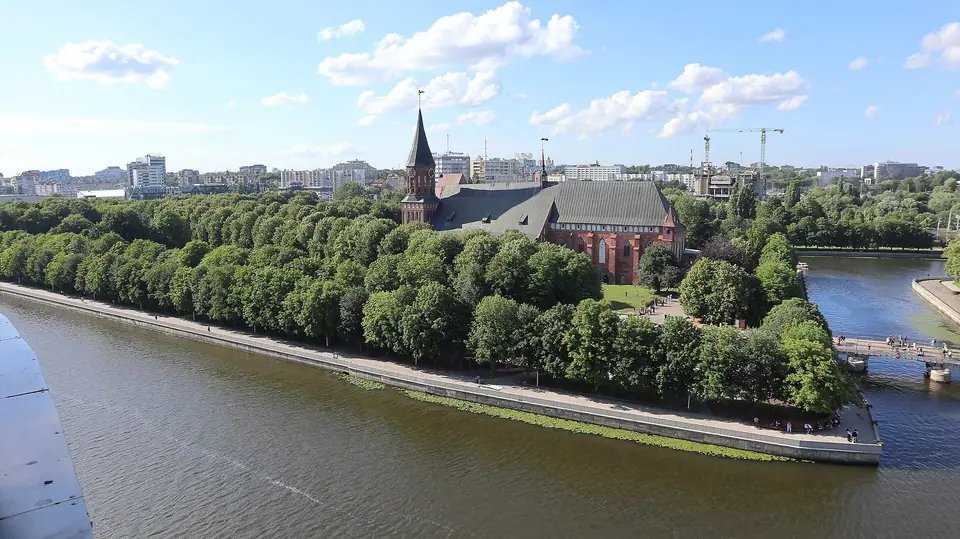
Photo: Александр Сигачёв · CC BY-SA 4.0
Kant Island and Königsberg Cathedral: Brick Gothic Architecture and Kant's Tomb
Discover Kant Island and Königsberg Cathedral in Kaliningrad, exploring medieval Brick Gothic architecture, Immanuel Kant's mausoleum, and island park routes.
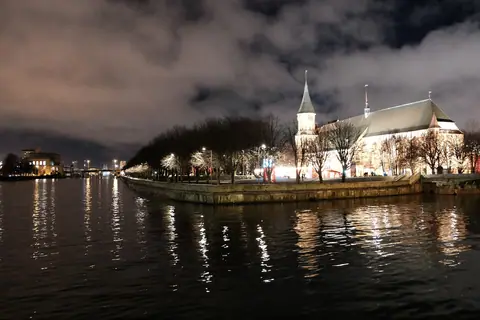
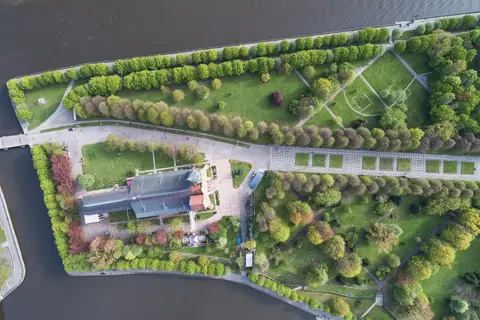
Kant Island, historically known as Kneiphof, rests between the New Pregolya and Old Pregolya river branches in central Kaliningrad. Covering roughly 10 hectares, this marshy river island was granted town rights in 1327 as the youngest of medieval Königsberg's three distinct settlements. Before the destruction of the Second World War, Kneiphof was a dense urban quarter packed with 304 houses across 28 narrow streets. Five of the famous seven bridges of Königsberg linked the island to neighbouring riverbanks: Krämerbrücke built in 1286, Grüne Brücke in 1322, Dombrücke in 1330, Köttelbrücke in 1377, and Honigbrücke in 1542. Today, the island functions as an open parkland anchored by the towering Brick Gothic volume of Königsberg Cathedral, making it a primary stop on any comprehensive Kaliningrad 3-Day Itinerary: Königsberg Heritage, Fortresses and Baltic Dunes.
To ground the cathedral on unstable alluvial ground, medieval master masons drove hundreds of oak foundation piles deep into the mud. Samland Bishop Johann Clare had obtained the eastern third of Kneiphof in 1322, confirming the precinct's independence through a 1333 treaty signed with Teutonic Order Grand Master Luther von Braunschweig. Construction advanced from roughly 1330 until 1380, yielding a monumental brick house of worship dedicated to the Virgin Mary and Saint Adalbert of Prague. After the secularisation of the Teutonic Order State into the Duchy of Prussia in 1525, Johann Briesmann delivered the island's first Lutheran sermon inside the nave on 27 September 1523. The cathedral formally transformed into the university church for the newly founded Albertina University in 1544, serving as the resting place for Duke Albert of Prussia and university scholars.
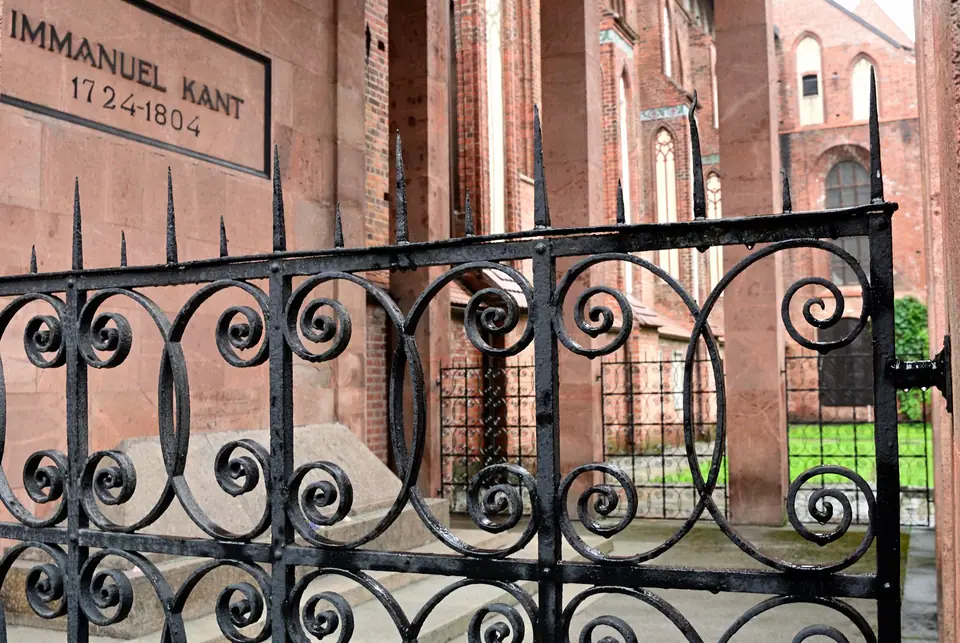
The Philosopher's Colonnade: Kant's Resting Place and Lahrs Memorial
Adjoining the north-eastern exterior corner of the cathedral stands the final resting place of Immanuel Kant, the world-renowned philosopher born in Königsberg in 1724. Kant died in 1804 and was initially interred within the academic crypt of the cathedral choir. In 1880, his remains were exhumed and relocated into a dedicated neo-Gothic exterior chapel. To mark the bicentenary of Kant's birth in 1924, architect Friedrich Lahrs completed the current open-air mausoleum, replacing the earlier structure with a restrained stone colonnade. The monument features square red porphyry pillars supporting a flat roof over a raised stone cenotaph, set apart from public walkways by simple wrought-iron railings.
During the intense Allied air raids of late August 1944, British Royal Air Force bombers targeted the urban core of Königsberg. The second night raid, launched on 30 and 31 August 1944, dropped incendiaries across Kneiphof, destroying its 304 residential timber-framed homes and gutting the cathedral. The philosopher's colonnade survived the inferno and the subsequent 1945 ground assaults with minimal structural harm. When Soviet authorities cleared the ruins of Kneiphof in the post-war decades, Kant's international stature protected the cathedral shell and his memorial from complete demolition. Visitors exploring nearby historical districts, as detailed in our guide to Fishing Village and Oktyabrsky Island: Quays, Synagogue and Bridges, cross the surviving Honigbrücke directly to reach this open memorial.
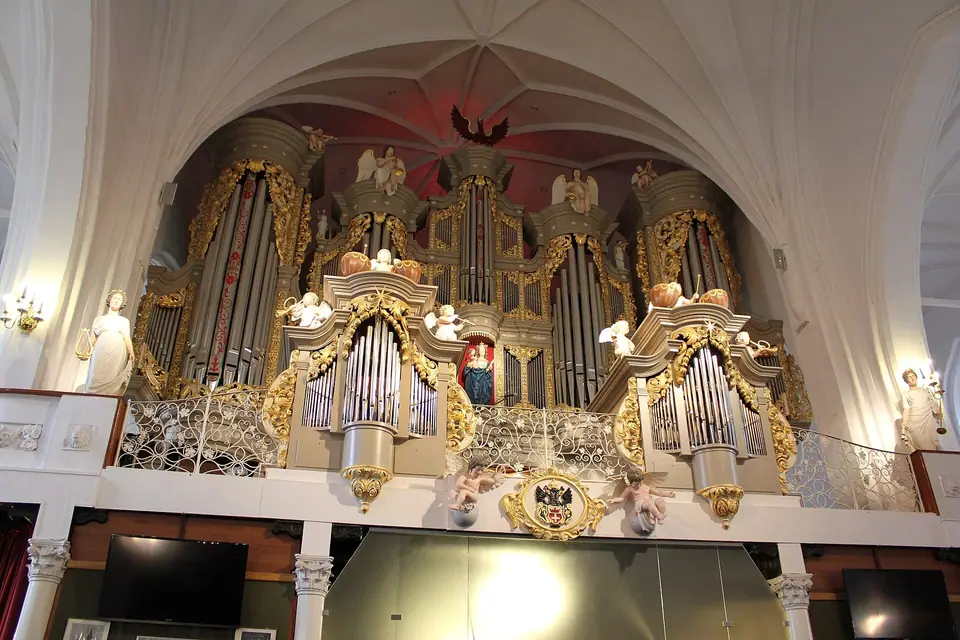
Post-War Rebirth, Mechanical Bells and Great Organ Concerts
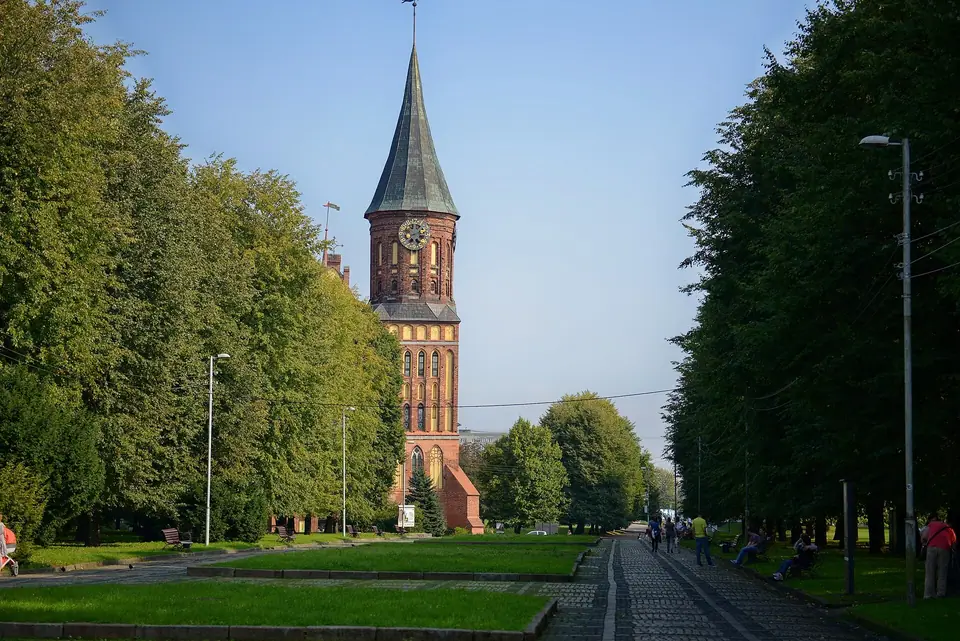
For almost fifty years after 1945, Königsberg Cathedral remained a roofless, exposed brick shell standing alone among secondary park trees. Restoration teams initiated structural stabilisation in 1992 following the dissolution of the Soviet Union. Engineers lifted a reconstructed timber and copper-clad spire onto the south tower using a heavy-lift helicopter in 1994. A new tower clock was installed in 1995, equipped with four cast bells weighing 1,180, 700, 500, and 200 kilograms. The clock chimes on every quarter-hour, marking each full hour with the opening notes of Ludwig van Beethoven's Symphony Number 5. Reconstruction of the steep main nave roof was completed between 1996 and 1998, followed by stained glass window replacements.
Inside the restored interior, the cathedral serves as a cultural and museum complex housing Russian Orthodox and Lutheran chapels, the Wallenrodt Library exhibition hall, and a monumental organ complex. The main instrument is housed within an ornamental timber casework adorned with gilded wood carvings, echoing East Prussian baroque design. Regular organ recitals make full use of the nave's commanding reverberation, presenting baroque and classical repertory throughout the week. Visitors planning an architectural walk through the area can consult our overview of Things to Do in Kaliningrad: Prussian Monuments, Historic Fleet and Baltic Coast to combine musical recitals with surrounding urban monuments.
Architectural Milestones Across Kneiphof
The following table tracks verifiable historical milestones across Kneiphof and Königsberg Cathedral:
| Historical Era | Architectural Milestone | Physical Feature |
|---|---|---|
| 1322 to 1333 | Kneiphof acquisition and treaty | Submerged oak foundation piles |
| 1330 to 1380 | Cathedral nave construction | Brick Gothic choir, murals, and walls |
| 1544 | Albertina University affiliation | North tower gable roof and library chamber |
| 1924 | Kant bicentenary memorial | Friedrich Lahrs colonnade and stone cenotaph |
| 1992 to 1998 | Modern reconstruction campaign | Rebuilt spire, clock bells, and copper roof |
Visiting Logistics and Seasonal Planning
Kant Island is accessible on foot around the clock through paved park promenades that follow the outlines of former medieval streets. The interior museum exhibits, organ concert hall, and chapels operate under scheduled entry cycles; travellers should check the official cathedral operator website for updated concert times and ticketing policies before arriving. Navigating the open island park requires outdoor preparation depending on the time of year. Summer weather from June through August brings daytime highs between 21.2°C and 23.5°C, balanced by monthly rainfall totals between 69 and 91 millimetres across 15 to 16 wet days. Winter brings temperatures averaging around freezing, with January posting daily highs of 0.9°C and lows of -3.5°C over 14 wet days. Autumn visits during October and November face cooler winds along the Pregolya, with rainfall occurring across 18 wet days per month, making waterproof layers advisable when walking between Kant's tomb and the surrounding river embankments.
Where it is
- 1Kant Island and Königsberg Cathedral
- Khrabrovo Airport (KGD) · about 21 km from here in a straight line
- Directions in Google Maps
Stations and taxi ranks: OpenStreetMap. Airports: OurAirports. Distances are in a straight line.
Traveller tips
Real advice from people who have been to Kaliningrad. Every tip is read by our team before it goes live.
No tips yet. Been here? Yours could be the first.
Thank you! Your tip will appear here after a quick review.
More in Kaliningrad
Continue exploring Kaliningrad with related neighbourhood, food, and planning guides
Kaliningrad 3-Day Itinerary: Historic Islands, Prussian Forts and Baltic Dunes
Kaliningrad, Russia
Kaliningrad: Exclave Geography, Historic Districts and Seasonal Planning
Kaliningrad, Russia
Things to Do in Kaliningrad: Prussian Monuments, Historic Fleet and Baltic Coast
Kaliningrad, Russia
Fishing Village and Oktyabrsky Island: Quays, Synagogue and Bridges
Kaliningrad, Russia
