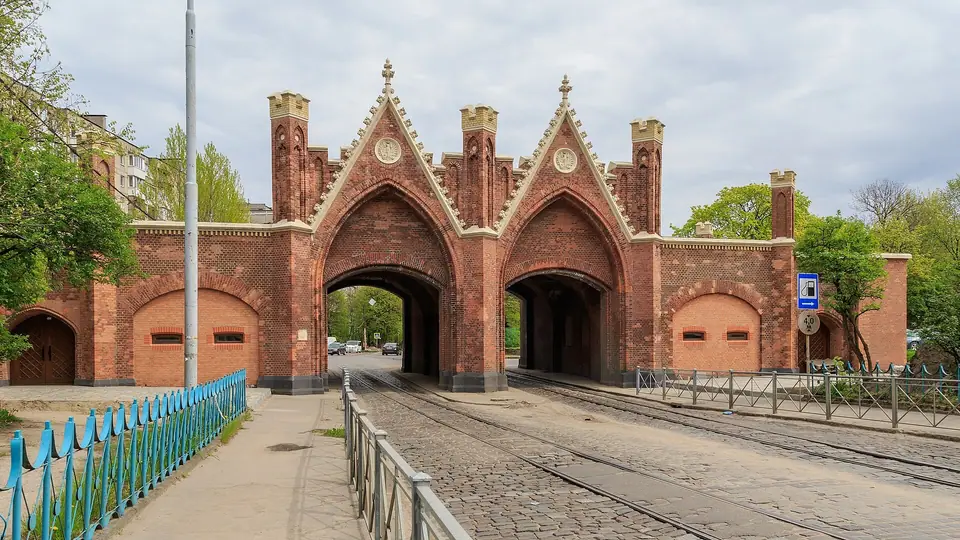
Photo: A.Savin · CC BY-SA 4.0
Kaliningrad City Gates and Fort No. 5: Prussian Defensive Architecture
Plan your route through Kaliningrad's nineteenth-century Prussian fortifications, from surviving neo-Gothic inner gates to the water moat and casemates of Fort No. 5.
Between the 1840s and 1880s, Prussian military engineers led by General Ernst Ludwig von Aster and architect Friedrich August Stüler encircled Königsberg with an extensive defensive network. This system combined an inner brick rampart punctuated by neo-Gothic gates with an outer ring of twelve main forts, historically referred to as the Night Featherbed of Königsberg. Today, seven historic brick gates, two standalone circular artillery towers, and heavily fortified outer installations survive across the urban fabric of Kaliningrad.
These structures reflect the transition from early modern bastions to industrial-era brick fortification. The ramparts between the urban gates were largely leveled in the early twentieth century after the German military department judged them obsolete in 1910 and transferred them to municipal authority. That civic intervention left the gates standing as detached architectural monuments on central roundabouts and boulevard medians. Surviving sites now house cultural exhibitions managed by regional institutions such as the Museum of the World Ocean, showcasing naval history, pre-war city life, and military engineering.
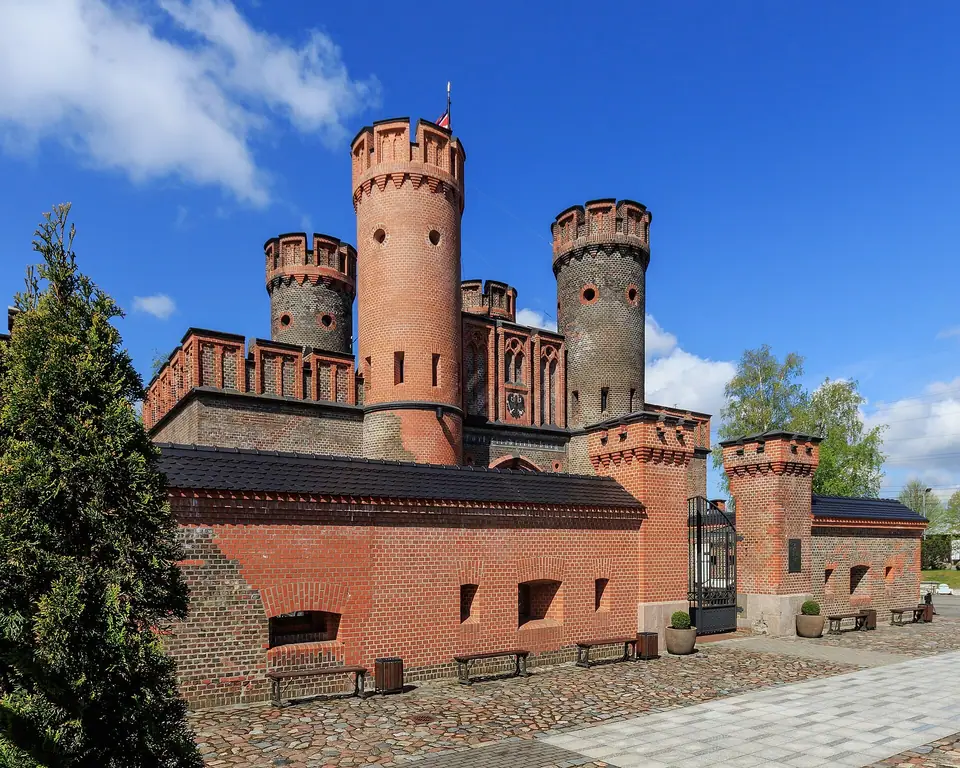
Surviving Inner Bastion Gates and Neo-Gothic Portals
The inner fortification belt preserves several distinctive gates constructed from dark Baltic clinker brick. King's Gate, situated at the junction of Frunze Street and Litovsky Val, was built between 1843 and 1850. The ceremonial foundation stone was laid in the presence of King Frederick William IV of Prussia. Its exterior features three sandstone statues carved by Wilhelm Ludwig Stürmer, depicting King Ottokar II of Bohemia, King Frederick I of Prussia, and Duke Albert of Prussia. Restored thoroughly for the municipal anniversary in 2005, the interior houses the Great Embassy exhibition dedicated to diplomatic history and the journeys of Peter the Great.
Brandenburg Gate on Bagration Street was originally built of timber in 1657 before reconstruction in brick in 1843. It remains the only historic gate in Kaliningrad that still accommodates active motor traffic through its twin pointed arches. The gables display medallions of Field Marshal Hermann von Boyen and General Ernst von Aster. Inside its restored side chambers, visitors can browse exhibits at the Marzipan Museum, celebrating the regional culinary tradition of baked almond confectionery.
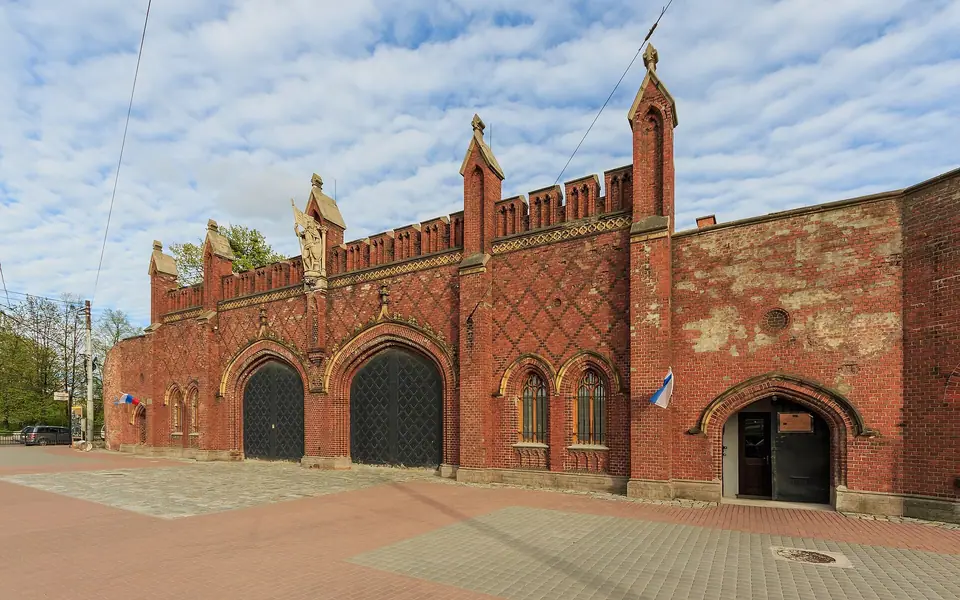
Friedland Gate stands at the intersection of Dzerzhinskogo Street at the edge of South Park. Erected during the nineteenth century, its casemates contain an extensive interactive museum displaying pre-war urban everyday items, shop signage, vintage bicycles, and domestic hardware salvaged from former Königsberg residential basements. Sackheim Gate, located at Litovsky Val 61, retains sculpted portraits of Generals Ludwig Yorck von Wartenburg and Friedrich Wilhelm von Bülow. Nearby along the water, Friedrichsburg Gate on Portovaya Street survives as the sole remnant of the older 1657 Friedrichsburg citadel. Completed in 1852 with four stout circular towers, it now displays historical boatbuilding craft and maritime archaeology.
Artillery Redoubts: Dohna Tower and Wrangel Tower
In addition to the gates, Prussian engineers reinforced the northern perimeter of the city with two massive standalone circular towers built in the 1850s to protect Upper Pond. Dohna Tower, named after Field Marshal Karl Friedrich Emil zu Dohna-Schlobitten, and Wrangel Tower, named after Field Marshal Friedrich von Wrangel, measure approximately 34 metres in external diameter and 12 metres in height.
Both towers feature walls several metres thick, built of dense fired brick with gun embrasures engineered to repel direct artillery fire. Dohna Tower accommodates the regional amber repository, detailed further in our guide to the Amber Museum, Dohna Tower and Upper Pond. The two towers formed an integrated defensive axis designed to sweep the water and prevent flanking movements across the northern ramparts.
Fort No. 5 King Frederick William III: Structure and Assault History
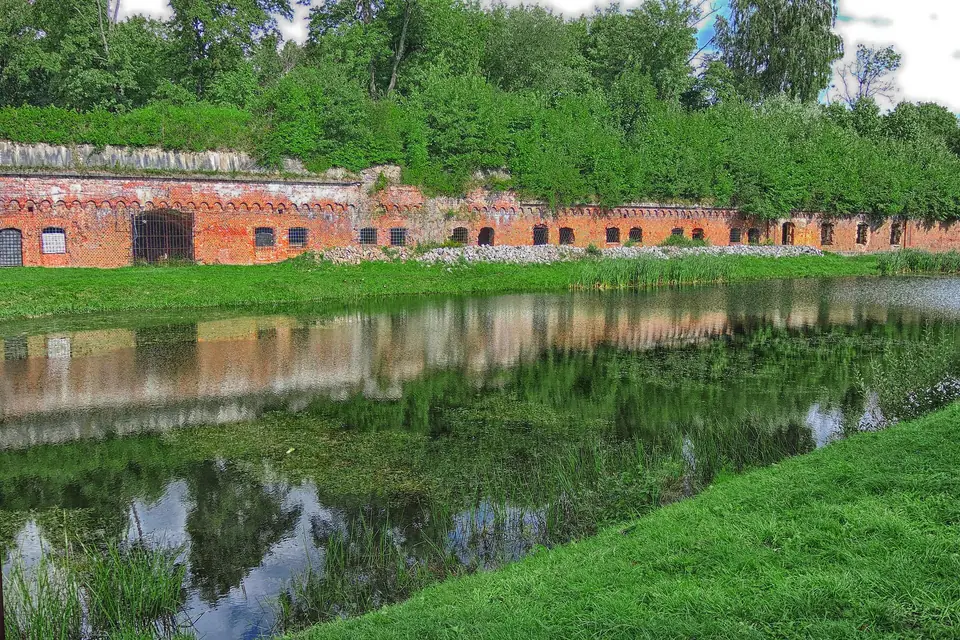
Constructed in the 1870s as part of the twelve-fort outer ring, Fort No. 5 lies north of the city centre along the road toward the Baltic coast. Officially designated King Frederick William III, this hexagon-shaped red-brick bastion measures 215 metres in length by 105 metres in width. It is completely surrounded by a water-filled moat measuring between 20 and 25 metres across and up to 5 metres deep.
The fort contained vaulted subterranean galleries, ammunition magazines, barracks, and reinforced gun platforms covered by earth revetments. During the Soviet storm of Königsberg in the East Prussian offensive, the fort presented a formidable obstacle. Between 6 and 8 April 1945, Red Army assault detachments engaged in prolonged combat to breach the outer revetments and subterranean chambers. Heavy artillery bombardments cracked the reinforced concrete caps, leaving fractured casemates and collapsed vaulting that remain visible today. Fifteen Soviet soldiers received the title of Hero of the Soviet Union for actions during the siege. Since 1979, the site has operated as an open-air military museum displaying artillery pieces, mine throwers, and an underground memorial path through the dark casemate galleries.
Architectural and Operational Comparison of Major Fortification Sites
The table below compares the structural features, original completion periods, and current functional roles of Kaliningrad's most prominent surviving defensive complexes.
| Fortification Name | Original Build Period | Key Architectural Features | Current Use |
|---|---|---|---|
| King's Gate | 1843 to 1850 | Neo-Gothic castle turrets and three sandstone royal statues | Great Embassy historical exhibition branch |
| Brandenburg Gate | 1843 (wooden original 1657) | Dual roadway barrel vaults with defensive stone medallions | Active road portal and Marzipan Museum |
| Friedland Gate | Mid-nineteenth century | Steep gables, water passage, and brick defensive ramparts | Interactive museum of pre-war street culture |
| Friedrichsburg Gate | 1852 | Four crenellated towers and heavy central vehicular arch | Traditional shipbuilding and maritime craft exhibition |
| Fort No. 5 | 1870s | Earth-covered brick casemates and 25-metre water moat | Open-air military memorial and trench museum |
Field Route Planning and Seasonal Weather Conditions
To examine the fortification ring efficiently, begin in the south at Brandenburg Gate and Friedland Gate before proceeding along Litovsky Val to King's Gate and Dohna Tower. This inner belt route can easily be integrated into a broader Kaliningrad 3-Day Itinerary. Reaching Fort No. 5 requires separate ground transit toward the northwestern perimeter, where buses and taxis run from central transport nodes near Victory Square.
Visiting underground galleries and damp brick moats requires appropriate clothing tailored to Baltic weather patterns. Meteorological records from 2015 through 2024 show that winter in Kaliningrad remains cold and damp, with January averaging highs of 0.9°C and lows of -3.5°C over 14 wet days. July and August deliver the warmest weather, reaching average highs of 23.5°C and 23.3°C, though both months experience peak rainfall at 91 millimetres across 15 to 16 wet days. Autumn is prone to frequent maritime precipitation, with October recording 86 millimetres across 18 wet days. Subterranean corridors inside Fort No. 5 maintain cool internal temperatures and humid air regardless of outdoor summer heat, so sturdy footwear with reliable tread and an extra windproof jacket are necessary when exploring unpaved outer ramparts and brick galleries.
Where it is
- 1Kaliningrad City Gates and Fort No. 5
- Khrabrovo Airport (KGD) · about 20 km from here in a straight line
- Directions in Google Maps
Stations and taxi ranks: OpenStreetMap. Airports: OurAirports. Distances are in a straight line.
Traveller tips
Real advice from people who have been to Kaliningrad. Every tip is read by our team before it goes live.
No tips yet. Been here? Yours could be the first.
Thank you! Your tip will appear here after a quick review.
More in Kaliningrad
Continue exploring Kaliningrad with related neighbourhood, food, and planning guides
What to Eat in Kaliningrad: Königsberger Klopse, Baltic Seafood and Baked Marzipan
Kaliningrad, Russia
How to Get to Kaliningrad and Travel Around: Khrabrovo Airport, Railway Hubs and Trams
Kaliningrad, Russia
Where to Stay in Kaliningrad: District Guide and Baltic Coastal Bases
Kaliningrad, Russia
Kaliningrad 3-Day Itinerary: Historic Islands, Prussian Forts and Baltic Dunes
Kaliningrad, Russia
