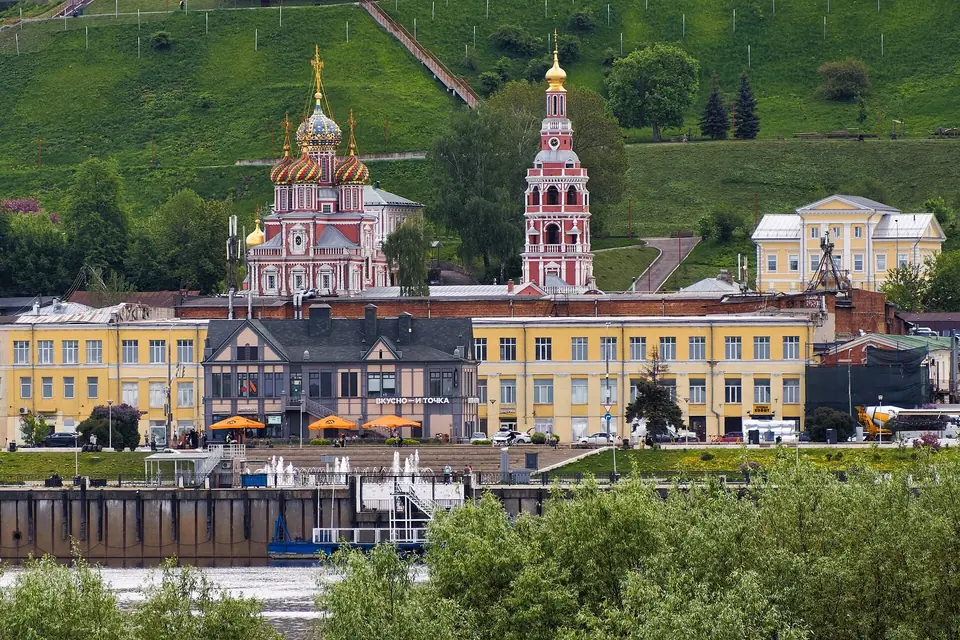
Photo: Alexxx1979 · CC BY-SA 4.0
Rozhdestvenskaya Street, Stroganov Church and Fedorovsky Embankment
Discover Lower Posad heritage on Rozhdestvenskaya Street, inspect the 1719 Stroganov Church carvings, and enjoy river panoramas from Fedorovsky Embankment.
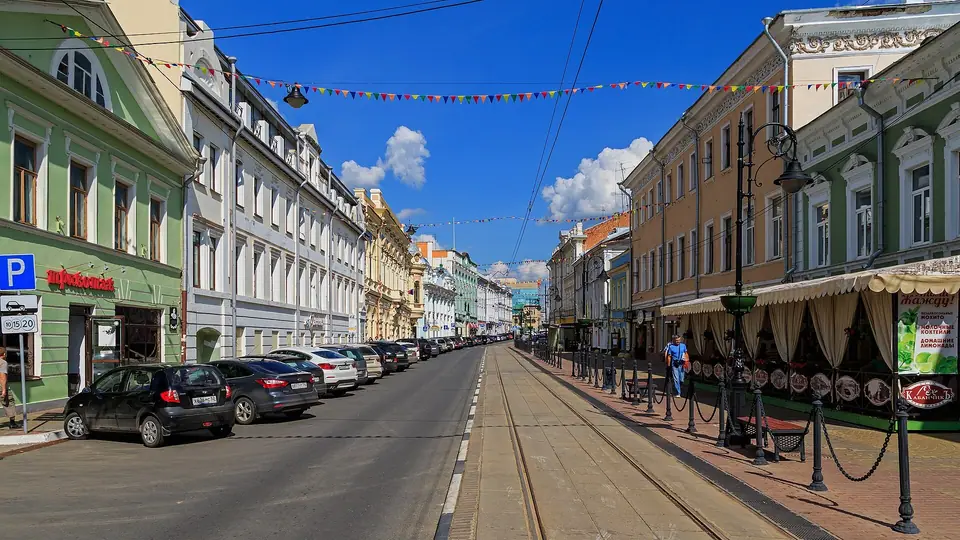
Running parallel to the river between the lower slopes of the city bluffs and the harbour wharves, Rozhdestvenskaya Street served as the financial engine of Nizhny Novgorod. When regional commerce expanded across the Oka River, salt magnates, banking dynasties, shipping lines, and grain dealers erected grand brick warehouses and stone offices here. Today this lower district preserves 35 protected architectural monuments. The thoroughfare connects National Unity Square below the Ivanovskaya Tower with Alexander Nevsky Square near the Kanavinsky Bridge. Visitors exploring the neighbourhood encounter carved limestone facades, ironwork balconies, historic tram tracks, and steep footpaths climbing up to the bluffs of Fedorovsky Embankment.
A well-planned walking route through the Lower Posad pairs commercial history with Russian church architecture. It connects directly with itineraries outlined in our Nizhny Novgorod 3-Day Itinerary. Taking time to inspect the intricate details of merchant residences reveals how trade transformed this riverfront during the imperial period.
The 1719 Stroganov Church and National Unity Square
At the eastern threshold of the street on National Unity Square stands the Church of the Nativity of John the Baptist on the Torg. Rebuilt in stone between 1676 and 1683, it marks the historic assembly ground where Kuzma Minin rallied the townspeople during the Time of Troubles. In front of the sanctuary stands a bronze replica of the monument to Minin and Pozharsky. Heading west, travellers pass the Blinov Passage, constructed during the 1870s at number 24, as well as several landmark properties once owned by the merchant Bugrov family.
The visual focal point of the lower street is the Church of the Nativity of the Blessed Virgin Mary at 34 Rozhdestvenskaya Street. Universally referred to as the Stroganov Church, the complex was commissioned in 1696 by the wealthy salt industrialist Grigory Dmitrievich Stroganov. Following his death, his widow Maria Yakovlevna oversaw the completion of the structure, which Archbishop Pitirim consecrated on 21 June 1719. It stands as a premier example of the Stroganov Baroque style. Intricate white limestone tracery wraps around the deep red-brick exterior walls, framing windows, entry portals, and columns with carvings of grapevines and floral patterns. Five onion domes decorated with swirling multi-coloured patterns rise above the roofline. An octagonal bell tower carries a mechanical clock restored in the late nineteenth century under architects Lev Dahl and Robert Kilevain.
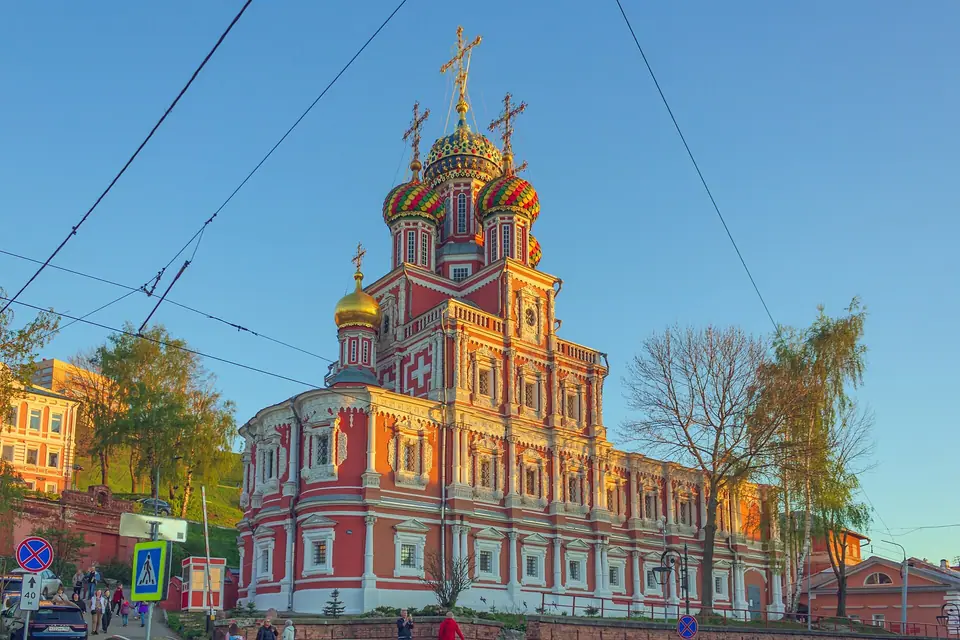
During the Soviet antireligious campaigns of the 1930s, the Stroganov Church was preserved from demolition largely through the documented efforts of Father Sergius Veisov. Inside, the sanctuary houses an original carved iconostasis that survived centuries of river damp and political upheaval. Travellers entering the building should observe traditional Russian Orthodox dress standards, which are detailed in our guide on What to Wear in Nizhny Novgorod. Respectful clothing ensures comfortable access to active parish spaces.
Lower Posad Architecture and Historic Tram Tracks
Landscaped extensively in 2012, Rozhdestvenskaya Street features wide stone pavements and period cast-iron streetlamps. The route incorporates tracks for the city tram network, which originally began operating on 8 (20) May 1896 as one of the earliest electric systems in Russia. Historic tram line 11 runs down the centre of the avenue during the warmer months, linking riverfront stops with the bluffs above. Heritage rail transit provides an effortless connection to the broader transit network described in Getting Around Nizhny Novgorod.
Walking westward reveals the depth of commercial banking presence in imperial Nizhny Novgorod. Stately stone buildings housed shipping headquarters, flour brokerage offices, and private banks. These institutions financed the seasonal bulk trade crossing between European Russia and Central Asia. The street terminates near the 1221 Annunciation Monastery, which anchors the western bluff with its five-domed cathedral completed in 1649.
| District Landmark | Address or Location | Construction Era | Key Architectural Feature |
|---|---|---|---|
| Nativity of John the Baptist | National Unity Square | 1676 to 1683 | Stone parish church on the old marketplace |
| Stroganov Church | 34 Rozhdestvenskaya Street | 1696 to 1719 | Carved limestone filigree on red brick |
| Blinov Passage | 24 Rozhdestvenskaya Street | 1870s | Grand merchant arcade with brick styling |
| Annunciation Monastery | Western end of Rozhdestvenskaya | Founded 1221, cathedral 1649 | Riverside monastery with five-domed cathedral |
| Fedorovsky Embankment | Bluffs above Lower Posad | Laid out after 1834 | Multi-tiered viewing park above Oka-Volga confluence |
Ascending to Fedorovsky Embankment and River Panoramas
Behind the merchant facades of Rozhdestvenskaya Street, steep cobbled alleys and public staircases climb 80 metres up the bluffs to Fedorovsky Embankment. Laid out originally following orders issued after 1834 and formally named in 1963, this terrace crowns the steep hillside overlooking the confluence of the Oka and Volga rivers. A major landscape redesign completed for the city octocentenary in 2021 transformed the ridge into a terraced public park with wooden lounge platforms, paved belvederes, and sweeping sunset lookouts.
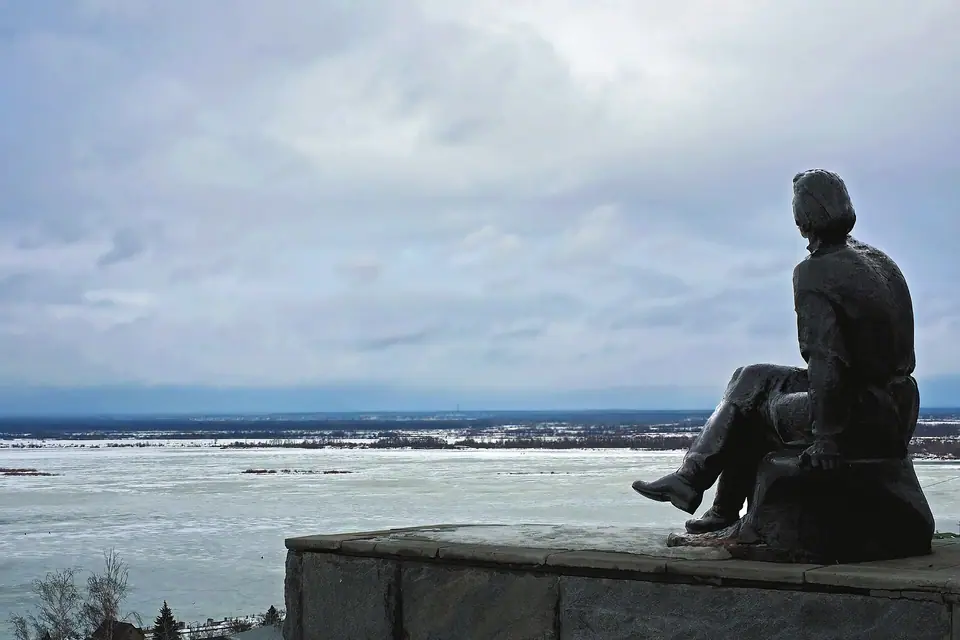
Perched upon the highest crest of the embankment stands the dark bronze statue of Maxim Gorky, sculpted by Vera Mukhina and erected in 1972. The monument depicts the author seated in contemplation, looking out across the vast expanses of the lower river plain. From this vantage, visitors look across to the Strelka Spit, where the iron-framed Pakgauzy pavilions and the Alexander Nevsky Cathedral stand above the water. A footbridge links the slopes across deep gullies, connecting Fedorovsky Embankment directly toward the upper ramparts of the Nizhny Novgorod Kremlin.
Visiting the embankment during late afternoon allows you to watch twilight fall over the river basin. Long summer evenings in June and July provide warm daylight until late, with afternoon temperatures averaging 22 to 25 degrees. In contrast, winter journeys between December and February bring freezing conditions down to minus 11 degrees. Sturdy footwear helps navigate the stairs between the river level and the bluffs when frost coats the slopes. Travellers seeking accommodation nearby will find convenient riverfront and bluff options reviewed in Where to Stay in Nizhny Novgorod.
Where it is
- 1Rozhdestvenskaya Street, Stroganov Church and Fedorovsky Embankment
- Nizhny Novgorod / Strigino International Airport (GOJ) · about 17 km from here in a straight line
- Directions in Google Maps
Stations and taxi ranks: OpenStreetMap. Airports: OurAirports. Distances are in a straight line.
Traveller tips
Real advice from people who have been to Nizhny Novgorod. Every tip is read by our team before it goes live.
No tips yet. Been here? Yours could be the first.
Thank you! Your tip will appear here after a quick review.
More in Nizhny Novgorod
Continue exploring Nizhny Novgorod with related neighbourhood, food, and planning guides
Chkalov Stairs and Upper Volga Embankment: Mansions and River Panoramas
Nizhny Novgorod, Russia
Bolshaya Pokrovskaya Street and the 1913 State Bank
Nizhny Novgorod, Russia
Strelka Spit: Alexander Nevsky Cathedral, Pakgauzy and Fairgrounds
Nizhny Novgorod, Russia
Volga Aerial Cable Car to Bor and Pechersky Ascension Monastery
Nizhny Novgorod, Russia
