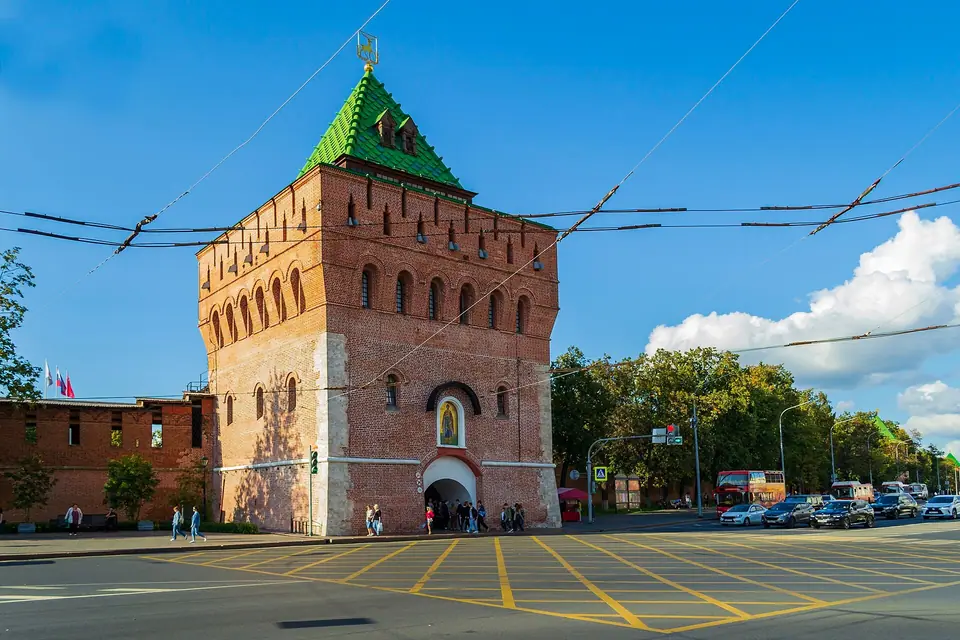
Photo: Алексей Трефилов · CC BY-SA 4.0
Things to Do in Nizhny Novgorod: Kremlin Walls, River Lookouts and Fairgrounds
Discover things to do in Nizhny Novgorod across the Kremlin bluffs, Upper Volga Embankment, Rozhdestvenskaya Street, and the Volga cable car with our verified guide.
Nizhny Novgorod rewards travellers who navigate its steep topography and nineteenth-century merchant quarters overlooking the Oka and Volga rivers. Grand Prince Yuri II Vsevolodovich founded the settlement in 1221 at this vital river confluence. The city splits into two distinct levels. The Upper Town occupies bluffs rising 80 metres on the right bank of the Oka, while the Lower Town stretches across the flat western plain. Most historic landmarks sit within walking distance of Minin and Pozharsky Square or across the bridges toward the Strelka cape.
Upper Town Fortifications and River Promenades
The red-brick fortress of the Nizhny Novgorod Kremlin forms the historic heart of the city. Italian architect Pietro Francesco directed its construction between 1500 and 1515, completing a formidable defensive ring designed to withstand regional sieges. The complex incorporates 13 surviving towers across a circuit measuring 2,045 metres. Visitors can explore the preserved battlements and visit the tent-roofed Archangel Michael Cathedral, which was consecrated in 1631 and contains the tomb of national hero Kuzma Minin. Detailed walking strategies for the ramparts are covered in our guide to the Nizhny Novgorod Kremlin towers and Archangel Cathedral.
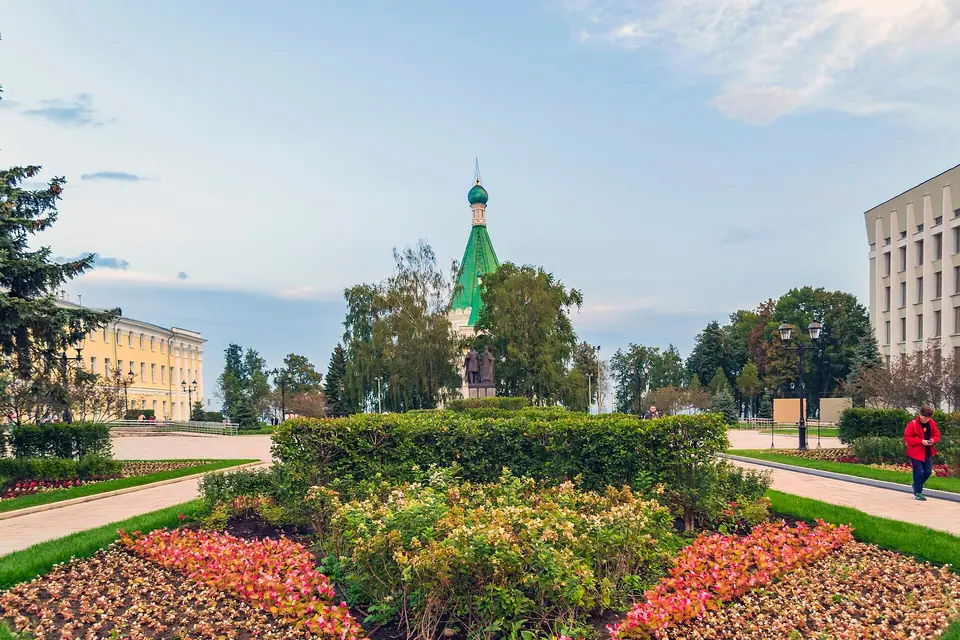
East of the fortress, the Upper Volga Embankment extends 1.75 kilometres from Minin and Pozharsky Square to Sennaya Square. Tsar Nicholas I ordered the construction of this cliffside terrace in 1834, and municipal teams paved it by 1836. The promenade offers panoramic views across the Volga water meadows and displays ornate merchant architecture. Notable facades include the eclectic Rukavishnikov Mansion at number 7, completed in 1877, and the neoclassical Sirotkin House at number 3, built between 1913 and 1916 by the Vesnin brothers.
Connecting the clifftop with the water level below, the monumental Chkalov Stairs and Upper Volga Embankment create a dramatic riverside descent. Architects Alexander Yakovlev, Lev Rudnev, and Vladimir Munts designed the staircase between 1943 and 1949. Shaped in sweeping figure-eight curves, the structure contains two observation platforms, 442 steps down the right branch, and 560 steps across both sides combined. At the crest stands the 1940 bronze monument honoring test pilot Valery Chkalov. At the bottom, the steps terminate at the Kater Geroy boat monument on the Lower Volga Embankment.
Historic Merchant Boulevards and Lower Terraces
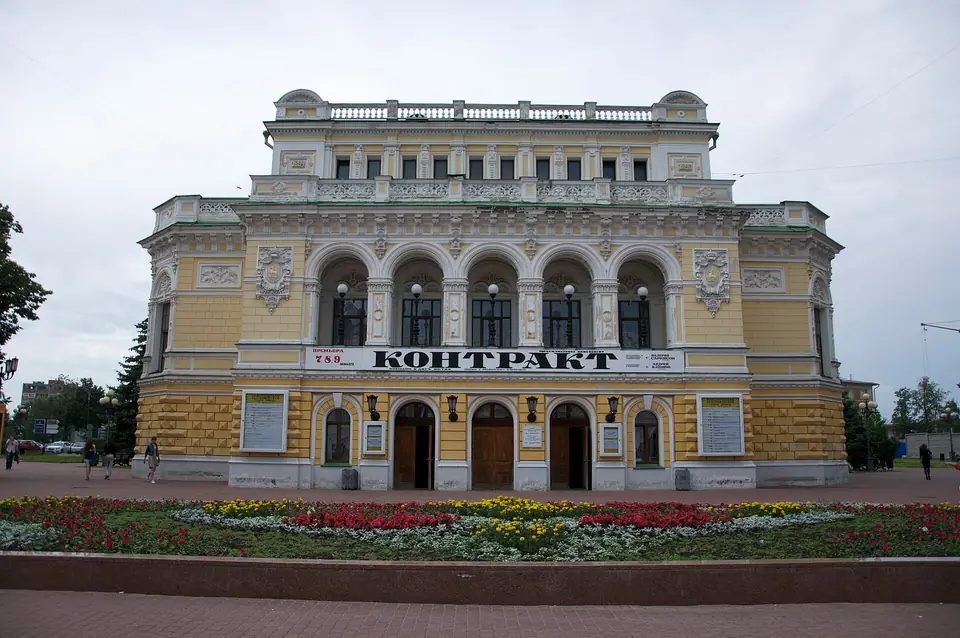
Bolshaya Pokrovskaya Street serves as the main pedestrian spine of the Upper Town, running 2,232 metres from Minin and Pozharsky Square toward Gorky Square. A section measuring 1,236 metres was closed to motor traffic during the 1980s. Walking past the bronze municipal statues, travellers encounter the 1896 Drama Theatre designed by Viktor Schröter and the 1826 Noble Assembly. The street also features the Neo-Russian State Bank at number 26, constructed between 1911 and 1913 for the Romanov Tercentenary. Architectural highlights along this avenue appear in our feature on Bolshaya Pokrovskaya Street and the State Bank.
Down on the river terrace below the Kremlin, Rozhdestvenskaya Street preserves 35 protected architectural monuments. The most striking structure is the Stroganov Church of the Nativity of the Blessed Virgin Mary at number 34. Consecrated on 21 June 1719, the building showcases ornate white-stone carvings, multicoloured domes, and an adjoining clock tower. Fedorovsky Embankment rises above the street along the terrace slopes, offering expansive vantage points over the river mouth.
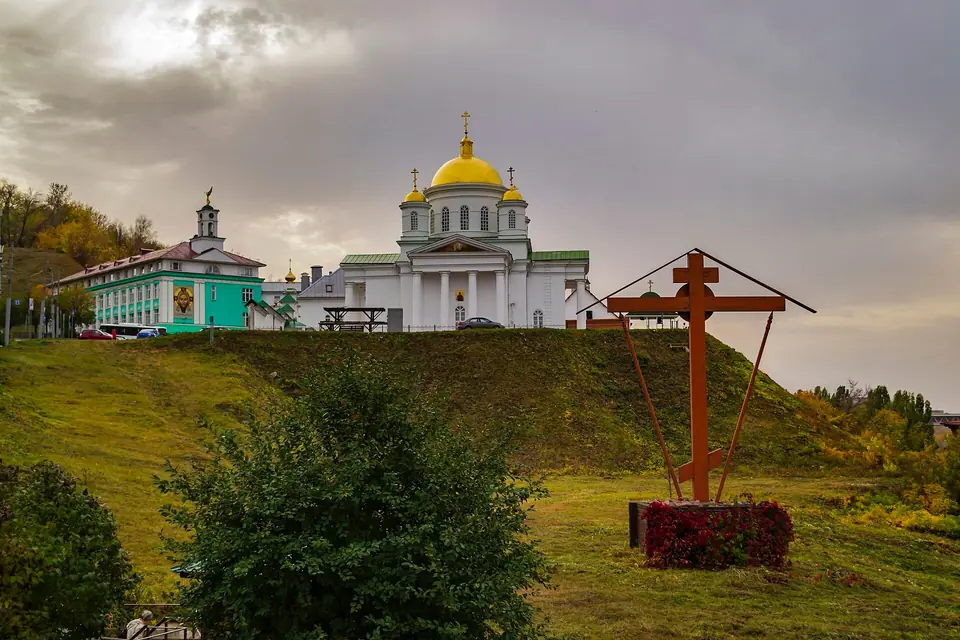
Beyond the central core, the Pechersky Ascension Monastery sits on the green slopes of Privolzhskaya Sloboda. Saint Dionysius of Suzdal founded the original community between 1328 and 1330. Following a devastating landslide on 18 June 1597, builders relocated the monastery one kilometre upstream. The site contains the 1632 five-domed Ascension Cathedral and historic monastic quarters.
Confluence Panoramas and Trans-Volga Transit
Across the Oka River, the triangular Strelka Spit marks the junction where the Oka empties into the Volga. The skyline is anchored by the 87-metre Alexander Nevsky Cathedral, built between 1868 and 1881 by architect Lev Dahl. Directly behind the cathedral stand the open-work iron Pakgauzy pavilions. Originally engineered for the 1882 Moscow Exhibition and relocated for the 1896 All-Russia exhibition in Nizhny Novgorod, these structures were uncovered in 2015 and now serve as modern concert and gallery halls. Modern sporting events take place next door at the 44,899-seat Nizhny Novgorod Stadium.
To cross the broad Volga waterway, visitors can board the aerial cableway connecting Nizhny Novgorod with the town of Bor. Operational since 9 February 2012, this cable car spans 3,660 metres on 10 support pylons. Two 82-metre steel masts support an unsupported water span of 882 metres over the Volga, ranking among the longest over-water crossings in Europe. The crossing takes 13 minutes in eight-passenger cabins, offering views of the river traffic and distant monastery domes. Travellers planning multi-day stays should consult our Nizhny Novgorod 3-day itinerary to organise these crossings efficiently.
Core Sights Geographic Orientation
| District or Area | Key Landmark | Architectural or Historical Era | Primary Setting |
|---|---|---|---|
| Upper Town Ridge | Nizhny Novgorod Kremlin | 1500 to 1515 Italian brick fortification | 80-metre bluff over Oka-Volga confluence |
| Volga Cliffside | Chkalov Stairs | 1943 to 1949 monumental staircase | Slope between Upper and Lower Volga Embankments |
| Central Pedestrian Spine | Neo-Russian State Bank | 1911 to 1913 Romanov Tercentenary | Pedestrian Bolshaya Pokrovskaya Street |
| Merchant Quarter | Stroganov Nativity Church | 1696 to 1719 Stroganov Baroque | Lower Town river terrace at Rozhdestvenskaya |
| Strelka Peninsula | Alexander Nevsky Cathedral and Pakgauzy | 1881 cathedral and 1882 iron pavilions | Confluence spit between Oka and Volga rivers |
Seasonal Planning and Daily Flow
Navigating Nizhny Novgorod requires accounting for river winds and steep elevation changes. Open-Meteo climate records from 2015 to 2024 indicate warm summer temperatures, with July averaging daily highs of 24.9°C and lows of 15.5°C across 10 wet days. Summer visitors can walk the outdoor embankments and Kremlin battlements comfortably. Winters are cold and snowy, with January recording average highs of -6.5°C, lows of -11.6°C, and 17 days of precipitation. Ice forms quickly along the Chkalov Stairs and the stone ramps leading down to Rozhdestvenskaya Street. Sturdy footwear is essential when exploring the hills, and public transit schedules should be verified locally across seasonal shifts.
Where it is
- 1Nizhny Novgorod
- Nizhny Novgorod / Strigino International Airport (GOJ) · about 18 km from Nizhny Novgorod in a straight line
- Directions in Google Maps
Stations and taxi ranks: OpenStreetMap. Airports: OurAirports. Distances are in a straight line.
Traveller tips
Real advice from people who have been to Nizhny Novgorod. Every tip is read by our team before it goes live.
No tips yet. Been here? Yours could be the first.
Thank you! Your tip will appear here after a quick review.
More in Nizhny Novgorod
Continue exploring Nizhny Novgorod with related neighbourhood, food, and planning guides
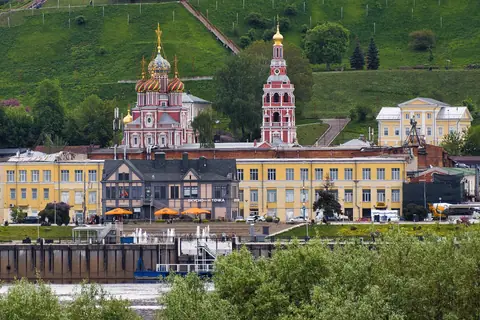
Rozhdestvenskaya Street, Stroganov Church and Fedorovsky Embankment
Nizhny Novgorod, Russia
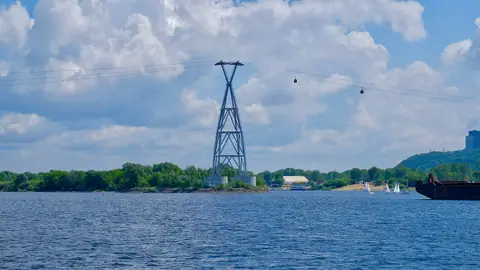
Volga Aerial Cable Car to Bor and Pechersky Ascension Monastery
Nizhny Novgorod, Russia
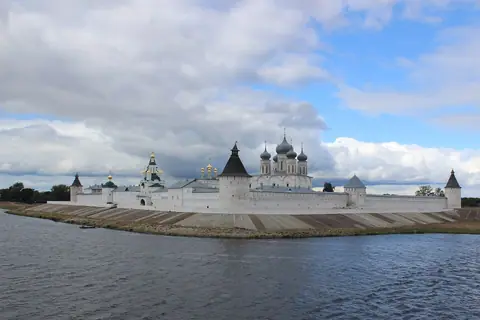
Day Trips from Nizhny Novgorod: Gorodets, Makaryev and Shukhov Tower
Nizhny Novgorod, Russia
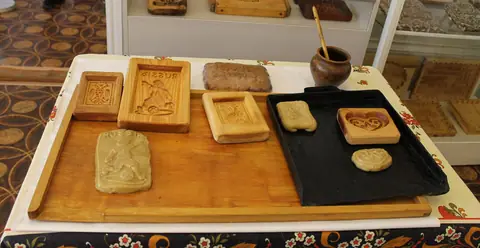
What to Eat in Nizhny Novgorod: Volga Fish, Ukha and Gorodets Pryanik
Nizhny Novgorod, Russia
