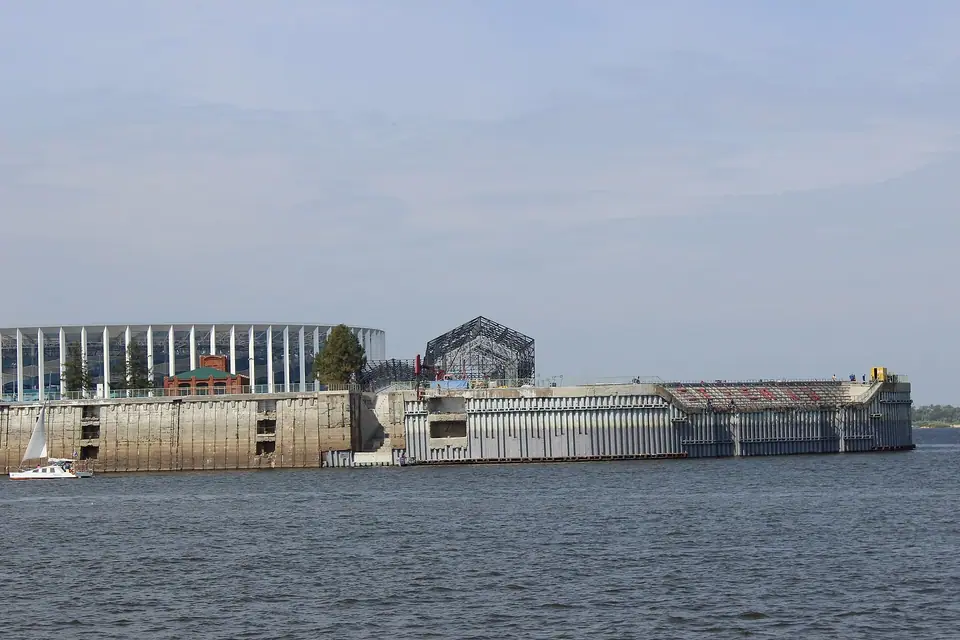
Photo: Olga-lisenkova · CC BY-SA 4.0
Strelka Spit: Alexander Nevsky Cathedral, Pakgauzy and Fairgrounds
Discover Nizhny Novgorod's Strelka Spit at the Oka and Volga confluence, home to the 87-metre Alexander Nevsky Cathedral, historic Pakgauzy halls, and Fairgrounds.
Projecting like a triangular prow into the confluence where the Oka flows into the Volga, the Strelka Spit forms one of the most distinctive geographic landmarks in European Russia. From 1817, this spit served as the primary shipping harbour and transhipment wharf of the famed Nizhny Novgorod Fair. Steamboats and timber barges unloaded tea from China, iron from the Urals, Persian silk, cotton, and grain along its banks. During the Soviet period, authorities converted the spit into a secure cargo port, walling off public river access behind industrial warehouses. Major infrastructure upgrades for the 2018 FIFA World Cup and the city octocentenary in 2021 transformed this former shipping depot into an open public promenade with panoramic views across the water towards the Nizhny Novgorod Kremlin and the scenic lookouts of Fedorovsky Embankment.
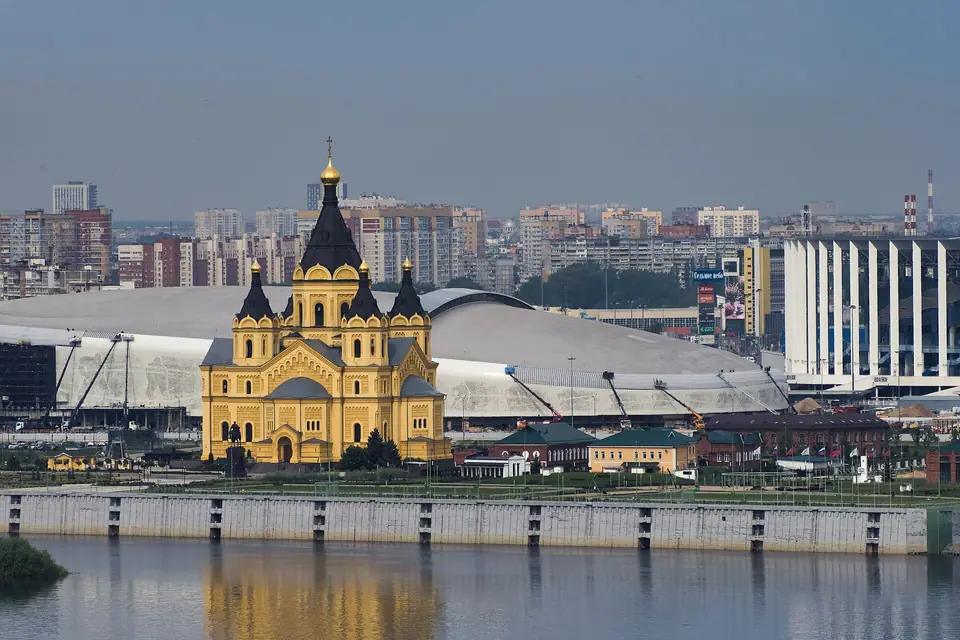
Alexander Nevsky Cathedral on Strelka Street
Rising commandingly at 3a Strelka Street, the yellow-brick Cathedral of Saint Alexander Nevsky stands as the tallest ecclesiastical building in Nizhny Novgorod. Known historically as the New Fair Cathedral, the structure was commissioned by wealthy merchants who sought a monumental worship space directly adjacent to the shipping wharves. Architect Lev Dahl designed the church, which was erected between 1868 and 1881 and consecrated on 20 July 1881. The massive five-tented central tower reaches 87 metres high, ranking it as the third-tallest Orthodox cathedral in the country. Its unusual floor plan eliminated interior dividing columns to accommodate massive trade fair crowds, using clever engineering arches to carry the roof weight. Visitors exploring the interior can admire extensive fresco restorations that re-create the nineteenth-century merchant heritage of Nizhny Novgorod.
The 1896 Industrial Ironwork of the Pakgauzy
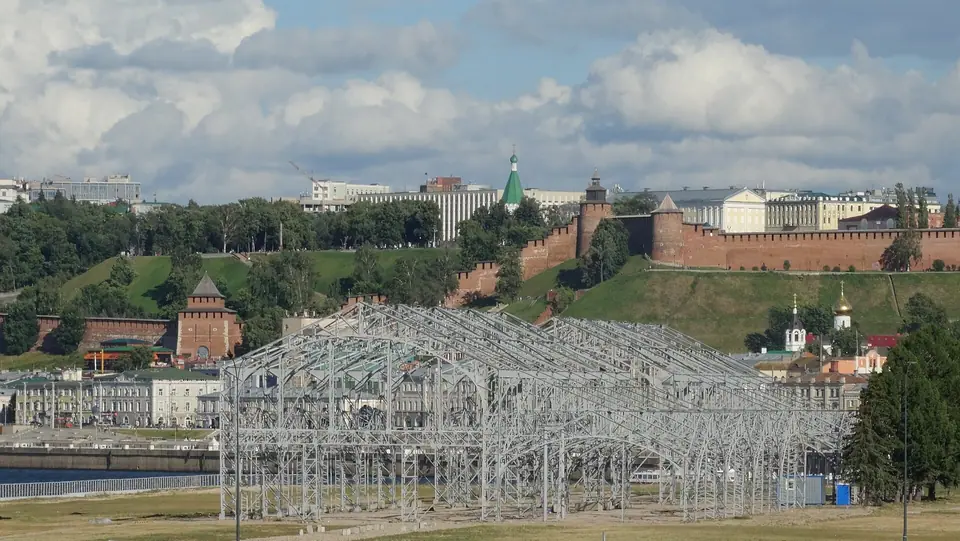
At 21 Strelka Street, directly on the waterfront edge of the spit, stand two remarkable open-work metal pavilions known locally as the Pakgauzy. These intricate cast-iron frames possess a complex architectural lineage. Engineers originally erected them in 1882 for the All-Russia Industrial and Art Exhibition in Moscow. In 1896, workers transported the structures to Nizhny Novgorod to serve as central halls for the XVI All-Russia Exhibition. After the exhibition closed, port authorities dismantled the framework, reassembled it at the Strelka wharves, and enclosed the metal behind plain brick and corrugated sheets to use as standard freight sheds. Researchers uncovered the historic ironwork by chance in 2015 during pre-tournament clearance works. In 2022, urban architects converted the restored iron skeletons into twin glass-enclosed cultural facilities: a concert hall with river views and an art exhibition space.
Nizhny Novgorod Stadium and Riverbank Landscapes
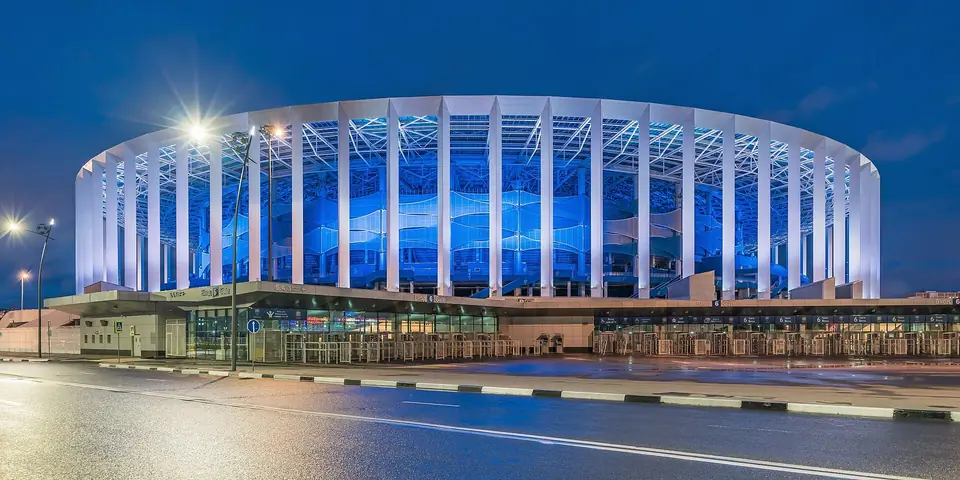
Adjacent to the open-work iron pavilions stands the 44,899-seat Nizhny Novgorod Stadium. Built between 2015 and 2018 to host matches for the 2018 FIFA World Cup, the arena features a circular colonnade inspired by the natural wind and water currents around the Volga river basin. The broad concrete esplanades surrounding the stadium link smoothly into landscaped walking paths, tiered river lookouts, and recreational lawns. Pedestrians can walk directly from the stadium concourse down to the waterline, observing where the darker waters of the Oka merge into the wider current of the Volga. The vast waterfront promenade serves as a prime vantage point during summer evenings, when sunsets illuminate the red brick Kremlin walls on the opposite bluffs.
The Fairgrounds District and Transfiguration Cathedral
A short walk westward from the spit leads into the historic Fairgrounds district, where the Nizhny Novgorod Fair operated after transferring from the Makaryev Monastery in 1817. The district preserves two major architectural landmarks from this commercial golden age. The oldest is the Transfiguration Cathedral, commonly referred to as the Old Fair Cathedral, built between 1818 and 1822 under the direction of engineers Auguste de Montferrand and Agustin de Betancourt. Its neoclassical porticoes and balanced domes set the tone for the surrounding streets. Nearby stands the Neo-Russian Main Fair Building, designed by architects Karl Treiman, Alexander von Gogen, and Alexei Trampitski in 1890. This ornate administrative palace once housed offices, trading rooms, and reception suites during peak trading seasons, and it now serves as a modern historical exhibition centre.
| Site Name | Street Address | Construction Period | Primary Architectural Feature |
|---|---|---|---|
| Alexander Nevsky Cathedral | 3a Strelka Street | 1868 to 1881 | 87-metre five-tented Neo-Russian tower |
| Pakgauzy Cultural Pavilions | 21 Strelka Street | 1882 to 1896; 2022 | Exposed nineteenth-century open-work iron frame |
| Transfiguration Old Fair Cathedral | Proyezd Betankura | 1818 to 1822 | Neoclassical Empire stone porticoes |
| Main Fair Building | 13 Sovnarkomovskaya | 1890 | Grand Neo-Russian merchant exhibition halls |
Practical Access and Urban Planning
Accessing the Strelka district is straightforward thanks to public transport links developed across the Lower Town. Strelka Metro Station opened on 12 June 2018 as an extension of the Sormovsko-Meshcherskaya Line, depositing travellers within a short stroll of the stadium gates and the cathedral entrance. Those planning their transit across districts can review route details in our guide on getting around Nizhny Novgorod. When incorporating the spit into a broader touring schedule, we suggest following our Nizhny Novgorod 3-day itinerary, which combines the historic Fairgrounds with upper city viewpoints.
- Pack windproof outerwear during spring and autumn; Open-Meteo records show October average highs of 8.2 degrees and November averages hovering around 0.1 degrees, with biting river breezes.
- Examine the iron framework of the Pakgauzy from the river amphitheatre to view the original structural rivets set against the Kremlin hillside.
- Check the official cultural centre website in advance if you wish to attend an evening classical concert inside the glass-walled Pakgauzy auditorium.
- Walk westward toward Sovnarkomovskaya Street after visiting the cathedral to see how Betancourt planned the original fair layout.
Where it is
- 1Strelka Spit
- Nizhny Novgorod / Strigino International Airport (GOJ) · about 16 km from here in a straight line
- Directions in Google Maps
Stations and taxi ranks: OpenStreetMap. Airports: OurAirports. Distances are in a straight line.
Traveller tips
Real advice from people who have been to Nizhny Novgorod. Every tip is read by our team before it goes live.
No tips yet. Been here? Yours could be the first.
Thank you! Your tip will appear here after a quick review.
More in Nizhny Novgorod
Continue exploring Nizhny Novgorod with related neighbourhood, food, and planning guides
Day Trips from Nizhny Novgorod: Gorodets, Makaryev and Shukhov Tower
Nizhny Novgorod, Russia

What to Eat in Nizhny Novgorod: Volga Fish, Ukha and Gorodets Pryanik
Nizhny Novgorod, Russia
How to Get to Nizhny Novgorod: Rail Terminals and Airport Arrivals
Nizhny Novgorod, Russia
Getting Around Nizhny Novgorod by Metro, Tram and Cable Car
Nizhny Novgorod, Russia
