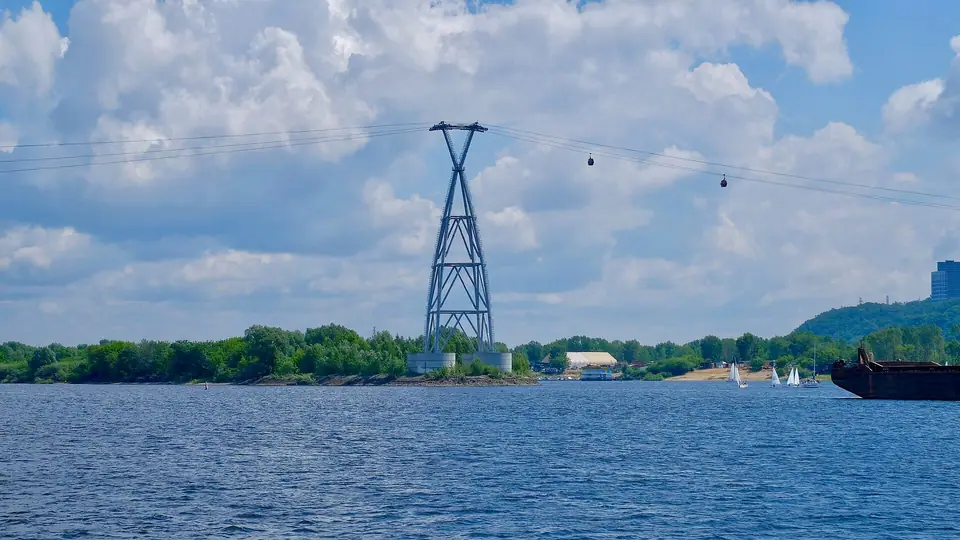
Photo: Vyacheslav Bukharov · CC BY-SA 4.0
Volga Aerial Cable Car to Bor and Pechersky Ascension Monastery
Plan your trip across the Volga River on the Nizhny Novgorod to Bor aerial cable car and explore the historic Pechersky Ascension Monastery on the riverbank bluff.
At the eastern terminus of the 1.75-kilometre Chkalov Stairs and Upper Volga Embankment near Sennaya Square, two contrasting landmarks share the right-bank river bluffs. High on the crest stands the departure terminal for the aerial cableway connecting Nizhny Novgorod to Bor. Down on the sheltered river slope below sits the white-walled Pechersky Ascension Monastery. Combining both sites creates a practical half-day excursion that pairs modern transit engineering with fourteenth-century monastic heritage.
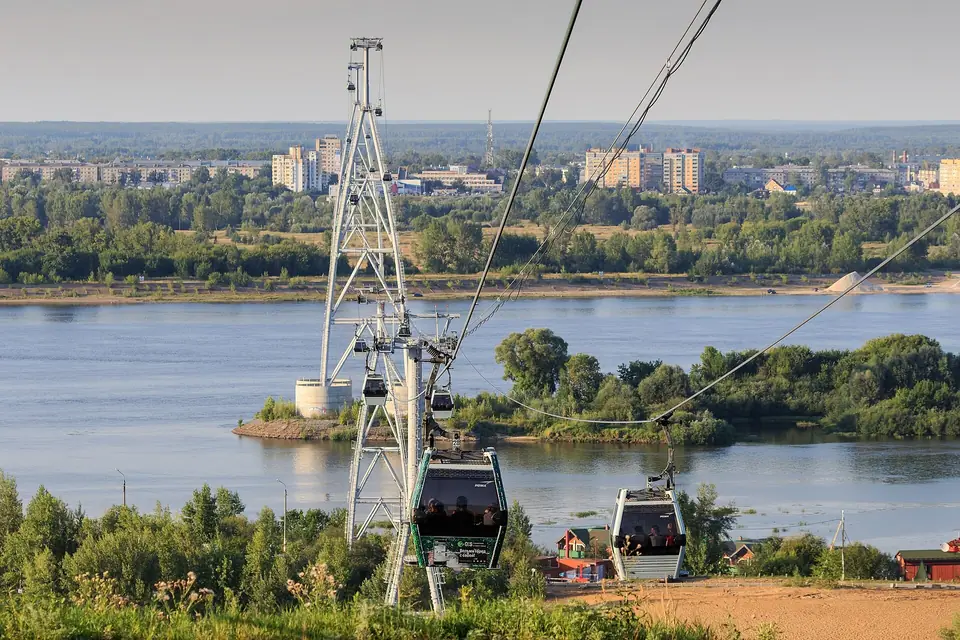
Engineering of the 3,660-Metre Aerial Cableway to Bor
The Nizhny Novgorod to Bor aerial cableway opened on 9 February 2012. It serves as both a commuter connection across the Volga and a scenic crossing for travellers. The total line stretches 3,660 metres between Nizhegorodskaya Station on Kazanskaya Embankment and Borskaya Station on the left bank in Bor. The route relies on ten steel support towers. The central engineering feat is a pair of 82-metre masts anchored on opposing shores of the main shipping channel. These pylons support an unsupported water span of approximately 882 metres directly above the river.
Eight-passenger cabins glide across the water at a steady clip. A one-way journey takes approximately 13 minutes from platform to platform. Passengers float high above the Grebnoy Canal, commercial river barges, and the sprawling alluvial plains of the Bor riverbank. Because thousands of regional commuters rely on the line for daily work trips, lines peak in the early morning and late afternoon on weekdays. Planning a crossing during the middle of the day reduces wait times substantially. Wind speeds above operational safety thresholds will trigger temporary system shutdowns, so consult real-time operator notices before setting out.

Visiting Pechersky Ascension Monastery Below the Bluffs
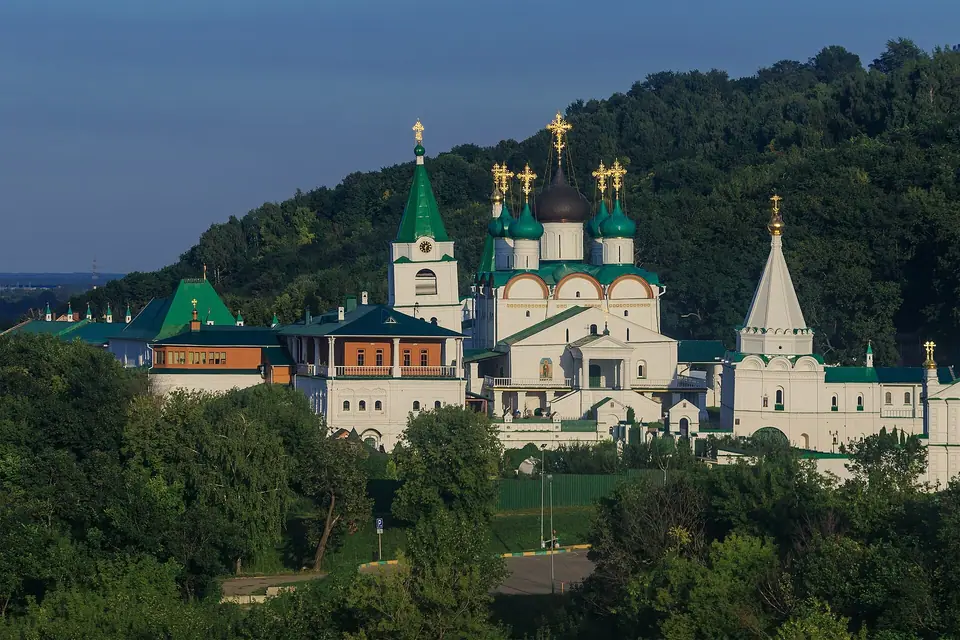
Directly beneath the bluff east of Sennaya Square stands the Pechersky Ascension Monastery at 108 Privolzhskaya Sloboda. Saint Dionysius of Suzdal founded the original cloister between 1328 and 1330. It quickly became one of the most influential spiritual centres in eastern Rus. In 1377, the monk Laurentius copied the famous Laurentian Chronicle within these walls, preserving the oldest extant manuscript of the Primary Chronicle. That historic foundation stood slightly downstream until 18 June 1597, when a massive hillside landslide destroyed the wooden compound. The monks subsequently relocated the complex one kilometre upstream to its current, more stable terrace.
The rebuilt stone ensemble dates from the seventeenth century. Master builders erected the five-domed Ascension Cathedral between 1630 and 1632, flanked by a leaning bell tower that tilts noticeably towards the river slope. Additional stone churches, including the Dormition Church and the Gate Church of the Holy Euphemius, followed across the 1640s. Heavy defensive stone walls with corner turrets encircle the grounds, shielding peaceful fruit orchards and monastic workshops from modern road noise. Modest dress is expected on the grounds. Review current regional dress standards in our What to Wear in Nizhny Novgorod guide before descending into the complex.
Practical Route Planning and Terrain Navigation
Navigating between the cable car station and the monastery requires negotiating significant elevation changes. The Upper Town bluffs rise roughly 80 metres above the water line. A paved footpath with stone steps descends from the upper rim down through the wooded ravine towards Privolzhskaya Sloboda. The climb back up to Sennaya Square can test physical stamina, particularly during the humid summer months or across icy winter paving. Taxis and local public buses run along the lower riverbank and upper avenues for travellers wishing to avoid steep ascents.
| Transit Segment | Starting Point | Arrival Point | Primary Feature |
|---|---|---|---|
| Aerial Cableway | Nizhegorodskaya Station | Borskaya Station (Bor) | 882-metre unsupported river span |
| Bluff Path Footpath | Sennaya Square Crest | Monastery Gatehouse | Steep wooded descent with stone steps |
| Upper Promenade Walk | Minin and Pozharsky Square | Kazanskaya Embankment | 1.75-kilometre paved blufftop route |
| Riverside Lower Road | Privolzhskaya Sloboda | Grebnoy Canal Embankment | Flat access road below the clay bluffs |
For citywide transit connections, consult our guide to Getting Around Nizhny Novgorod. Sennaya Square connects directly to major bus routes and tram corridors leading back into Minin and Pozharsky Square. Travellers mapping a wider multi-day circuit can incorporate this half-day itinerary into our suggested Nizhny Novgorod 3-Day Itinerary.
Seasonal Considerations Across the Volga
Weather conditions on the exposed river span change dramatically throughout the year. Based on ten-year climate data from 2015 to 2024, winter conditions bring deep freezes. January records average daily highs of -6.5°C and lows of -11.6°C, accompanied by 17 wet days. In February, averages reach highs of -5.2°C and lows of -10.9°C across 14 wet days. Stiff gusts sweeping down the frozen river channel enhance the chill. Cabins remain enclosed and wind-resistant, but platform queues require insulated footwear and windproof coats.
Spring thaw begins slowly in March, when temperatures reach 1.1°C by day and -5.1°C at night over 12 precipitation days. April warms briskly to an average high of 10.9°C and a low of 2.3°C across 10 wet days. Melting snow can make the ravine path below the monastery muddy and slippery, requiring sturdy grip soles. May offers comfortable conditions, averaging 18.7°C in the afternoon and 8.9°C overnight with 10 wet days.
Summer brings long daylight hours over the water. June averages 22.6°C by day and 13.2°C at night with 68 millimetres of rainfall over 11 wet days. July stands as the warmest month, recording daytime highs of 24.9°C and evening lows of 15.5°C, beside 74 millimetres of rain across 10 days. August maintains pleasant warmth with 22.7°C highs and 13.6°C lows across 10 wet days. Thunderstorms can occasionally disrupt cableway operations on hot July afternoons.
Autumn brings crisp visibility and turning foliage along the clay bluffs. September records average highs of 16.2°C and lows of 8.6°C over 11 wet days with 56 millimetres of rain. October cools to 8.2°C by day and 2.8°C at night across 13 wet days. November marks the return of freezing conditions, averaging 0.1°C by day and -3.8°C at night over 16 wet days. December closes the year with highs of -4.7°C, lows of -9.3°C, and 18 precipitation days. Checking wind forecasts before boarding ensures a smooth crossing in any season.
Where it is
- 1Nizhny Novgorod
- Nizhny Novgorod / Strigino International Airport (GOJ) · about 19 km from Nizhny Novgorod in a straight line
- Directions in Google Maps
Stations and taxi ranks: OpenStreetMap. Airports: OurAirports. Distances are in a straight line.
Traveller tips
Real advice from people who have been to Nizhny Novgorod. Every tip is read by our team before it goes live.
No tips yet. Been here? Yours could be the first.
Thank you! Your tip will appear here after a quick review.
More in Nizhny Novgorod
Continue exploring Nizhny Novgorod with related neighbourhood, food, and planning guides
Nizhny Novgorod: Geography, Districts and Seasons
Nizhny Novgorod, Russia
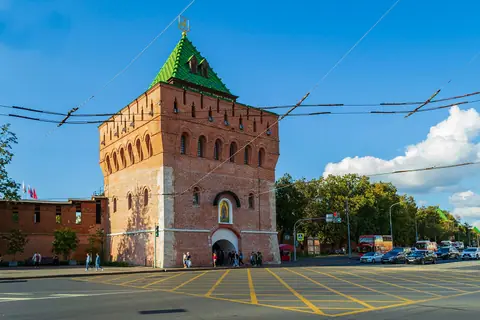
Things to Do in Nizhny Novgorod: Kremlin Walls, River Lookouts and Fairgrounds
Nizhny Novgorod, Russia
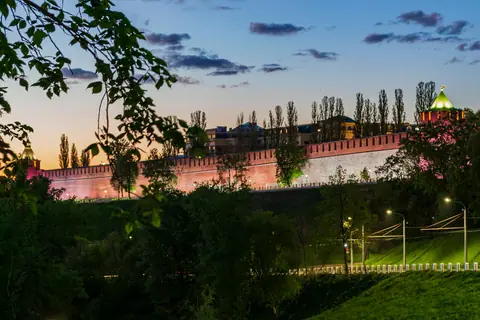
Nizhny Novgorod Kremlin: 13 Towers, Fortress Walls and Archangel Cathedral
Nizhny Novgorod, Russia
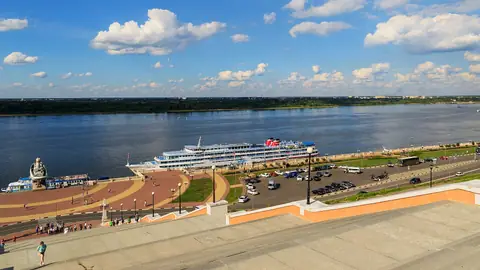
Chkalov Stairs and Upper Volga Embankment: Mansions and River Panoramas
Nizhny Novgorod, Russia
