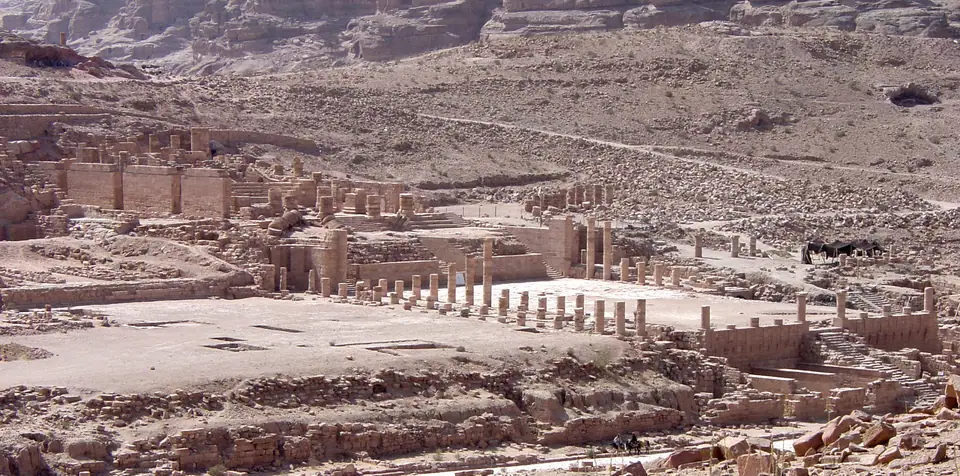
Photo: Michael Gunther · CC BY-SA 4.0
Colonnaded Street, Great Temple, Qasr al-Bint and Petra Museum Guide
Paved monumental thoroughfares connect colossal ancient temples and modern museum galleries along the civic spine of Petra.
Passing westward from the theatre, the valley basin opens into the historic civic centre of ancient Petra. The Colonnaded Street served as the principal commercial and ceremonial thoroughfare of the city. Flanked by limestone columns and paved walkways, it carried merchants, worshippers, and civil officials across the valley floor. Many travellers planning their wider itinerary balance this central architectural route with other active monuments across the valley before ascending the surrounding clifftops.
Walking along the flagstones reveals traces of lateral porticoes, public fountains, and market stalls that once lined the path. Drainage channels cut into the stone run alongside the curbs. They demonstrate the sophisticated water management systems that protected civic life during flash floods. Early starts along the King's Highway or from Amman align cleanly with regional coach and road arrivals before midday valley heat rises.
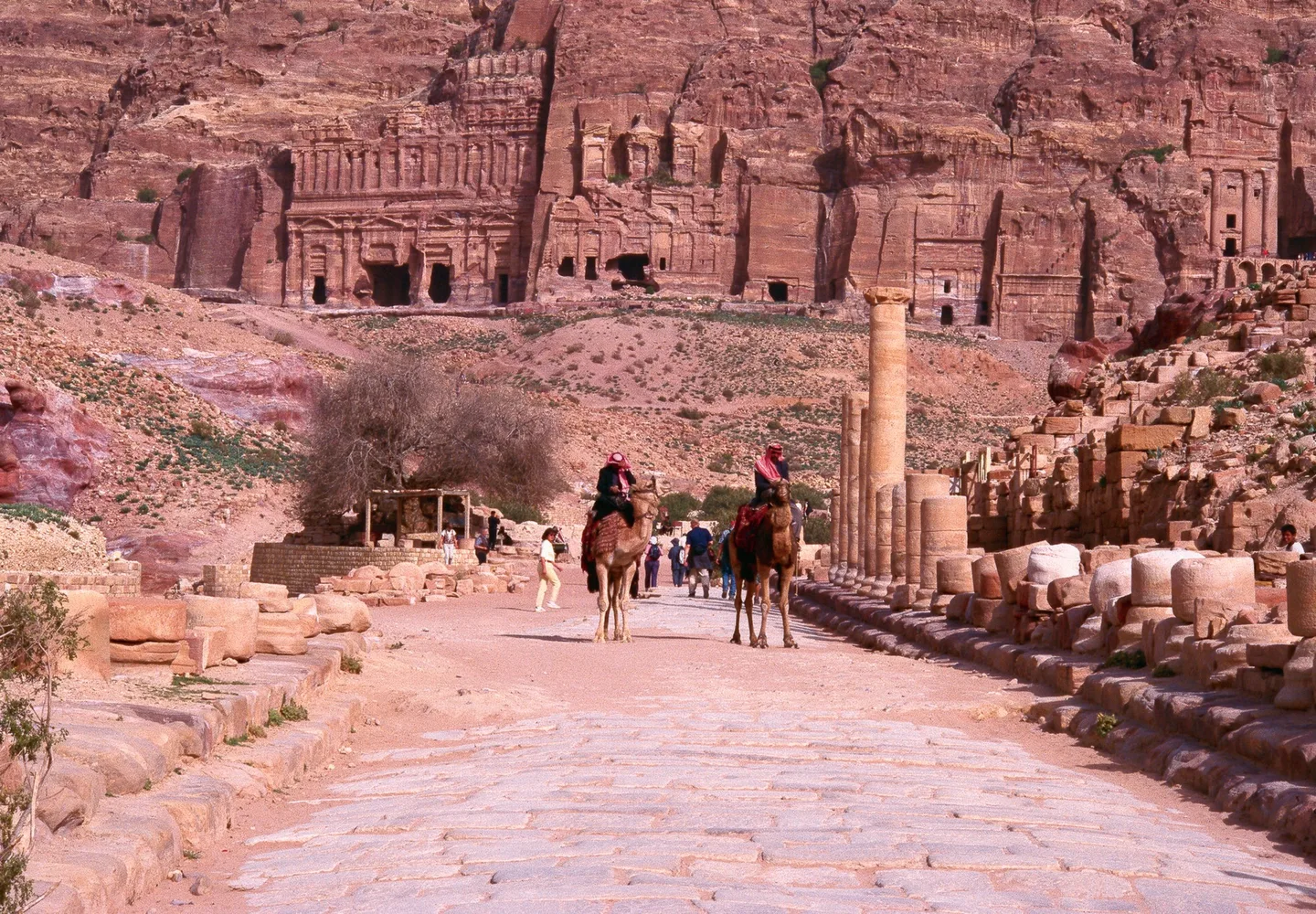
Walking the Colonnaded Street and Roman Civic Spine
The paved street stretches along the southern bank of the main wadi. It connects the central public sectors directly with the western sanctuary enclosures. Reconstructed sandstone columns line the southern side, giving a clear sense of the monumentality that defined the city during its classical era. The paving stones beneath your feet still bear shallow grooves carved by carriage wheels and pack animals from antiquity.
Walking westward keeps the dramatic sandstone crags of the western valley framing your forward view. Sandstone steps occasionally branch left towards elevated hillside residences and civic terraces. These flights allow visitors to appreciate the multi-tiered town planning of the ancient capital. Keep steady footwear on this stretch, as portions of the original paving remain smooth and uneven underfoot.
- Follow the southern paved walkway to observe the original limestone kerbs and carved water channels.
- Look out for stone bases of ancient shops that once traded frankincense, spices, and textiles.
- Pause near the monumental arched gateway that historically demarcated the profane civic street from the sacred precinct.
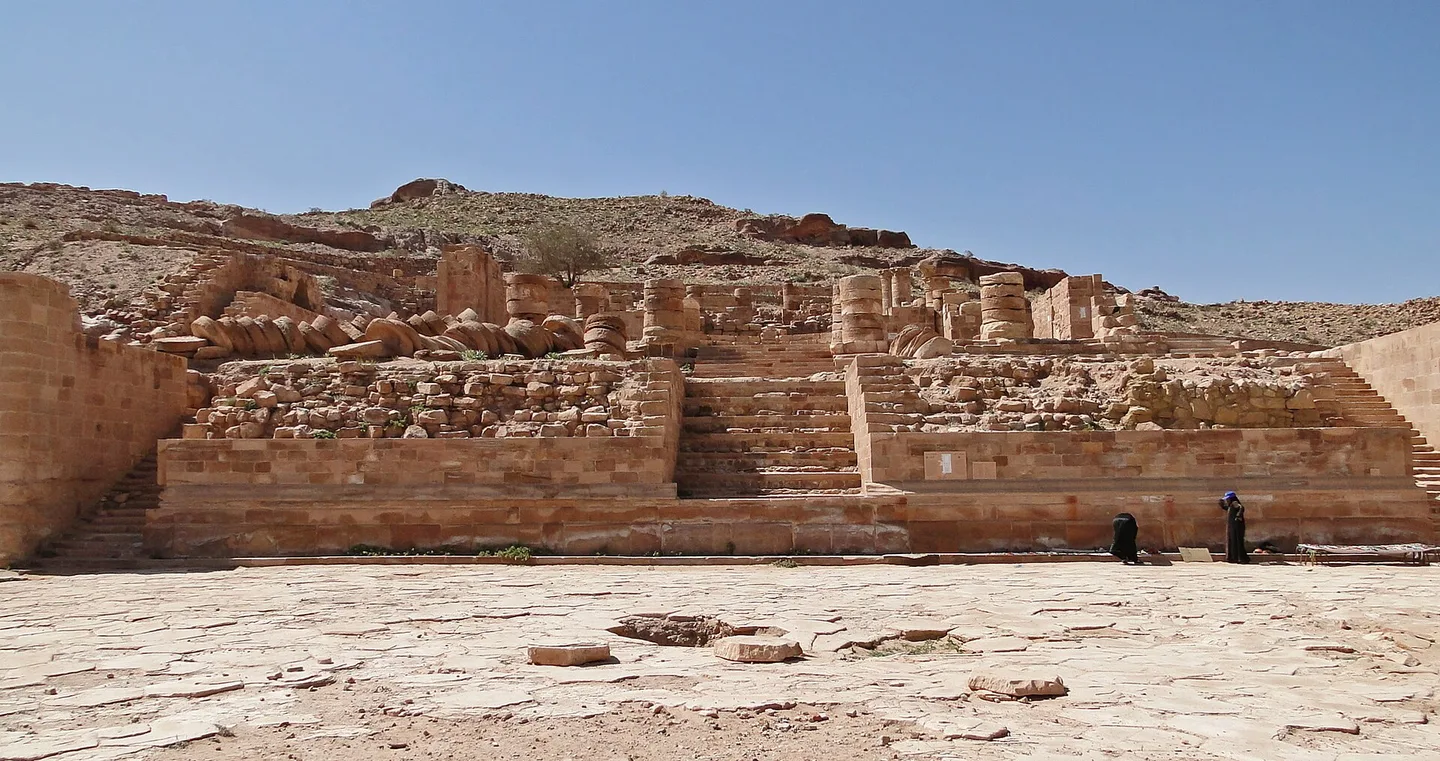
Exploring the Monumental Great Temple Complex
Rising south of the street, the Great Temple represents one of the largest freestanding architectural complexes surviving in central Petra. Ascending the monumental staircases brings you onto the Lower Temenos. This terrace was once flanked by twin colonnades featuring elaborately carved capitals. The elevated position offers expansive vistas across the riverbed towards the Royal Tombs cut into the eastern cliffs.
Further up the slope lies the Upper Temenos and the primary hall. This area includes a semi-circular council chamber or small indoor theatre. Scholars continue to debate whether this vast complex served primarily as a religious sanctuary, a royal audience hall, or an administrative civic forum. Elaborate stucco fragments, monumental columns, and vaulted subterranean cisterns point to extraordinary Nabataean engineering and decorative skill. Take care when navigating the stone steps and elevated stone walls, as edges are exposed and unprotected.
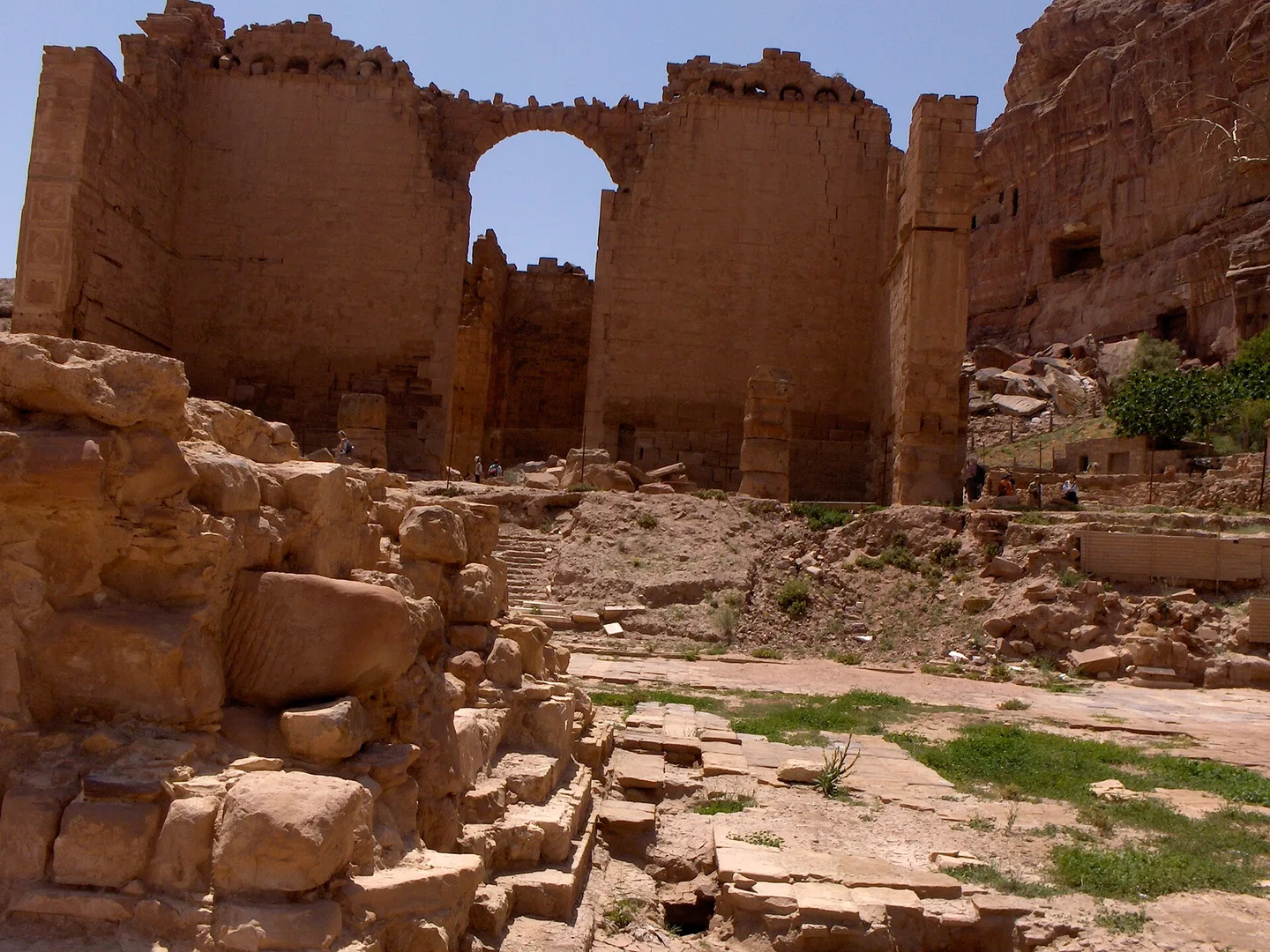
Qasr al-Bint and the Western Basin Temenos
At the western terminus of the thoroughfare stands Qasr al-Bint, the most substantial freestanding stone structure surviving in the entire archaeological park. Built from dressed yellow sandstone ashlar, this towering cubic temple reached impressive heights. It survived major earthquakes that flattened neighbouring colonnades. Its structural survival stems from timber string courses built into the thick walls, which absorbed destructive seismic shockwaves.
The temple was dedicated to Dushara, the principal Nabataean deity. It featured an expansive open-air courtyard with a monumental sacrificial altar facing its northern steps. Walking around the base allows you to admire surviving sections of moulded plaster friezes and grand pilasters that once covered the exterior stone walls. The open precinct here serves as an important junction point where paths diverge towards the hill trails or the museum facilities near the park boundary.
| Monuments and Galleries | Architectural Character | Key Highlight |
|---|---|---|
| Colonnaded Street | Paved public thoroughfare with flanking columns | Preserved Roman paving and carved drainage conduits |
| Great Temple | Multi-terraced administrative and sacred complex | Semi-circular indoor seating chamber and vaulted cisterns |
| Qasr al-Bint | Freestanding sandstone ashlar sanctuary | Earthquake-resistant timber framing inside masonry walls |
| Petra Museum | Contemporary interpretive museum galleries | Intact sculpture, inscribed pottery, and interactive displays |
The Petra Museum and Transition Beyond the Site
While the temples and streets occupy the heart of the ancient basin, the modern Petra Museum sits adjacent to the visitor centre entrance outside the gorge. Visiting this contemporary facility either before your walk or at the conclusion of your day gives valuable cultural context for the stone ruins. The climate-controlled exhibition halls display finely carved capitals, terracotta figurines, Nabataean ceramics, and bronze artefacts recovered during archaeological excavations.
Interactive displays explain the hydrology, trade networks, and linguistic heritage of the Nabataeans. They bring the sandstone architecture of the valley into sharp focus. Setting aside time to walk through the galleries helps piece together the domestic and ritual objects that once filled the empty stone chambers within the basin.
Official prices and opening hours
- Petra Archaeological Park Entry TicketsOfficial site ↗
- Jordan Pass (Includes Petra + 40 Sites)Official site ↗
Where it is
- 1Colonnaded Street, Great Temple, Qasr al-Bint and Petra Museum
- Ramon International Airport (ETM) · about 79 km from here in a straight line
- Directions in Google Maps
Stations and taxi ranks: OpenStreetMap. Airports: OurAirports. Distances are in a straight line.
Traveller tips
Real advice from people who have been to Petra. Every tip is read by our team before it goes live.
No tips yet. Been here? Yours could be the first.
Thank you! Your tip will appear here after a quick review.
More in Petra
Continue exploring Petra with related neighbourhood, food, and planning guides
Exploring Petra: Monuments, Ancient Trails, and Canyon Vistas
Petra, Jordan
Getting to Petra: Transit Routes from Amman, Aqaba, and Desert Borders
Petra, Jordan
Best Time to Visit Petra: Seasonal Weather, Crowds and Flash Floods
Petra, Jordan
What to Wear in Petra: Hiking Footwear, Sun Gear and Dress Codes
Petra, Jordan
