Photo: Dennis G. Jarvis · CC BY-SA 4.0
Street of Facades, Roman Theatre and Royal Tombs Walk in Petra
Sandstone pathways lead from the Outer Siq past the Roman Theatre directly to the monumental Royal Tombs in Petra.
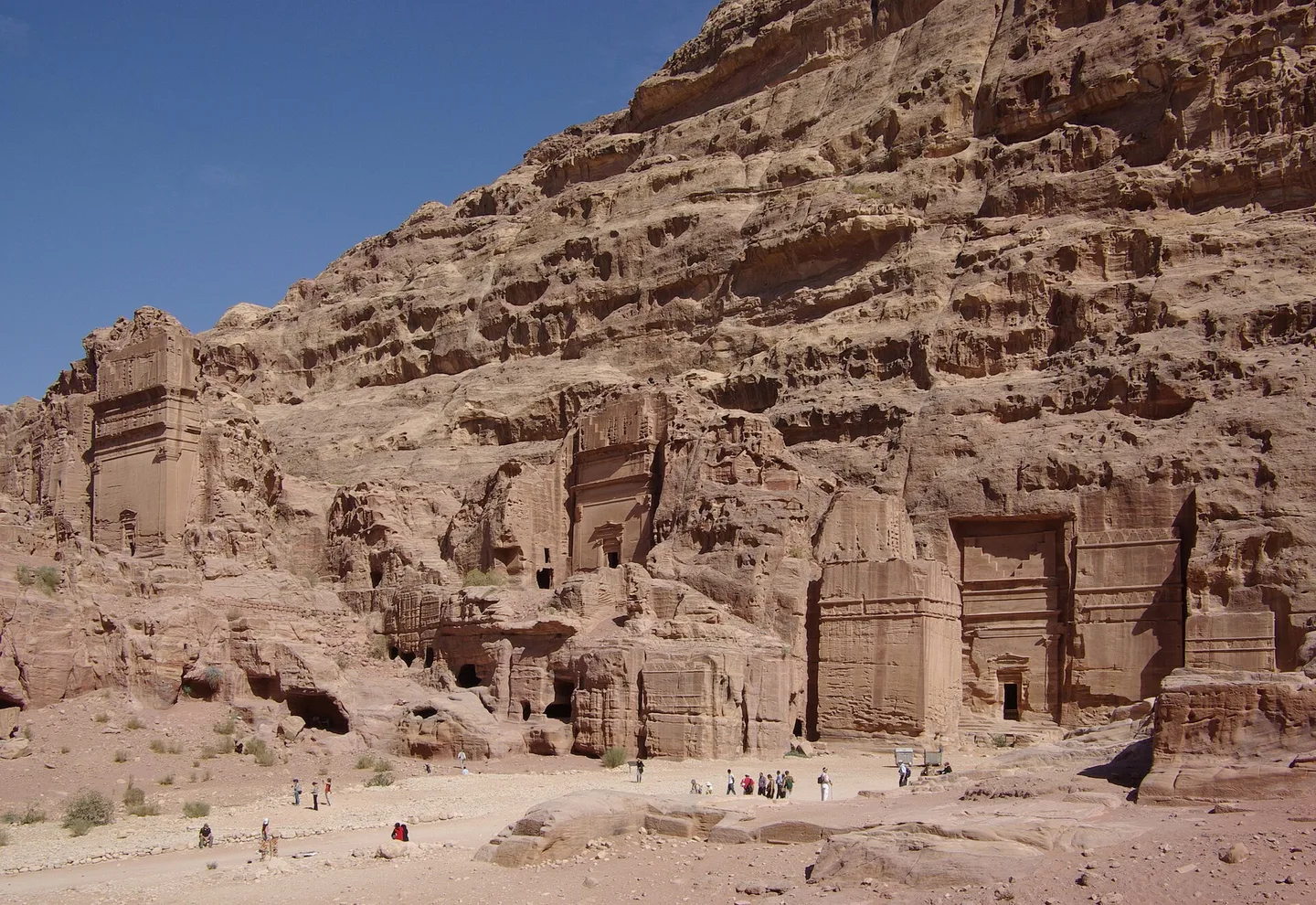
Leaving the narrow chasm of the Siq behind, we enter an opening where canyon walls pull back into a broader natural amphitheatre. Pink sandstone cliffs frame this wide sandy corridor, commonly known among travellers as the Outer Siq. As the path widens, rows of tomb chambers appear carved directly into the rock faces on our right and left. We follow the central gravel channel towards the cluster known as the Street of Facades. Here, dozens of burial chambers sit stacked in multiple rows across the sheer rock slopes. Broad historical context across park logistics and the main Siq corridor helps orient these early Nabataean burial styles cleanly.
The monuments along the Street of Facades display distinctive crowstep crenellations and simple stepped friezes above each doorway. Centuries of flash floods and windblown sand have weathered the lowest layers of the sandstone rock. Despite this erosion, we can still trace pilasters, hollow doorways, and small exterior burial niches. Several chambers rest high above the current path level, accessible only by weathered rock steps cut into the mountainside. We keep our footing secure on the loose gravel surface as pack animals and other walkers pass along the main trackway.
The carved openings vary in scale from simple square recesses to elaborate family sepulchres. Ancient Nabataean stonemasons cut these chambers directly into vertical strata of red and ochre rock. Walking close to the base reveals chisel marks left by hand tools over two thousand years ago. In many spots, natural mineral veins run horizontally across the facade carvings. These mineral bands produce natural wavy patterns across the weathered doorways. Taking time along the Outer Siq helps us understand the density of Petra's necropolis before we reach the city centre.
Passing the Rock-Cut Roman Theatre
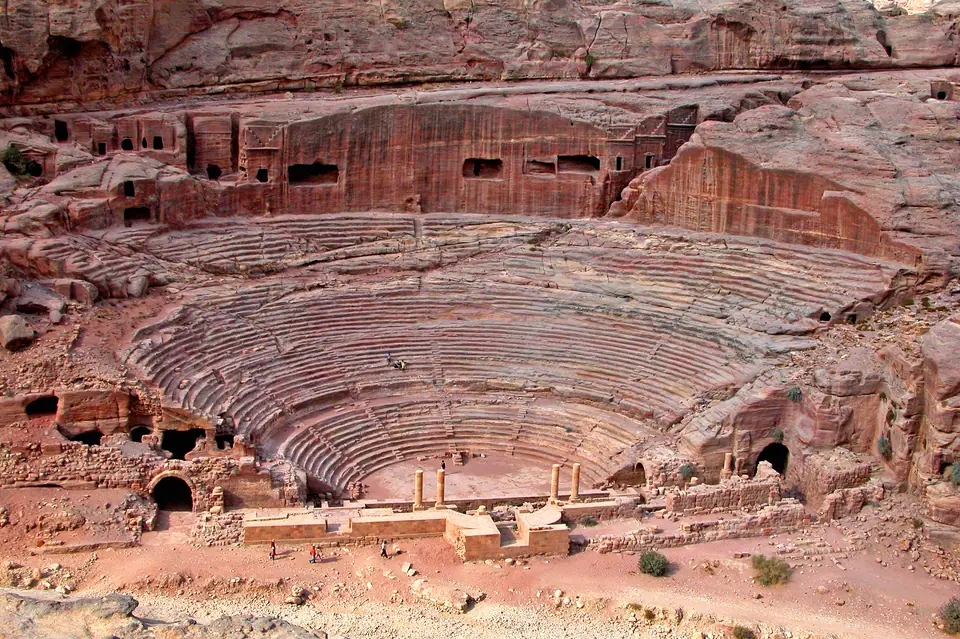
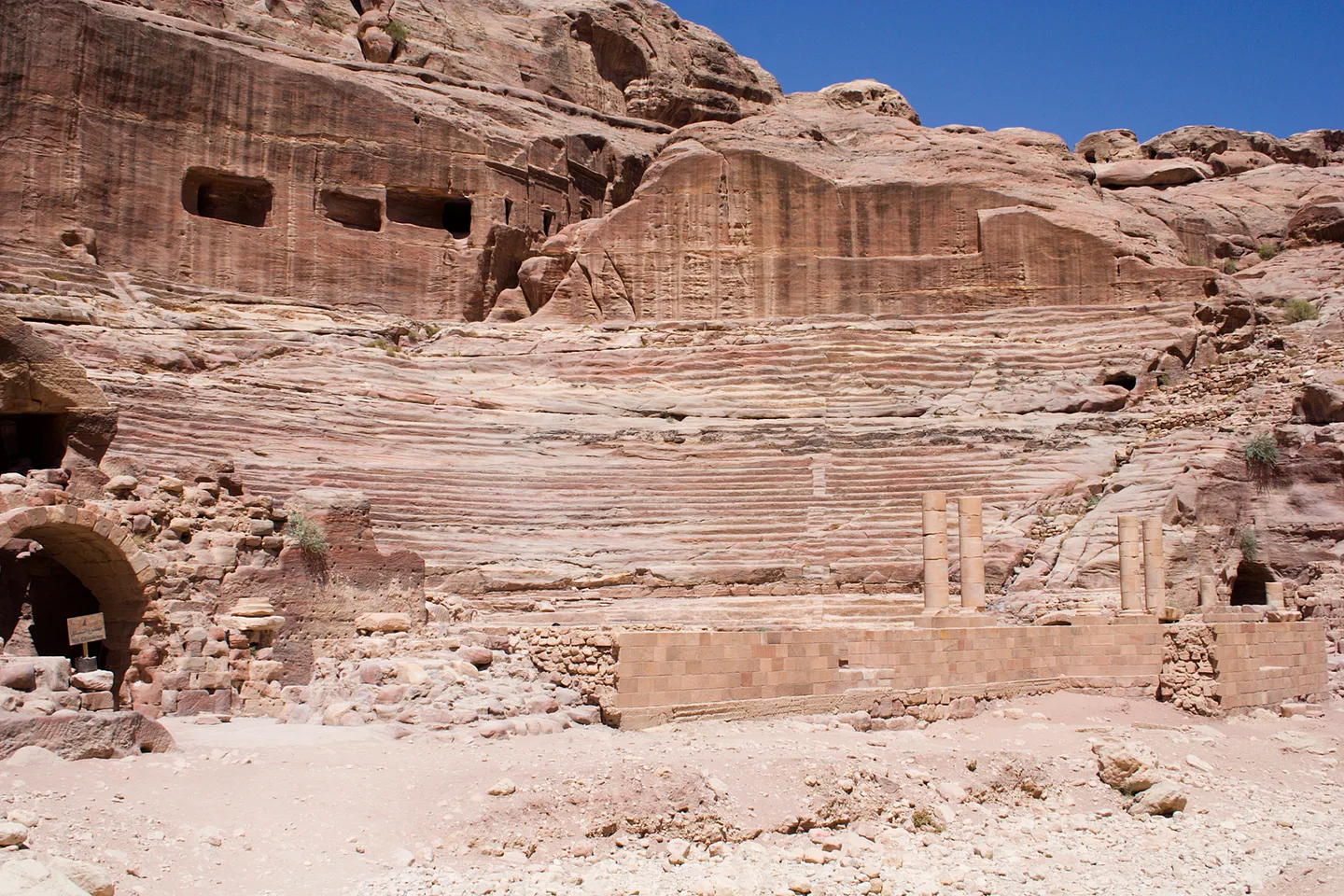
Continuing down the widening canyon, the natural rock face on our left opens to reveal the immense curved bowl of the Roman Theatre. Unlike typical free-standing Roman arenas built from stone masonry, this structure was hewn directly into the living rock of the mountainside. Nabataean engineers carved away existing tombs to form the auditorium, leaving hollowed burial shafts visible in the cliff face above the upper tiers. When the Romans annexed the kingdom, they expanded the seating capacity and rebuilt the decorative stage area along the wadi bed.
We can view the semi-circular orchestra floor and the rows of stepped stone benches from the trail barrier. The rock displays deep bands of ochre, plum, and yellow, shifting in tone as daylight moves across the sandstone surface. Because visitor access inside the fragile seating tiers is restricted to prevent stone degradation, we study the carving from the marked pathway. Planning your arrival during cooler hours in our overview of the best time to visit Petra makes walking this open gravel expanse far more comfortable.
The sheer scale of rock removal required to create the seating tiers remains one of Petra's great engineering feats. Thousands of cubic metres of solid sandstone were quarried away to hollow out the hillside. Above the top tier, deep tomb chambers cut into earlier cliffs were sliced open by the auditorium builders. We can see these exposed chambers clearly from the wadi path below. The contrast between ancient tombs and civic performance space illustrates how Petra evolved through Nabataean and Roman periods.
Ascending the Terrace of the Royal Tombs
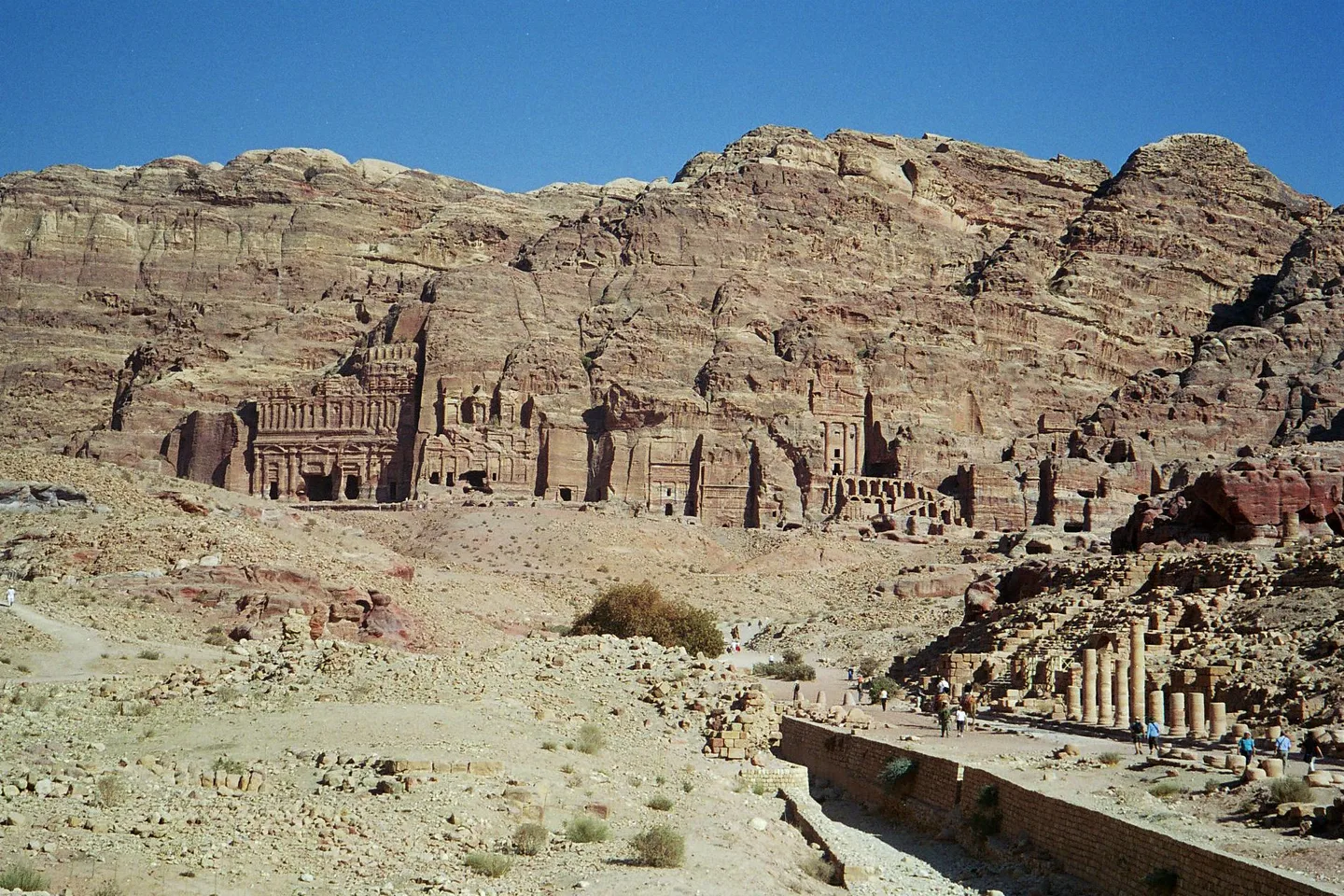
Beyond the theatre, the main pathway approaches the western cliff of Jabal al-Khubtha, where four monumental facades dominate the skyline. These structures comprise the Royal Tombs, elevated on a wide rocky shelf above the valley bed. We leave the dusty wadi floor by following stone stairs that climb towards the Urn Tomb. A vast open courtyard supported by two tiers of arched vaults stands before the main chamber. Deep inside, the interior room reveals swirling ceiling patterns of red, white, and purple sandstone, later converted into an early church.
Following the shelf northwards, we walk past the remaining three royal facades that line the cliff:
- Urn Tomb: A grand monument flanked by colonnaded porticoes and elevated vaults overlooking the central valley.
- Silk Tomb: A smaller facade famous for its swirling bands of yellow, pink, grey, and white sandstone strata.
- Corinthian Tomb: An intricate hybrid facade blending classical Hellenistic capitals with Nabataean floral patterns.
- Palace Tomb: A vast three-storey facade modelled after Roman palace architecture, with upper levels built from cut ashlar blocks.
We pause along this high terrace to look west over the valley floor below. From this raised ledge, the entire layout of the ancient city centre spreads out before us. The stone shelf offers open views across the wadi towards the distant mountain ridges that encircle the archaeological basin.
The Silk Tomb presents one of the most vivid rock colour displays anywhere in the archaeological park. Ribbons of rose, lilac, and cream ripple across the eroded facade pillars like watered silk. Next along the cliff, the Corinthian Tomb exhibits weathered floral capitals that echo the design of the Treasury. The massive Palace Tomb completes the row with its broad facade designed to resemble an imperial palace. Because the cliff face was not tall enough, Nabataean builders added free-standing ashlar blocks across the upper level.
Connecting Routes and Practical Walking Strategies
After surveying the Royal Tombs, we have several trail options depending on our schedule and remaining physical stamina. A continuation trail loops behind the Palace Tomb and climbs the rocky ridges of Jabal al-Khubtha to reach high viewpoints. Alternatively, descending the stone steps brings us back to the level trail that joins the Roman Colonnaded Street. Continuing past the adjoining valley monuments and Monastery climb extends your architectural walk smoothly.
| Route Section | Terrain Type | Key Architectural Focus |
|---|---|---|
| Street of Facades | Gravel canyon floor | Stepped friezes and Nabataean crowstep tombs |
| Roman Theatre | Flat wadi trackway | Curved rock-cut seating tiers and stage wall |
| Royal Tombs Terrace | Stone staircases and rock ledge | Urn, Silk, Corinthian, and Palace Tombs |
| Colonnaded Street link | Descending rocky pathway | Paved Roman roadway and public porticoes |
Walking between these three major monuments involves hard sandstone rock, uneven staircases, and open sun exposure. We carry plenty of water and apply sun cream before leaving the shaded protection of the Siq. Sturdy footwear with reliable grip helps manage the polished rock steps near the Urn Tomb terrace. Validate park passes at the Wadi Musa entrance gates before starting this sunlit eastern terrace loop.
Official prices and opening hours
- Petra Archaeological Park Entry TicketsOfficial site ↗
- Jordan Pass (Includes Petra + 40 Sites)Official site ↗
Where it is
- 1Street of Facades, Roman Theatre and Royal Tombs Walk in Petra
- Ramon International Airport (ETM) · about 79 km from here in a straight line
- Directions in Google Maps
Stations and taxi ranks: OpenStreetMap. Airports: OurAirports. Distances are in a straight line.
Traveller tips
Real advice from people who have been to Petra. Every tip is read by our team before it goes live.
No tips yet. Been here? Yours could be the first.
Thank you! Your tip will appear here after a quick review.
More in Petra
Continue exploring Petra with related neighbourhood, food, and planning guides
Walking the Siq in Petra: Bab al-Siq, Djinn Blocks and Water Channels
Petra, Jordan
Al-Khazneh (The Treasury) Guide: Light, High Overlooks and Etiquette
Petra, Jordan
Colonnaded Street, Great Temple, Qasr al-Bint and Petra Museum Guide
Petra, Jordan
Ad-Deir and the Little Petra Back-Door Trail
Petra, Jordan
