Photo: Panegyrics of Granovetter · CC BY-SA 4.0
Dendera & Abydos Day Trip from Luxor: Hathor & Seti I Temples
Plan a day trip north from Luxor to the Temple of Hathor at Dendera and Seti I at Abydos: routes, ceilings, and king lists.
Travellers with an extra day in Luxor should head north along the Nile Valley into Qena and Sohag governorates. The Temple of Hathor at Dendera and the Temple of Seti I at Abydos preserve two of the finest interiors in Egypt. Unlike the roofless courts of central Luxor, Dendera's massive sandstone roof slabs remain intact above a cleaned cosmos of glowing turquoise zodiacs. Further north, Abydos preserves the finest painted limestone raised reliefs of the Nineteenth Dynasty. Below is how to organize a half-day trip to Dendera or a full-day combined loop to Abydos and Dendera.
| Day-Trip Option | Route Overview | Monument Ticketing | Logistics |
|---|---|---|---|
| 1. Dendera Only (Half-Day) | North of Luxor near Qena | Check official site or at the gate (plus optional crypt/roof add-ons) | Private car round-trip |
| 2. Combined Abydos + Dendera (Full-Day) | North to Abydos, then south to Dendera, then return to Luxor | Check official site or at the gate for each temple | Private car full-day hire |
| 3. Luxor-to-Hurghada Transfer via Dendera | Stop at Dendera en route across the desert to the Red Sea | Check official site or at the gate | One-way car with luggage and Dendera stop |
The Temple of Hathor at Dendera: Turquoise astronomical ceilings and Cleopatra VII
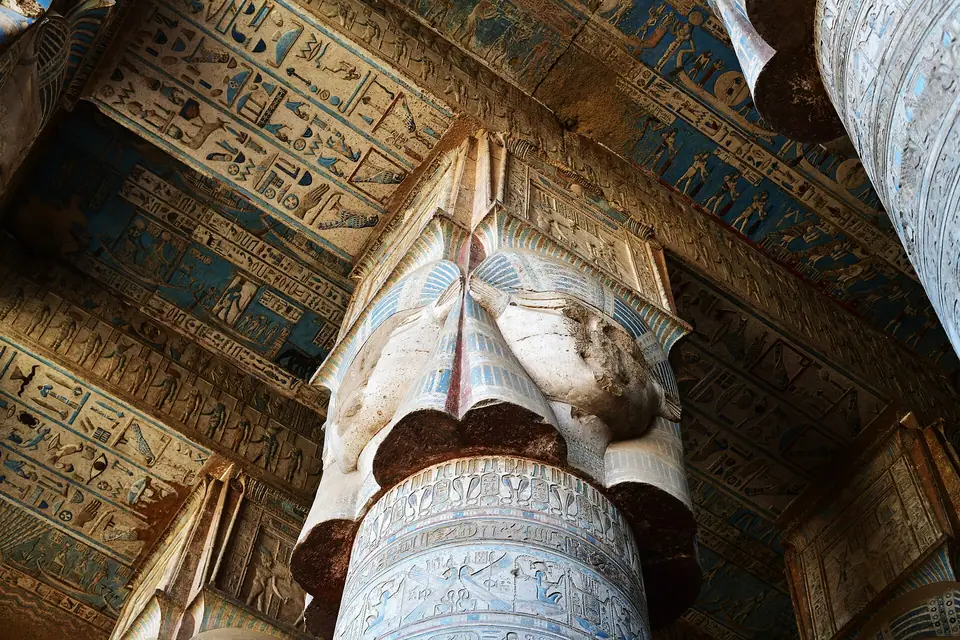
Located on the west bank of the Nile outside Qena, north of Luxor, the Dendera Temple Complex (Iunet) stands at the edge of the desert. In antiquity, it was the primary cult centre of Hathor, goddess of music, motherhood, and the sky. Although earlier shrines stood here from the Old Kingdom onwards, the sandstone temple standing today reflects later periods. Late Ptolemaic rulers (including Ptolemy XII and Cleopatra VII) and early Roman emperors built and decorated its halls. Conservators used gentle laser and poultice cleaning to strip away soot from the ceiling. Stepping through the northern portal today delivers an unforgettable shock of turquoise colour.
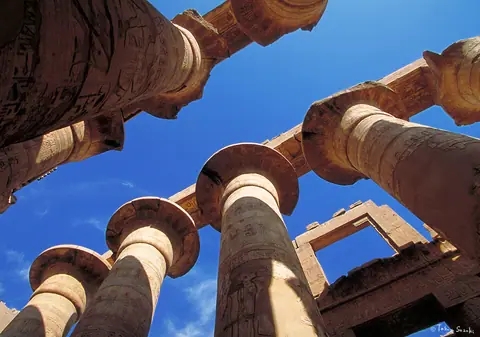
- The Hathor-Headed Columns and Astronomical Ceiling of the Great Hypostyle Hall (Pronaos). Towering columns support the outer hall, each topped with a sistrum capital bearing the cow-eared face of Hathor. Overhead, the massive sandstone ceiling is divided into astronomical bands. Look straight up to see the elongated body of the sky goddess Nut overarching the heavens beside winged solar discs. Across the bands sail decan star constellations, the signs of the Greco-Egyptian zodiac, and the phases of the moon. Every register glows in rich blue and turquoise pigment.
- The Subterranean Crypts, Staircases, and the Dendera Zodiac. Behind the inner Hypostyle Hall and the central Barque Sanctuary lie narrow subterranean wall crypts. These chambers sit inside the thickness of the temple masonry. Crisp reliefs inside the crypts depict cult statues and ritual Menat necklaces. One famous carving shows giant lotus buds holding coiled primordial snakes, often nicknamed the "Dendera lightbulbs". Next, climb the straight Western Staircase, whose walls show priests of the New Year's Festival (Wepet-Renpet) carrying Hathor's shrine up to the roof. On the upper terrace, enter the Rooftop Chapel of Osiris. A ceiling cast marks the original spot of the circular Dendera Zodiac.
- Cleopatra VII and Caesarion on the Exterior Rear Wall. The enclosure also contains a Roman Mammisi birth house, a Sacred Lake, and a mud-brick sanatorium. Before leaving, walk outside to the exterior southern wall. There, carved at monumental scale, stands a famous full-size temple relief of Queen Cleopatra VII Philopator. She stands directly behind her young son Ptolemy XV Caesarion (fathered by Julius Caesar) as they offer incense to Hathor.
The Temple of Seti I at Abydos: The holiest pilgrimage site of Osiris
Continuing north of Dendera into Sohag Governorate brings you to Abydos (ancient Egyptian: Abdju). Abydos was an important pilgrimage centre of ancient Egypt, where early dynasty kings were buried at Umm el-Qa'ab. Religious tradition held that the head of Osiris, lord of the underworld and resurrection, was buried here. Every pious Egyptian hoped either to make a pilgrimage to Abydos in life or to erect a memorial cenotaph stela near Osiris's processional route.
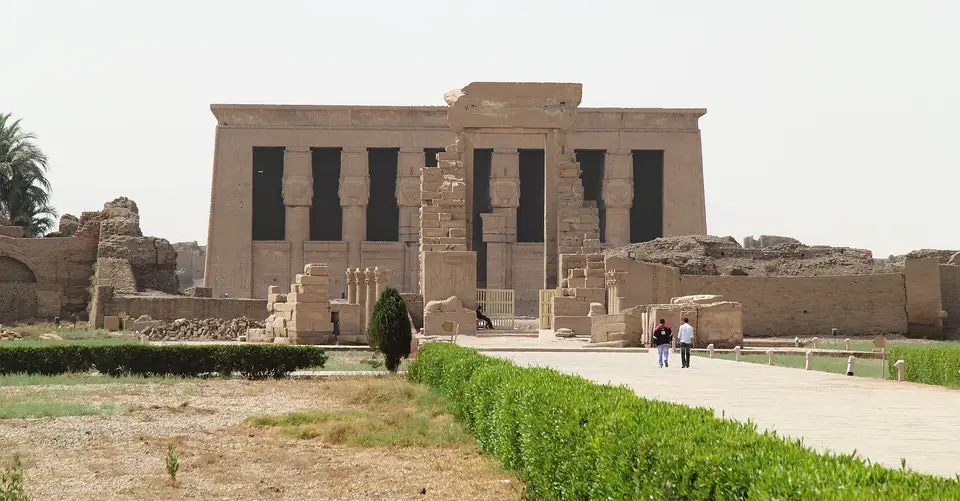
Nineteenth Dynasty Pharaoh Seti I founded the main sanctuary at Abydos, and Ramesses II completed it. Check the official site for current ticket rules before travel. Its distinctive L-shaped floor plan houses the finest painted limestone bas-reliefs of the New Kingdom.
- The Seven Vaulted Sanctuaries. Instead of terminating in a single sanctuary, the second hypostyle hall opens onto seven parallel vaulted chapels. From left to right, they honour the Deified King Seti I, Ptah, Ra-Horakhty, Amun-Ra, Osiris, Isis, and Horus. Because Seti I sourced fine white crystalline limestone rather than coarse sandstone, his sculptors achieved extraordinary detail. The walls preserve hair-thin facial profiles, pleated linen robes, and soft pastel blues, yellows, and reds.
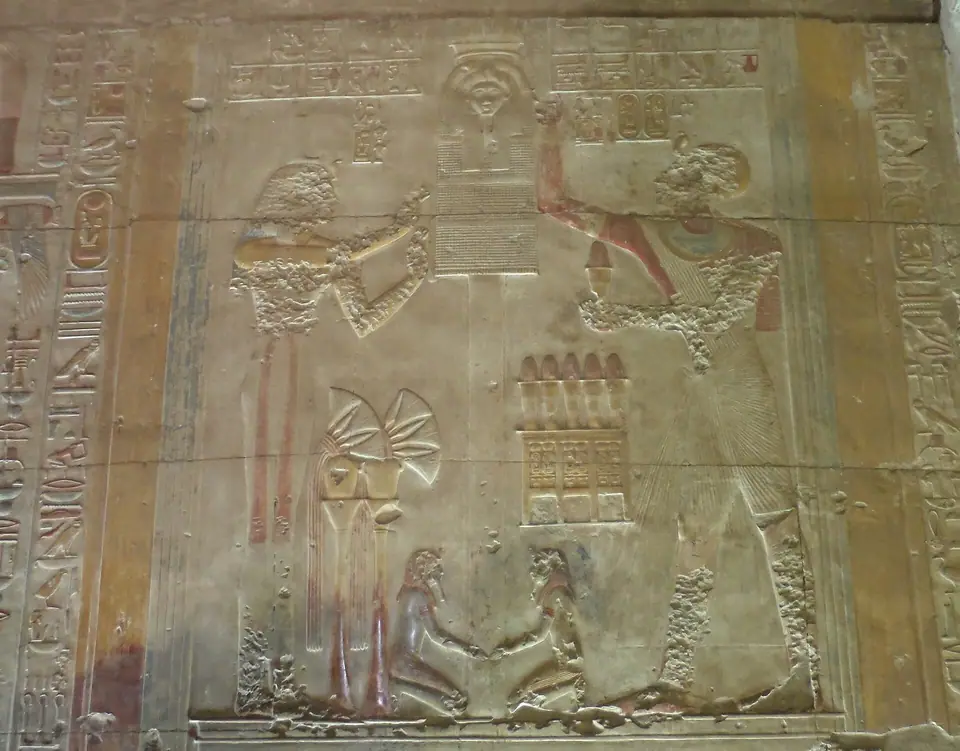
- The Abydos King List (Gallery of the Lists). Turning left into the southern wing of the L-shaped temple brings you into the Gallery of the Ancestors. On the right wall, Seti I holds a censer while young Prince Ramesses reads from a scroll before chronological royal cartouches. The list runs from early unifier Menes (Narmer) down to Seti I, while omitting Hatshepsut, Akhenaten, and Tutankhamun. Look on the opposite wall for the charming scene of Seti I and young Ramesses lassoing a wild bull by its horns and tail.
- The Subterranean Osireion and the Temple of Ramesses II. Walk out the rear door of Seti's temple to view the sunken Osireion, built below floor level from monolithic blocks of Aswan granite. Resting in natural groundwater, it served as a symbolic island cenotaph of Osiris. A short walk northwest stands the smaller, roofless Temple of Ramesses II. Open sunlight illuminates painted limestone reliefs of cattle offerings and scenes from the Battle of Kadesh.
Road logistics, checkpoints, and booking your driver
In the past, tourist police required foreign vehicles travelling to Abydos and Dendera to drive in slow early-morning armed convoys. Standard roadside checkpoints operate along the Desert Highway and Agricultural Road, allowing private tourist cars to travel flexibly during daylight hours:
- Visiting Abydos and Dendera on a Day Trip. If doing the combined excursion, depart your Luxor hotel in the early morning and drive north to the furthest point, Abydos. Spend time exploring the temples of Seti I and Ramesses II, then drive south to reach Dendera before returning to Luxor later in the day.
- Identity Documents and Route Permits. Police check ID regularly and will ask to see your passport, so keep your passport and visa handy. Drivers and front-seat passengers must wear seatbelts by law while on Egyptian roads. Check ticketing guidelines on the official site before travel.
Practical advice for day-trippers
Pack breakfast and water from Luxor, as dining options along the route are basic. Back in town, celebrate with a clay-pot dinner from our Luxor food guide. At Dendera, ask at the main ticket window about the optional add-on tickets. Separate passes cover the Rooftop Chapel of Osiris and the subterranean wall crypts. Purchasing those add-on tickets at the main gate saves walking back from the temple pronaos. Wear grippy closed-toe shoes for the narrow stone steps inside the Dendera crypts and staircase. Carry a small phone torch to view the incised reliefs without touching the stone.
Under UK FCDO travel guidance, Luxor, Qina, and the Nile Valley corridor are exempt from the general Western Desert advisory, making the daytime road trip straightforward.Where it is
- 1Dendera & Abydos Day Trip from Luxor
- Luxor International Airport (LXR) · about 52 km from here in a straight line
- Directions in Google Maps
Stations and taxi ranks: OpenStreetMap. Airports: OurAirports. Distances are in a straight line.
Traveller tips
Real advice from people who have been to Luxor. Every tip is read by our team before it goes live.
No tips yet. Been here? Yours could be the first.
Thank you! Your tip will appear here after a quick review.
More in Luxor
Continue exploring Luxor with related neighbourhood, food, and planning guides

What to Eat in Luxor: Upper Egyptian Tagines, Aish Shamsi & Karkadeh
Luxor, Egypt
Luxor: East vs West Bank, Cashless Tickets & Local Tips
Luxor, Egypt
Things to Do in Luxor: Temples, Royal Tombs & Nile Experiences
Luxor, Egypt

How to Get to Luxor: Airport, Nile Trains, Ferries & West Bank Taxis
Luxor, Egypt
