Photo: Diego Delso · CC BY-SA 4.0
Southern West Bank Guide: Medinet Habu, Ramesseum & Deir el-Medina
Explore Luxor's Southern West Bank circuit: painted reliefs at Medinet Habu, the artisan tombs of Deir el-Medina, the Ramesseum, and Colossi of Memnon.
Many tour coaches on the West Bank of Luxor focus on the Valley of the Kings and Hatshepsut's Temple. Yet the monuments along the Southern West Bank mortuary belt preserve deep-cut hieroglyphs and colourful original ceiling paint in Thebes. The Colossi of Memnon, Deir el-Medina, Medinet Habu, and the Ramesseum sit along a compact arc. You can explore all four sites together in a relaxed morning tour without crowds. You can book monument tickets online in advance to save time. Below is our step-by-step route, ticket checklist, and architectural guide.
| Stop & Order | Ancient Name & Era | Ticketing Advice | Where to Buy Ticket |
|---|---|---|---|
| 1. Colossi of Memnon & Amenhotep III Temple | Kom el-Hettan | Free roadside viewing | Visit the roadside viewing area and check the official site for ticket updates |
| 2. Deir el-Medina (Artisans' Village) | Set-Ma'at, "Place of Truth" | Card payment or online booking | Book online or at the ticket counter |
| 3. Medinet Habu (Temple of Ramesses III) | Djanet | Card payment or online booking | Book online or use the entrance ticket booth |
| 4. The Ramesseum (Temple of Ramesses II) | Mansion of Millions of Years | Card payment or online booking | Book online or buy in advance at the West Bank Ticket Office |
Stop 1: The Colossi of Memnon and the Ticket Office Strategy
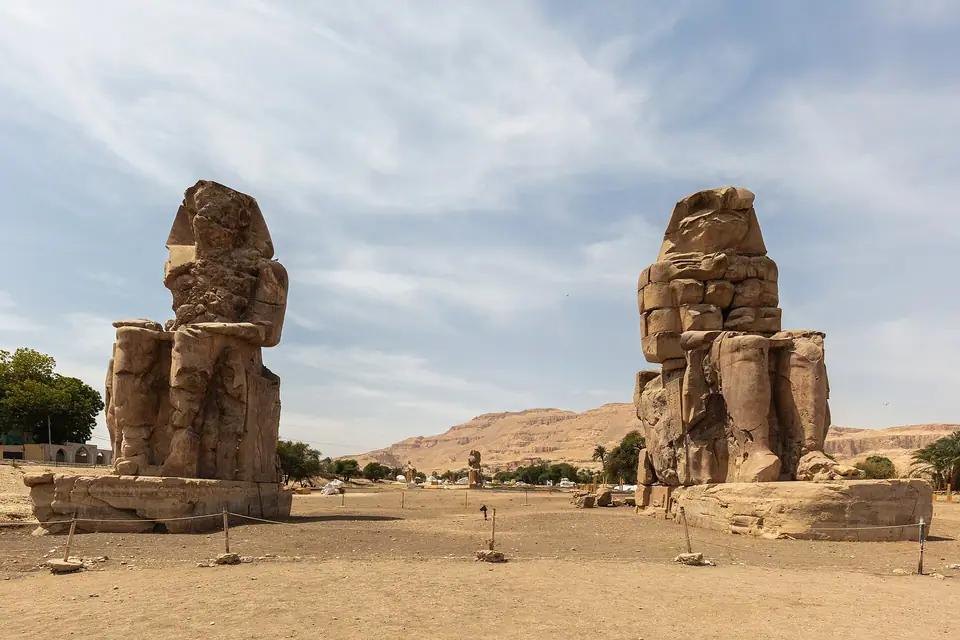
Driving west from the Al-Gezira ferry landing along the canal road leads towards the twin Colossi of Memnon (el-Colossat). The two seated statues rise at the edge of the farmland. Quarried from quartzite sandstone, these twin colossi depict Eighteenth Dynasty Pharaoh Amenhotep III seated on his throne. Smaller figures of Queen Mutemwiya and Queen Tiye stand beside his lower legs.
The statues stood before Amenhotep III's vast mortuary temple (Kom el-Hettan, where additional standing colossi have been re-erected during conservation work). In antiquity, an earthquake cracked the upper torso of the northern colossus. Greco-Roman travellers reported that the statue emitted a musical whistling note at dawn as sunlight warmed the fissured stone. Greek visitors identified the singing statue as Memnon, the mythical son of the dawn goddess Eos. Later Roman restoration patched the upper blocks and silenced the sound. Crucial Field Step: Right across the road from the Colossi car park stands the Main West Bank Antiquities Ticket Office. Step inside with your bank card to buy tickets for the Ramesseum and the Tombs of the Nobles, or book online in advance.
Stop 2: Deir el-Medina (The Royal Tomb Builders' Village and Painted Vaults)
Driving west into a sheltered desert hollow behind Qurnet Murai hill brings you to Deir el-Medina (ancient Egyptian: Set-Ma'at, "The Place of Truth"). This walled village housed the elite brotherhood of royal quarrymen, draughtsmen, and painters. Those artisans excavated and decorated the tombs in the Valley of the Kings. These literate royal artisans had access to fine mineral pigments and carved their own family sepulchres on rest days. Their miniature vaulted tombs on the western cliff are remarkably vivid:
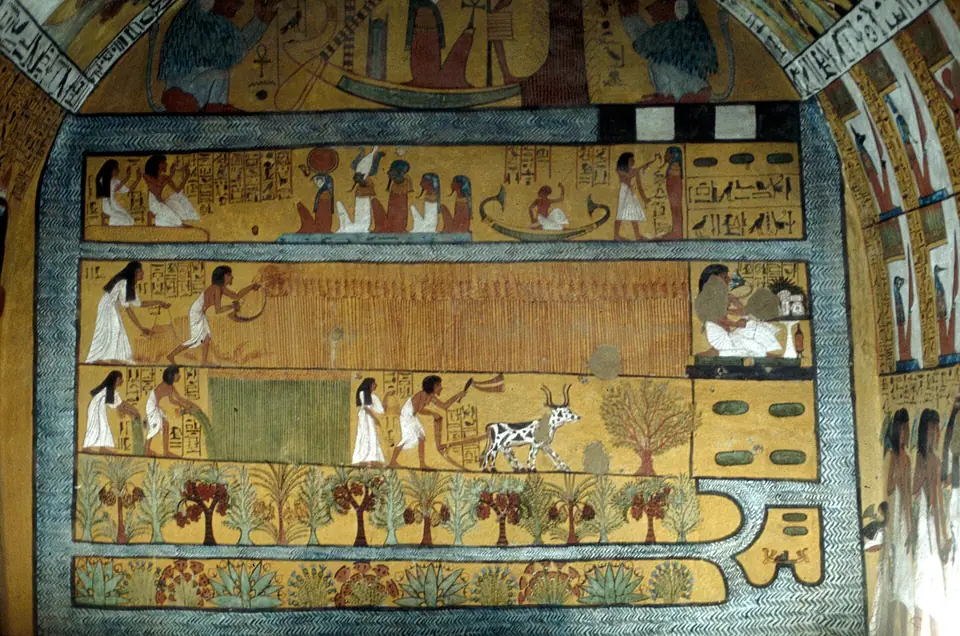
- The Tomb of Sennedjem (TT1) and Inherkhau (TT359). Climb the hillside steps and descend the steep metal ladder into the intact vaulted brick burial chamber of Sennedjem (TT1). Against a glowing golden-yellow background, Sennedjem and his wife Iyneferti plough and harvest wheat in the fertile Fields of Iaru (the Egyptian paradise). On the adjacent panel, Anubis tends Sennedjem's mummy on a lion-shaped couch. Just below lies the two-chamber tomb of Foreman Inherkhau (TT359). Its walls show intimate portraits of the foreman with his family and the Great Cat of Heliopolis slicing the serpent Apophis.
- The Tomb of Peshedu (TT3). Inside the burial chamber, look for the painting of Peshedu kneeling beside a fruit-laden date palm. He drinks from the waters of the afterlife beneath the falcon Horus.
- The Walled Village Street, Great Pit, and Ptolemaic Temple of Hathor. Walk down the central lane of the workmen's village, where ancient records document a famous historical labour strike. At the northern end of the enclosure, step inside the sandstone Ptolemaic Temple of Hathor and Ma'at to see its Judgement of Osiris relief.
Stop 3: Medinet Habu (The Fortified Mortuary Temple of Ramesses III)
South of Deir el-Medina rises Medinet Habu, the monumental mortuary complex of Twentieth Dynasty Pharaoh Ramesses III. Serving as an impressive temple complex in Luxor, Medinet Habu stands out for its remarkable preservation:
- The Syrian-Style Fortified Migdol Gateway (High Gate). You enter Medinet Habu through a two-storey stone gateway modelled on Syrian migdol fortresses. Its upper chambers preserve intimate reliefs of Ramesses III playing board games with royal women.
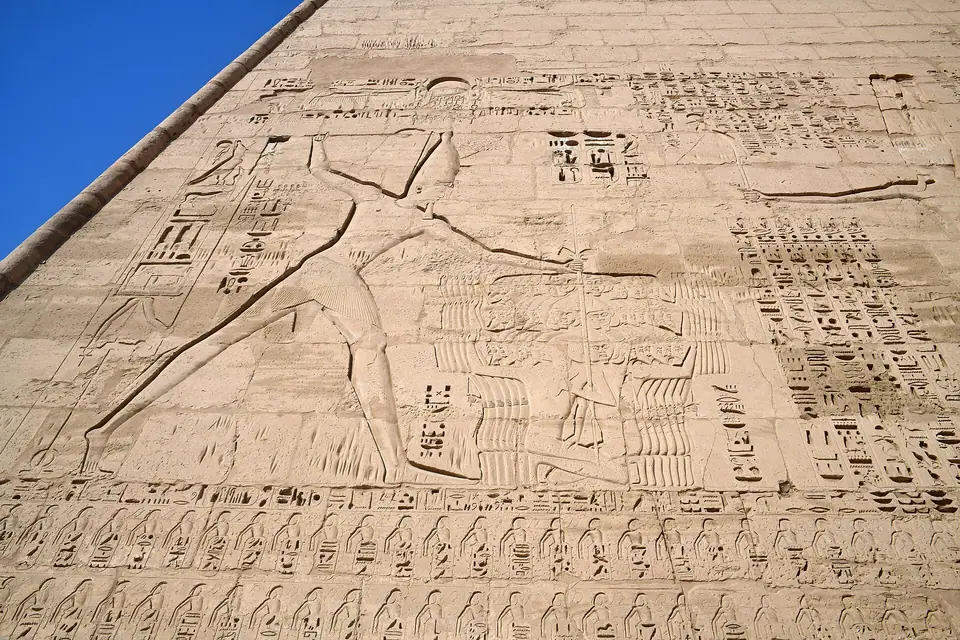
- Deep Sunk Hieroglyphs and Original Ceiling Blues. To prevent successors from usurping his cartouches, Ramesses III ordered his masons to chisel his inscriptions deep into the sandstone. You can place your hand inside a carved ankh or falcon sign. Walk through the monumental entrance pylon (showing Ramesses III smiting enemies before Amun-Ra) into the Second Peristyle Court. Early Christian Copts plastered over the porticos when they converted the court into a church. When that plaster fell away, the architraves and lotus capitals revealed ancient turquoise, lapis-lazuli, and crimson paint.
- The Sea Peoples Naval Battle on the Exterior Northern Wall. Walk outside along the northern exterior wall to inspect the famous relief of the Naval and Land Battle against the Sea Peoples. Feathered-helmet Peleset and horned-helmet Sherden warriors capsize in the Nile Delta marshes as royal scribes count captured equipment. On the rear of the entrance pylon, look for the dynamic relief of Ramesses III hunting wild bulls in the marshes.
Stop 4: The Ramesseum ("Ozymandias") and its Mud-Brick Granaries
Complete your southern loop further north at the Ramesseum, the mortuary temple built by Nineteenth Dynasty Pharaoh Ramesses II. In the second court lies the shattered upper torso of the fallen colossus of Ramesses II. Carved from a single block of pink Aswan granite, it stood as a monumental free-standing statue of antiquity. Its shoulder carries Ramesses II's throne name Usermaatre, rendered into Greek by Diodorus Siculus as Ozymandias. That shattered giant directly inspired Percy Bysshe Shelley's sonnet. Beyond the Osiride pillars of the second court, walk through the columns of the Hypostyle Hall and its astronomical ceiling. Surrounding the stone temple stand acres of vaulted ancient mud-brick storehouses and granaries.
Traveller tips
For photography, visit Medinet Habu in the morning when eastern sunlight pours through the entrance pylon into the painted courts. Alternatively, arrive in the afternoon when angled light rakes across the exterior Sea Peoples reliefs. Combine this southern circuit with Day 3 of our 3-day Luxor itinerary and cool off afterwards at the Luxor Museum. At Deir el-Medina, note that the subterranean burial chambers of Sennedjem (TT1) and Inherkhau (TT359) are reached via narrow vertical iron ladders and steep steps. Take your time descending backwards down the rungs, and wait at the top if another group is already inside the small vaulted room. Across the road from Medinet Habu, shaded local cafés serve cold bottled water and fresh lemon juice while your driver waits in the car park.
Under UK Foreign, Commonwealth and Development Office (FCDO) travel advice, Luxor and the West Bank archaeological zone are explicitly exempt from the Western Desert travel warning. Before starting your southern circuit, purchase Ramesseum tickets by bank card at the West Bank ticket office opposite the Colossi of Memnon. By contrast, Medinet Habu and Deir el-Medina operate their own on-site card terminals.
Where it is
- 1Southern West Bank
- Luxor International Airport (LXR) · about 12 km from here in a straight line
- Directions in Google Maps
Stations and taxi ranks: OpenStreetMap. Airports: OurAirports. Distances are in a straight line.
Traveller tips
Real advice from people who have been to Luxor. Every tip is read by our team before it goes live.
No tips yet. Been here? Yours could be the first.
Thank you! Your tip will appear here after a quick review.
More in Luxor
Continue exploring Luxor with related neighbourhood, food, and planning guides
How to Get to Luxor: Airport, Nile Trains, Ferries & West Bank Taxis
Luxor, Egypt
Best Time to Visit Luxor: Desert Seasons, Winter Sun & Heat Strategy
Luxor, Egypt
What to Wear in Luxor: Temple Etiquette, Tomb Heat & Packing Tips
Luxor, Egypt
Where to Stay in Luxor: East Bank Corniche vs West Bank Villages
Luxor, Egypt
