Photo: Alexander Baranov from Montpellier, France · CC BY-SA 4.0
Hatshepsut Temple & Valley of the Queens: Deir el-Bahari & Nefertari
Explore Queen Hatshepsut's terraced temple at Deir el-Bahari, the Punt and Birth colonnades, the Tombs of the Nobles, and the Valley of the Queens.
Directly across the limestone ridge from the Valley of the Kings, the eastern face of the mountain opens into a natural bay of towering vertical cliffs. This dramatic rock amphitheatre is known as Deir el-Bahari ("The Northern Monastery"). At the base of this pale-gold rock amphitheatre stands the Mortuary Temple of Queen Hatshepsut (Djeser-Djeseru, "Holy of Holies"). Her royal steward and chief architect Senenmut designed the terraced sanctuary. Just south along the lower slopes of the mountain belt lie the ancient Tombs of the Nobles at Sheikh Abd el-Qurna. Further south sit the royal sepulchres of the Valley of the Queens (Ta-Set-Neferu). Below is how to explore the sites on a West Bank loop.
| Monument / Site | Key Highlights | Official Ticket Details | Ticket Booth Location & Tip |
|---|---|---|---|
| Temple of Hatshepsut (Deir el-Bahari) | Limestone terraces, Punt Colonnade, Birth Colonnade, Chapels of Anubis & Hathor | Online advance booking available | Book online or check the official site before travel |
| Tombs of the Nobles (Ramose TT55, Userhat & Khaemhat) | Limestone reliefs of Ramose (TT55), Userhat (TT56) & Khaemhat (TT57) | Check the official site | Antiquities ticket office near the Colossi of Memnon |
| Tomb of Sennefer (TT96, "Vineyards") | Subterranean rock ceiling painted as a living canopy of green grapevines and clusters | Check the official site | Antiquities ticket office near the Colossi of Memnon |
| Valley of the Queens (Biban el-Harim) | Tombs include QV55 (Amun-her-khepeshef), QV44 (Khaemwaset) & QV52 (Titi) | Check the official site | Valley entrance ticket desk; check QV66 Nefertari status |
Architecture of Deir el-Bahari: Why Hatshepsut built a terraced temple
Female pharaoh Maatkare Hatshepsut commissioned this funerary monument as her "Mansion of Millions of Years". Her architect Senenmut drew inspiration from the adjacent temple of Mentuhotep II. Rather than erecting a massive stone pylon that would compete with the cliff, Senenmut turned the mountain itself into the temple backdrop. He linked wide colonnaded limestone terraces with central ramps originally flanked by Red Sea myrrh trees.
Tickets for Hatshepsut Temple in Luxor can be booked online in advance. Walk up the central ramp to the Middle Terrace, where painted colonnades and chapels flank the incline.
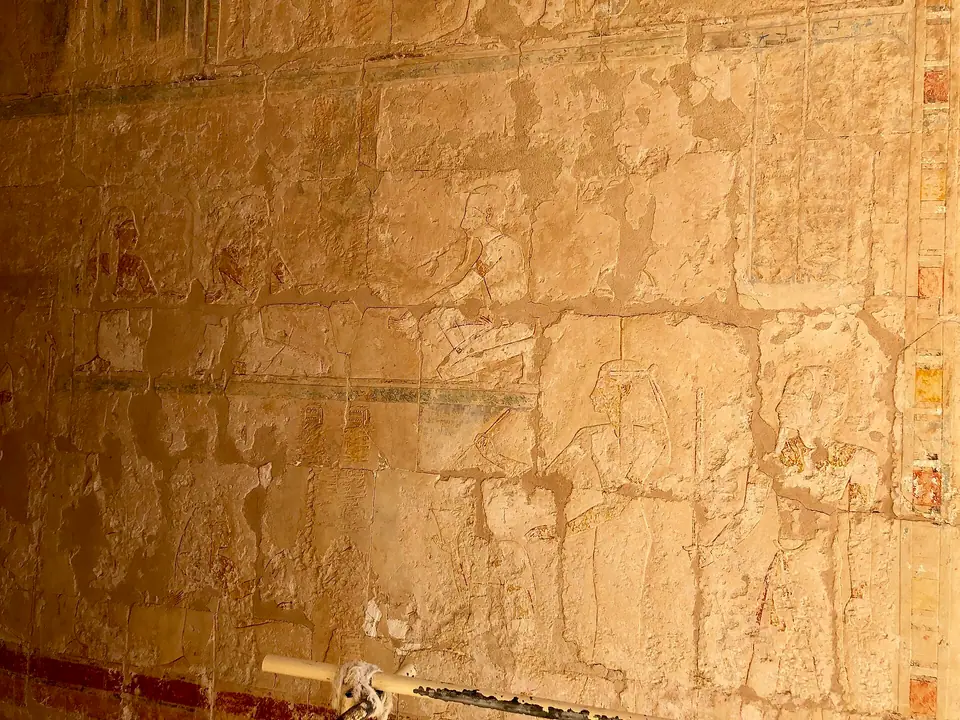
- The Punt Colonnade (Left / Southern Side of the Middle Terrace). Do not walk up to the top terrace without spending time along this southern portico. Carved in crisp raised relief with surviving red and yellow pigments, it records Hatshepsut's naval trading expedition. Egyptian sailing ships voyaged down the Red Sea to the Land of Punt (the Horn of Africa coast) during her reign. Look for the marine fish, squid, and sea turtles swimming in the Red Sea register below the ships. Above, Egyptian sailors load live Boswellia myrrh saplings in root balls while King Parahu of Punt greets the fleet with his wife, Queen Ati.
- The Chapel of Hathor (Far Left of the Middle Terrace). Immediately south of the Punt Colonnade stands the multi-aisled shrine of the motherhood goddess Hathor. Its pillars carry stone capitals carved with the cow-eared face of Hathor framed by curled wigs. Look on the side wall for the relief of the sacred Hathor cow licking Queen Hatshepsut's hand.
- The Birth Colonnade and the Chapel of Anubis (Right / Northern Side of the Middle Terrace). To legitimize her rule as female pharaoh beside young Thutmose III, Hatshepsut inscribed the Birth Colonnade with her divine origin story. The reliefs show Amun-Ra visiting her mother Queen Ahmose and the ram-headed potter god Khnum fashioning Hatshepsut on his wheel. At the far northern end of the terrace stands the Chapel of Anubis, fronted by proto-Doric fluted columns. Inside, a lapis-blue star ceiling and yellow-ochre walls of Anubis and Osiris preserve bright original pigments.
The Upper Terrace: Osiride statues and the Sanctuary of Amun-Ra
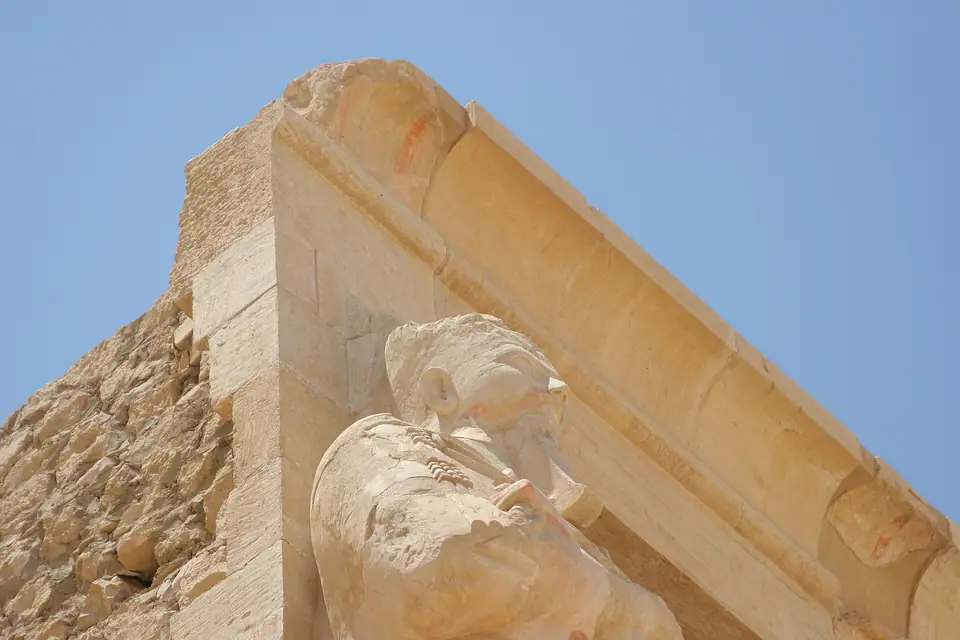
Ascend the second processional ramp, guarded at its base by a granite falcon of Horus. At the top opens the Upper Terrace, restored by the Polish-Egyptian Archaeological Mission. Along the front portico stand tall limestone Osiride statues of Hatshepsut wearing the royal false beard and double crown. Shattered after her death under Thutmose III, the statues were carefully pieced back together by modern conservators. Step through the pink granite portal at the rear of the Upper Court into the rock-cut Sanctuary of Amun-Ra. The chamber sits aligned on an astronomical axis with the Karnak Temple Complex across the Nile.
The Tombs of the Nobles at Sheikh Abd el-Qurna (Ramose TT55 & Sennefer TT96)
South of Deir el-Bahari, the limestone slopes of Sheikh Abd el-Qurna and El-Khokha hold private Tombs of the Nobles. These rock-cut chapels (designated TT for Theban Tomb) belonged to viziers, governors, and royal scribes. Unlike the royal tombs in the Valley of the Kings, the nobles' tombs burst with scenes of daily life in ancient Egypt. Walls depict wheat harvests, wine-pressing, female musicians, banquets, and hunting in papyrus marshes. Remember to purchase your tickets at the West Bank Antiquities Ticket Office near the Colossi of Memnon:
- The Tomb of Vizier Ramose (TT55, Combined Ticket with Userhat TT56 & Khaemhat TT57). Vizier Ramose served under both Amenhotep III and his son Amenhotep IV (later Akhenaten). His columned hall captures the transition when Egyptian art shifted styles. On the southern wall, weeping female mourners in white linen and portrait busts of Ramose's family are carved in classical limestone relief. On the rear wall, an unfinished scene shows young Akhenaten and Queen Nefertiti standing beneath the rayed sun disc of the Aten in the Amarna style. Next door in the same courtyard, enter TT56 (Userhat) for a painted desert chariot hunting scene. Right beside it, TT57 (Khaemhat) preserves detailed agricultural harvest reliefs.
- The Tomb of Mayor Sennefer (TT96, "The Tomb of the Vineyards"). Located higher up the hillside, the subterranean chamber of Sennefer (Mayor of Thebes under Amenhotep II) features an undulating rock ceiling. Painters transformed the rough roof into a canopy of twisting grapevines and purple grape clusters above decorated pillars.
The Valley of the Queens (Biban el-Harim): Princes' tombs and QV66 Nefertari
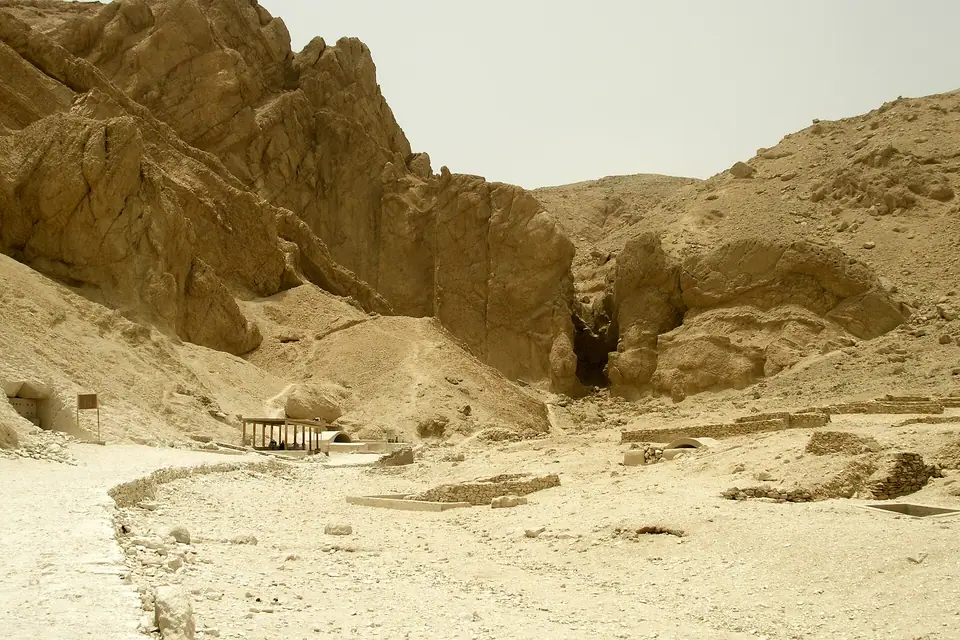
At the southern tip of the Theban hills lies the Valley of the Queens (Ta-Set-Neferu, "The Place of Beauty"). Tombs were cut here during the New Kingdom period for queens and young princes.
- The Standard Princes' Tombs. Even when QV66 is closed, the Valley of the Queens base ticket offers fine viewing because its princes' tombs were painted in glowing raised relief. Enter QV55 (Prince Amun-her-khepeshef) and QV44 (Prince Khaemwaset), built for sons of Ramesses III. On the walls, Ramesses III leads his braided-sidelock sons by the hand to introduce them to Ptah, Thoth, and Anubis. Round out your visit at QV52 (Queen Titi).
- The Tomb of Queen Nefertari (QV66). Ramesses II built tomb QV66 for his Great Royal Wife Nefertari ("For Whom the Sun Shines"). Discovered by Ernesto Schiaparelli, it is celebrated for its wall paintings. The Ministry of Tourism and Antiquities periodically closes QV66 for subterranean humidity and salt-crystal conservation. When open, it operates under strict daily visitor limits and a separate conservation ticket. Always verify QV66's current opening status on the official site before walking up to the valley.
Traveller tips for the West Bank
Because the cliffs of Deir el-Bahari face directly east-southeast, the open stone terraces of Hatshepsut's Temple reflect strong morning heat. Start early in the cooler hours to explore the open grounds comfortably. Wear modest clothing and a sun hat from our Luxor packing guide, then continue south to Medinet Habu.
Where it is
- 1Hatshepsut Temple & Valley of the Queens
- Luxor International Airport (LXR) · about 12 km from here in a straight line
- Directions in Google Maps
Stations and taxi ranks: OpenStreetMap. Airports: OurAirports. Distances are in a straight line.
Traveller tips
Real advice from people who have been to Luxor. Every tip is read by our team before it goes live.
No tips yet. Been here? Yours could be the first.
Thank you! Your tip will appear here after a quick review.
More in Luxor
Continue exploring Luxor with related neighbourhood, food, and planning guides
Luxor Temple Guide: Avenue of Sphinxes, Pylons & Evening Walk
Luxor, Egypt
Valley of the Kings Guide: Royal Tombs, KV62 Tutankhamun & Seti I
Luxor, Egypt
Southern West Bank Guide: Medinet Habu, Ramesseum & Deir el-Medina
Luxor, Egypt
Luxor Museum, Mummification Museum & Sunset Nile Felucca Guide
Luxor, Egypt
