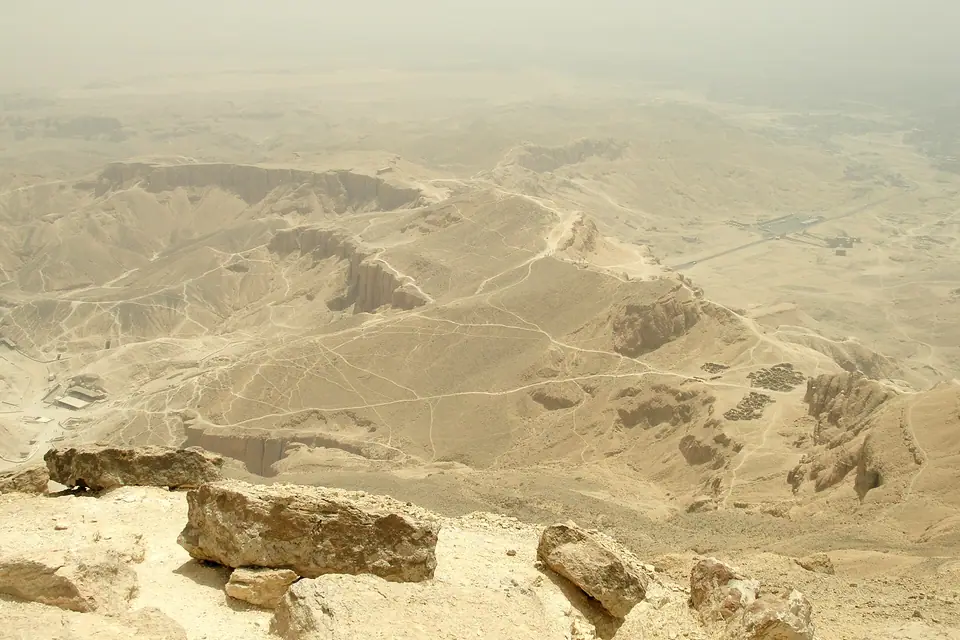
Photo: Vyacheslav Argenberg · CC BY-SA 4.0
Valley of the Kings Guide: Royal Tombs, KV62 Tutankhamun & Seti I
Master the Valley of the Kings ticket system in Luxor: pick the best tombs on your base ticket, compare extra options, and beat the heat.
The Valley of the Kings (Wadi Biban el-Muluk) is carved into a dry limestone wadi on the West Bank. Above the canyon rises the natural pyramid peak of al-Qurn. For centuries, this secluded canyon served as the royal necropolis of Egypt's New Kingdom pharaohs. Abandoning conspicuous pyramids to deter tomb robbers, builders excavated subterranean corridor tombs here in the mountainside. To date, archaeologists have catalogued numbered rock-cut tombs and shafts inside the East and West Valleys. Because conservation rules rotate open tombs and limit your standard ticket to three tombs, picking the right combination before you pass the turnstile is essential. Below is our guide to the tickets, standard tombs, and extra-ticket options.
| Ticket Category | Tombs Included | Approx. Card Fee | Field Verdict & Highlight |
|---|---|---|---|
| 1. Base Entry Ticket (3 Tombs) | Choice of open standard tombs (KV11, KV2, KV6, KV8, KV1, KV14, KV16, KV47) | Check official site + cash tram | Popular combo: KV11 (Ramesses III) + KV2 (Ramesses IV) + KV6 (Ramesses IX) or KV14 (Tausert) |
| 2. Extra: KV9 (Ramesses V & VI) | Single entry to KV9 (right opposite the rest area) | Check official site | Add-on featuring a dazzling gold-and-blue double astronomical ceiling of Nut |
| 3. Extra: KV62 (Tutankhamun) | Single entry to KV62 | Check official site | Compact tomb housing Tutankhamun's linen-wrapped mummy and painted burial chamber |
| Extra Ticket: KV17 (Seti I) | Single entry to KV17 | Check official site | Raised-relief painted walls and vaulted indigo astronomical burial hall |
| Extra Ticket: KV23 (Ay, West Valley) | Single entry to KV23 in the separate Western Valley | Check official site | Quiet desert wadi featuring marsh and hunting scenes |
How the Valley of the Kings ticket and punch-card system works
Make every ticketing decision at the Visitor Centre ticket window before boarding the electric tram. No add-on tomb tickets are sold inside the canyon itself:
- Buy All Extra Tomb Tickets at the Main Visitor Centre Window (Card Only). At the entrance plaza, inspect the glass display board listing which standard tombs are open that day (tombs rotate periodically for humidity control and conservation). Book your monument tickets online or pay by card for your Standard Valley Entry Ticket, which entitles you to visit three open standard tombs. Visitors can purchase tickets for Egyptian monuments online in advance to save time. At the exact same window, purchase any extra tickets you want for KV9 (Ramesses V & VI), KV62 (Tutankhamun), or KV17 (Seti I). For assistance with online e-tickets, official portal support can be reached at tourism_info@efinance.com.eg through the portal. At the entrance to each standard tomb, the guardian punches or scans one of your slots.
- The Electric Taf-Taf Tram. Walk through the topographical model of the valley inside the air-conditioned Visitor Centre. Outside, board the open-sided electric tram (taf-taf) for the short uphill ride to the canyon gate, carrying small cash notes from our orientation guide.
- Photography Rules Inside the Tombs. As a rule, non-flash personal smartphone photography is permitted inside standard tombs and KV9, though flash is strictly forbidden as it degrades ancient mineral pigments. In KV62 (Tutankhamun) and KV17 (Seti I), guardians enforce restrictions on photography, so always check signs at the tomb door and never use flash. Remember that a permit is required to enter Egypt with professional photography or filming equipment. Ministry of Tourism regulations on photography also state that you must get an Egyptian citizen's written permission before you take their photo. Taking pictures of children in Egypt is strictly prohibited. Importing or using drones in Egypt without permission from the Ministry of Defence can carry a prison sentence of up to seven years.
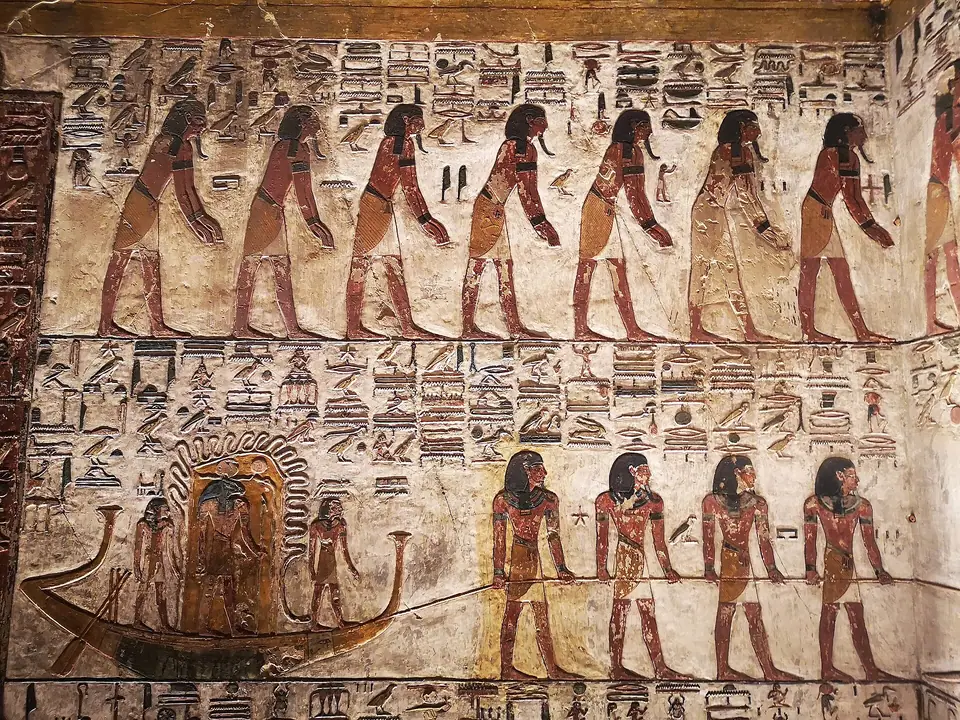
Tombs to consider on your standard base ticket
Early dynasty tombs were cut high in the cliffs with right-angle bends and steep stairs. By contrast, later Ramesside tombs were engineered as wide, straight, gently sloping corridors. Their walls glow with painted reliefs from ancient funerary compositions like the Book of Gates and Amduat. Prioritize three from this selection, depending on which are open on your morning:
- 1. KV11 (Ramesses III, The "Bruce's Tomb / Harper's Tomb"). Extending deep into the rock, KV11 is among the most decorated tombs on the standard ticket. Because its workmen accidentally broke into the adjacent tomb of Amenmesse (KV10), the corridor jogs sideways before continuing. Inspect the small side chambers just beyond the entrance for scenes of royal bakeries, armoury weapons, and boats. One famous chamber depicts two blind harpists playing before the gods.
- 2. KV2 (Ramesses IV). Located just inside the valley entrance with a wide, gently sloped corridor, KV2 is ideal if you want to avoid steep stairs. Its burial hall holds a massive red granite sarcophagus beneath a vaulted yellow-and-blue ceiling of the sky goddess Nut. Look along the upper walls for ancient Greek, Coptic, and Latin graffiti left by historical travellers.
- 3. KV6 (Ramesses IX) or KV14 (Queen Tausert & Setnakhte). Right across from KV62, KV6 features magnificent yellow-and-black reliefs of the resurrected figure of Osiris-Ramesses and an astrological ceiling in the burial hall. Alternatively, check whether KV14 (built for Queen Tausert and enlarged by King Setnakhte) is open. Walk its corridor to see two successive vaulted burial halls where Setnakhte plastered over earlier female cartouches.
- KV8 (Merenptah) or KV16 (Ramesses I). If you enjoy deep physical descents, KV8 (Merenptah, son of Ramesses II) plunges down steep wooden ramps. In the burial hall rests a massive pink granite sarcophagus lid carved with the recumbent king. By contrast, compact KV16 (Ramesses I) requires descending a short staircase into a burial chamber painted on blue-grey background plaster.
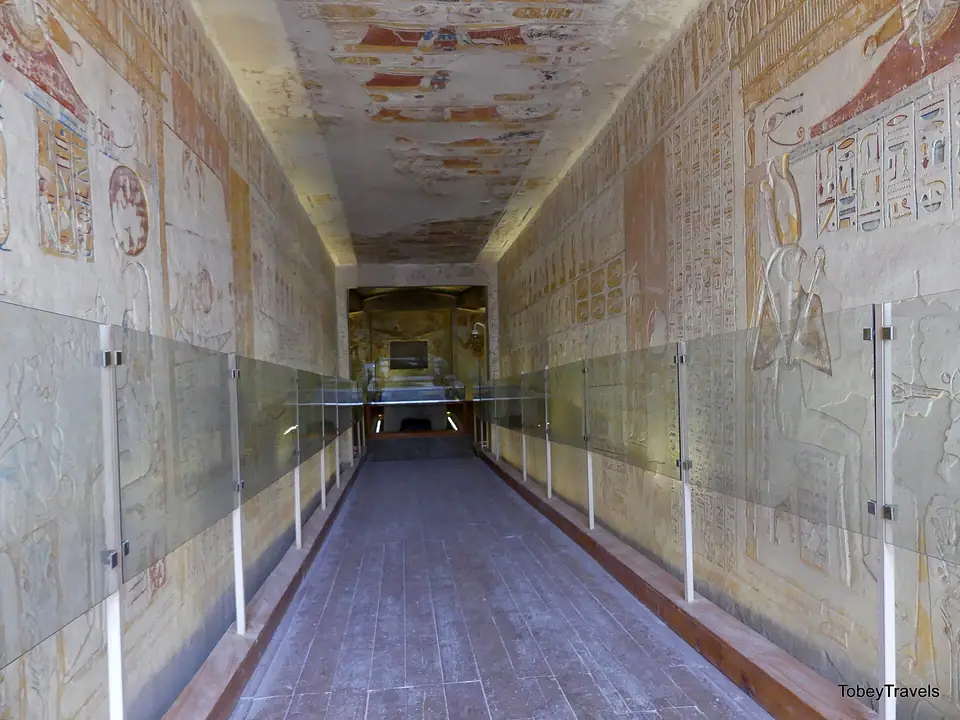
Comparing the 3 extra-ticket tombs: KV9, KV62 (Tutankhamun), and KV17 (Seti I)
How should you allocate your budget among the three extra-ticket tombs?
- KV9 (Ramesses V & Ramesses VI, Essential for Every Visitor). Do not skip KV9. For an additional fee, you walk down a wide, straight hall covered in extensive texts of the Book of Gates and Book of Caverns. The corridor culminates in a vaulted burial chamber beneath a lapis-blue ceiling. Overhead, the twin bodies of the sky goddess Nut swallow the evening sun disc.
- KV62 (Tutankhamun, Historical Icon & Real Royal Mummy). Archaeologists discovered KV62 beneath the ancient workmen's huts of KV9. The tomb is compact, and its burial chamber is painted with funerary figures, baboons, and the Opening of the Mouth ceremony performed by Ay. While many treasures are displayed in museums, KV62 still holds the outer gilded wooden coffin inside its red quartzite sarcophagus. Inside a climate-controlled glass case rests the linen-wrapped mummy of Pharaoh Tutankhamun. If you travel on to Cairo, note that a visit to the Grand Egyptian Museum includes access to the Tutankhamun Galleries. The Grand Egyptian Museum is the premier museum complex dedicated to pharaonic heritage.
- KV17 (Seti I, Artistic Masterpiece). The tomb of Seti I is renowned as an artistically accomplished rock-cut monument in the necropolis. Every wall of its chambers and pillared halls is carved in painted raised relief, including an unfinished room drawn in red and black scribe ink outlines. At the bottom arches a vaulted dark-blue astronomical burial hall.
Traveller tips
Arrive early at the Valley of the Kings Visitor Centre when the gates open, before the sun climbs over the eastern rim of the canyon. You can visit KV62 (Tutankhamun) and KV9 early to enjoy the burial chambers without heavy crowds. Queues often form on the narrow stairs later in the morning. Egyptian police regularly check identification and require tourists to present a passport and visa. Carry these documents securely with you when travelling on the West Bank. If you need to report a crime in Egypt, phone the tourist police on 126. After finishing your chosen tombs, travel across the ridge to Hatshepsut's Temple at Deir el-Bahari as outlined in our 3-day Luxor itinerary.
Where it is
- 1Valley of the Kings
- Luxor International Airport (LXR) · about 13 km from here in a straight line
- Directions in Google Maps
Stations and taxi ranks: OpenStreetMap. Airports: OurAirports. Distances are in a straight line.
Traveller tips
Real advice from people who have been to Luxor. Every tip is read by our team before it goes live.
No tips yet. Been here? Yours could be the first.
Thank you! Your tip will appear here after a quick review.
More in Luxor
Continue exploring Luxor with related neighbourhood, food, and planning guides
Where to Stay in Luxor: East Bank Corniche vs West Bank Villages
Luxor, Egypt
Luxor 3-Day Itinerary: East Bank Temples & West Bank Necropolis Route
Luxor, Egypt
Karnak Temple Guide: Hypostyle Hall, Sacred Lake & Precinct of Amun
Luxor, Egypt
Luxor Temple Guide: Avenue of Sphinxes, Pylons & Evening Walk
Luxor, Egypt
