Photo: Hannah Pethen · CC BY-SA 4.0
Karnak Temple Guide: Hypostyle Hall, Sacred Lake & Precinct of Amun
Explore the Karnak Temple Complex in Luxor: the Great Hypostyle Hall, Hatshepsut's Obelisk, Sacred Lake, Open-Air Museum chapels, and temple route.
Known to the ancient Egyptians as Ipet-isut ("The Most Select of Places"), the Karnak Temple Complex rises on the northern East Bank. It forms a vast religious sanctuary expanded across pharaonic history. The complex features the brick-enclosed Precinct of Amun-Ra together with surrounding shrines. Numerous pharaohs expanded Karnak across successive dynasties, starting from early rulers down to the Roman period. Unlike temples built to a single blueprint, Karnak grew along two intersecting processional axes. An East-West solar axis links ceremonial pylons, while a North-South ceremonial axis leads toward Luxor Temple. Below is how to navigate its pylons, obelisks, and chapels without getting overwhelmed.
| Karnak Sector | Key Monuments & Features | Ticket Rule | Recommended Order |
|---|---|---|---|
| Entrance Pylon & Great Forecourt | Criosphinxes, Entrance Pylon, Barque Shrine of Seti II, Ramesses III Temple | Check the official site for ticket booking | Explore early upon entering the complex |
| Great Hypostyle Hall | Colossal columns; Seti I & Ramesses II battle reliefs | Check the official site for ticket booking | Visit before larger tour groups arrive |
| Obelisks, Sanctuary & Akhmenu | Standing Obelisk of Hatshepsut, Philip Arrhidaeus Shrine, Botanical Room | Check the official site for ticket booking | Follow the East-West axis to the rear |
| Sacred Lake & Southern Axis | Sacred Lake, Scarab of Amenhotep III, Cachette Court, Khonsu Temple | Check the official site for ticket booking | Loop south around the Sacred Lake basin |
| Open-Air Museum | White Chapel of Senusret I, Red Chapel of Hatshepsut, Calcite Shrine of Amenhotep I | Check the official site for ticket booking | Visit as crowds fill the main central halls |
Approaching Karnak: The Criosphinxes, Entrance Pylon, and Great Forecourt
Located north of downtown Luxor, the Karnak site can be reached easily by local taxi. You can book your tickets online through the official EgyMonuments platform or use an authorised pass. After clearing the turnstiles, walk past the ancient Tribune Quay, where royal barges once moored along a Nile canal. From the quay, proceed down the Western Avenue of Ram-Headed Sphinxes (Criosphinxes). Sandstone lions carrying curved ram horns sacred to Amun-Ra line the approach, sheltering effigies of Pharaoh Ramesses II between their front paws.
You enter the temple proper through the unfinished entrance pylon, built during the Thirtieth Dynasty under Pharaoh Nectanebo I. The structure preserves a section of an ancient mud-brick construction ramp used to haul sandstone blocks into place. Inside the vast Great Forecourt, inspect the triple Barque Shrine of Seti II on your left. In the centre stands the tall Column of Taharqa, while the Temple of Ramesses III rises on your right. The scale of the perimeter masonry prepares you for the monumental architecture located deeper within the enclosure.
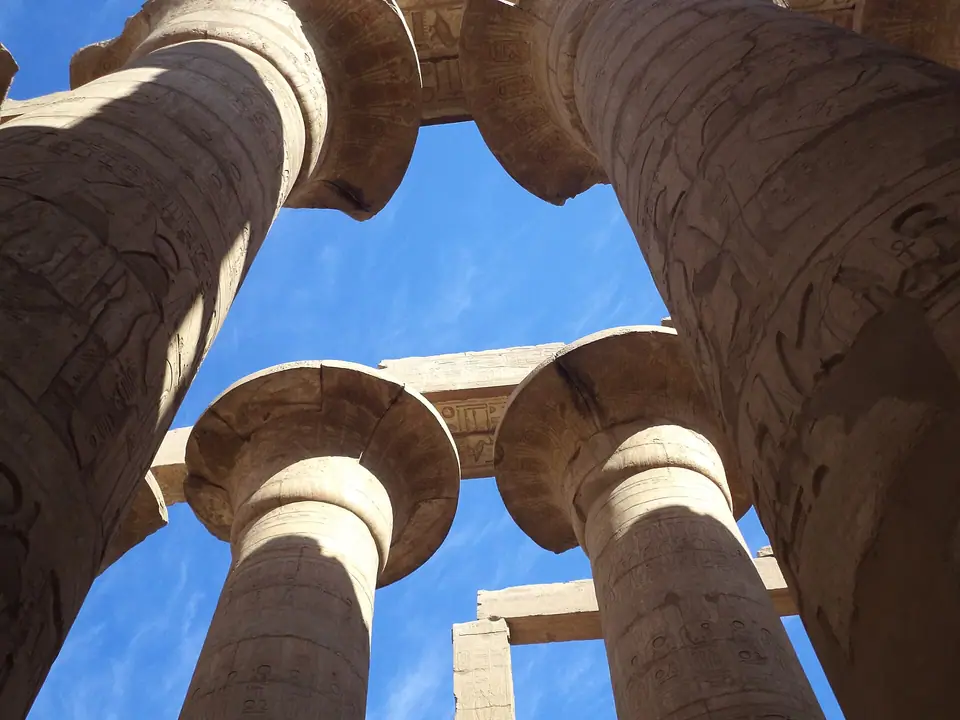
Inside the Great Hypostyle Hall of Seti I and Ramesses II
Pass between the colossal pink granite statue of Ramesses II and the ruined Second Pylon. You immediately step into the Great Hypostyle Hall, initiated by Pharaoh Seti I and completed by Ramesses II. This massive stone forest represents the primordial papyrus marsh of Egyptian creation mythology:
- Central Open-Papyrus Columns and Closed-Bud Columns. The central nave is supported by colossal sandstone columns with flared, open-umbrella papyrus capitals. Above them survive the stone clerestory window grilles that once channelled shafts of daylight into the roofed hall. Flanking the central aisle in multiple rows stand slightly shorter columns carved with closed papyrus-bud capitals. Look straight up at the architraves and column undersides to spot vivid turquoise, ochre, and lapis-blue pigments restored by conservation teams.
- Comparing Seti I's Delicate Raised Relief with Ramesses II's Deep Sunk Relief. Step outside the northern and southern exterior walls of the Hypostyle Hall to see a textbook lesson in New Kingdom art history. The northern half of the hall (built by Seti I) is carved in refined, low-profile raised relief (bas-relief) depicting military campaigns in Canaan and Syria. When Ramesses II took the throne, he instructed his sculptors to carve the southern half in deep sunk relief (relief en creux). Cutting deep into the sandstone prevented successors from chiselling away his cartouches. It also cast sharp shadows across his Battle of Kadesh reliefs and the Egyptian-Hittite Peace Treaty on the southern wall.
The Obelisk of Hatshepsut, Bark Sanctuary, and Akhmenu of Thutmose III
Continuing east beyond the Third and Fourth Pylons brings you to an ancient core of the temple:
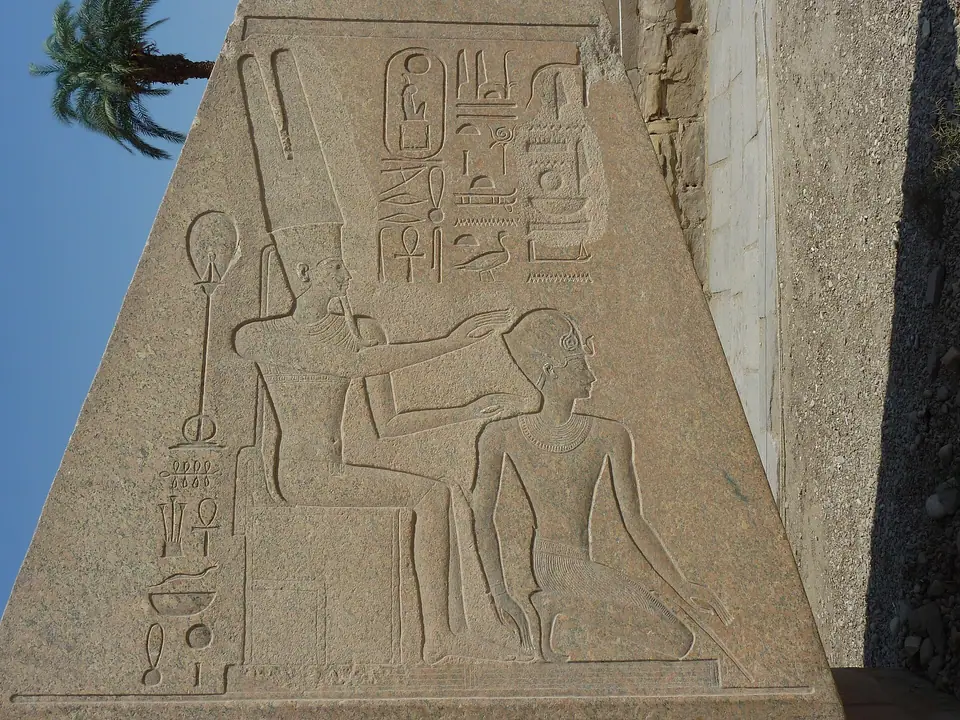
- The Standing Obelisk of Queen Hatshepsut. Quarried from red Aswan granite, Hatshepsut's northern obelisk remains standing tall inside the temple precinct. Its fallen sister obelisk lies by the Sacred Lake, where you can examine the exquisite carved apex (pyramidion) showing Amun crowning Hatshepsut face-to-face.
- The Pink Granite Sanctuary of Philip Arrhidaeus and the Middle Kingdom Court. Directly ahead stands the polished pink granite bark shrine built for Alexander the Great's successor, Philip Arrhidaeus, on the footprint of Thutmose III's shrine. Beyond an open courtyard, where Middle Kingdom building work once stood, rises the Festival Hall (Akhmenu) of Thutmose III. Look for its distinctive tent-pole columns, carved wider at the top than at the base to mimic wooden military tent poles. Next door sits the Botanical Chamber, carved with exotic birds and plants brought back from Syrian campaigns.
The Sacred Lake, Open-Air Museum, and Temple of Khonsu
Before leaving Karnak, explore three sectors that hasty tour groups routinely bypass:
- The Sacred Lake and Giant Granite Scarab. Lined with cut stone steps, the Sacred Lake supplied water for priests during purification rituals. At its corner stands a colossal red granite Scarab Beetle of Amenhotep III dedicated to Khepri, god of the rising sun.
- The Open-Air Museum. Tucked into the northern area of the complex, the Open-Air Museum displays reconstructed barque shrines. Later pharaohs had dismantled these monuments and used their blocks as rubble fill inside later pylons. Highlights include the limestone White Chapel of Senusret I, the quartzite Red Chapel of Queen Hatshepsut, and the Alabaster Chapel of Amenhotep I. Visitors can observe how different royal patrons chose varying stone materials to commemorate their sacred devotion.
- The Southern Axis and the Temple of Khonsu. Extending south, monumental pylons built by New Kingdom pharaohs form a grand ceremonial axis. In the Cachette Court, archaeologists unearthed thousands of buried stone statues and bronzes. In the southwestern corner of the enclosure stands the intact Twentieth Dynasty Temple of Khonsu, dedicated to the moon god. Its Ptolemaic gateway opens directly onto the Avenue of Sphinxes.
Practical Traveller Advice and Planning
North of the Hypostyle Hall stands the compact Temple of Ptah, where a statue of the lioness goddess Sekhmet gleams under a shaft of roof light. Attendants there and near the Temple of Khonsu sometimes wave visitors behind ropes for baksheesh. Keep your official ticket handy and politely decline unofficial tours. When arranging your wider journey through Upper Egypt, review local transport options in our Luxor travel advice. Travellers heading across the Nile should consult our Luxor orientation guide for essential ticketing pointers. Pair your morning at Karnak with our 3-day Luxor itinerary and Luxor Museum guide. Restrooms and a shaded café sit right beside the Sacred Lake, making it a reliable spot inside the enclosure for a mid-morning water break.
Before setting out, you can reserve Karnak entry passes online through the official Ministry ticketing portal (egymonuments.com). Customer support is available by phone at +20235317344 or by email at tourism_info@efinance.com.eg. Combining digital tickets with an early arrival lets you walk straight through security into the Great Court. At dawn, the sandstone columns glow in soft morning light.
Where it is
- 1Karnak Temple
- Luxor International Airport (LXR) · about 7 km from here in a straight line
- Directions in Google Maps
Stations and taxi ranks: OpenStreetMap. Airports: OurAirports. Distances are in a straight line.
Traveller tips
Real advice from people who have been to Luxor. Every tip is read by our team before it goes live.
No tips yet. Been here? Yours could be the first.
Thank you! Your tip will appear here after a quick review.
More in Luxor
Continue exploring Luxor with related neighbourhood, food, and planning guides
Where to Stay in Luxor: East Bank Corniche vs West Bank Villages
Luxor, Egypt
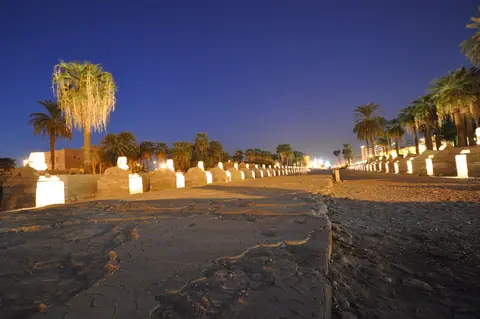
Luxor 3-Day Itinerary: East Bank Temples & West Bank Necropolis Route
Luxor, Egypt
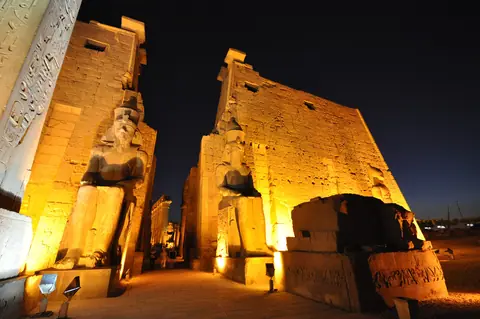
Luxor Temple Guide: Avenue of Sphinxes, Pylons & Evening Walk
Luxor, Egypt
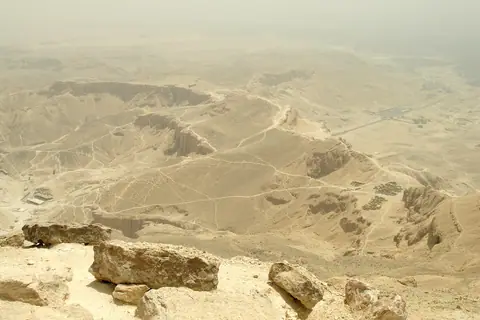
Valley of the Kings Guide: Royal Tombs, KV62 Tutankhamun & Seti I
Luxor, Egypt
