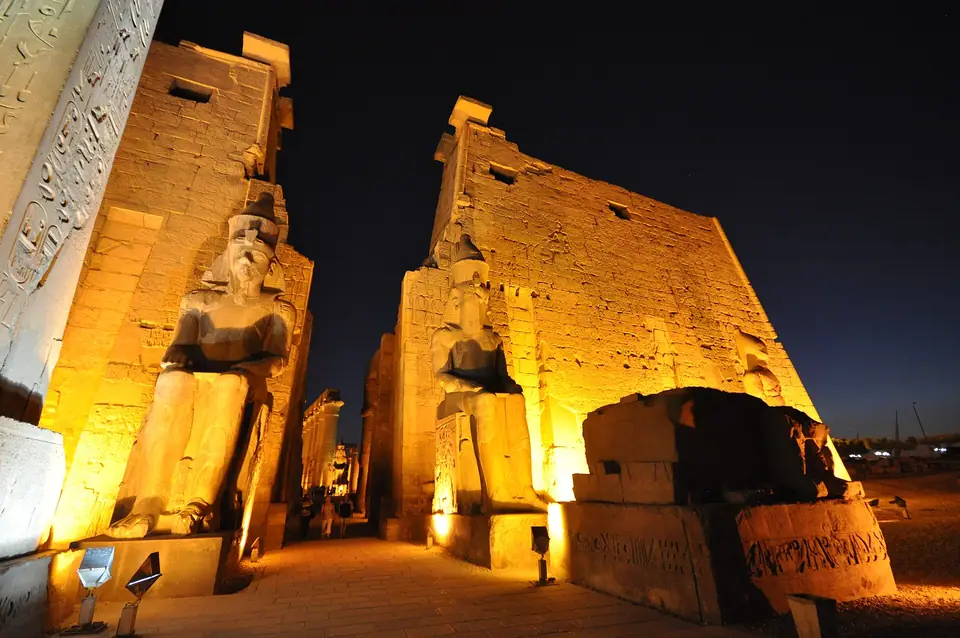
Photo: Jorge Láscar from Melbourne, Australia · CC BY-SA 4.0
Luxor Temple Guide: Avenue of Sphinxes, Pylons & Evening Walk
Walk the Avenue of Sphinxes into Luxor Temple: explore the monumental pylon, the living Abu el-Haggag Mosque, Amenhotep III's Colonnade, and Roman chapel frescoes.
Rising right on the East Bank Nile Corniche, Luxor Temple (Ipet-resyt, "The Southern Sanctuary") differs from every other major temple in Thebes. Unlike mortuary sanctuaries built for deceased kings, Luxor Temple was dedicated to the annual rejuvenation of the royal ka (divine life-force of kingship). That royal renewal took place during the Opet Festival in the Nile inundation season. Two New Kingdom rulers built the core complex: Amenhotep III in the south and Ramesses II in the north. Over centuries, the site remained a continuously active place of worship. It layers pharaonic bark shrines, a Sanctuary of Alexander the Great, a Roman legionary chapel, Coptic churches, and the Mosque of Sheikh Yusuf Abu el-Haggag. Below is a step-by-step route through the temple and the Avenue of Sphinxes.
| Monument Zone | Era & Builder | What to Look For | Best Lighting Window |
|---|---|---|---|
| Avenue of Sphinxes (Tariq al-Kebash) | Ancient Dynasty to Late Period | Paved processional road lined by human- and ram-headed sphinxes | Late afternoon or floodlit evening walk |
| Pylon & Obelisk | Ramesses II | Pylon with Battle of Kadesh reliefs, pink granite obelisk and colossi | Sunset when western sun hits the pylon facade directly |
| Court of Ramesses II & Mosque | Ramesses II and Sheikh Abu el-Haggag | Papyrus columns, granite colossi and historic mosque perched high up on walls | Dusk when mosque minarets and columns light up |
| Colonnade & Solar Court | Amenhotep III and Tutankhamun | Open-papyrus columns, Opet Festival reliefs and double-row Sun Court | Theatrical upward floodlighting |
| Inner Sanctuaries & Roman Frescoes | Amenhotep III, Alexander the Great and Roman era | Divine Birth Room, Alexander's Granite Shrine and Roman wall paintings | Late afternoon or evening |
Walking the Avenue of Sphinxes (Tariq al-Kebash)
Reopened after extensive excavation across downtown Luxor, the Avenue of Sphinxes (Tariq al-Kebash) restores the ancient processional highway. It links the precinct of the Karnak Temple Complex straight to Luxor Temple. Sandstone pedestals along the route originally supported numerous sphinxes. Human-headed androsphinxes line the southern stretch, while ram-headed criosphinxes guard the Karnak approach. Along the verges, excavations uncovered ancient mud-brick wine presses, Nilometers, and Roman water cisterns.
You have two ways to experience the Avenue of Sphinxes. You can view the southern stretch inside your standard Luxor Temple ticket, or walk the route from Karnak. Tickets for Luxor Temple can be booked online via the official ticketing website. Carry water and wear a sun hat from our packing guide, as the sunken sandstone road has zero shade before sunset.
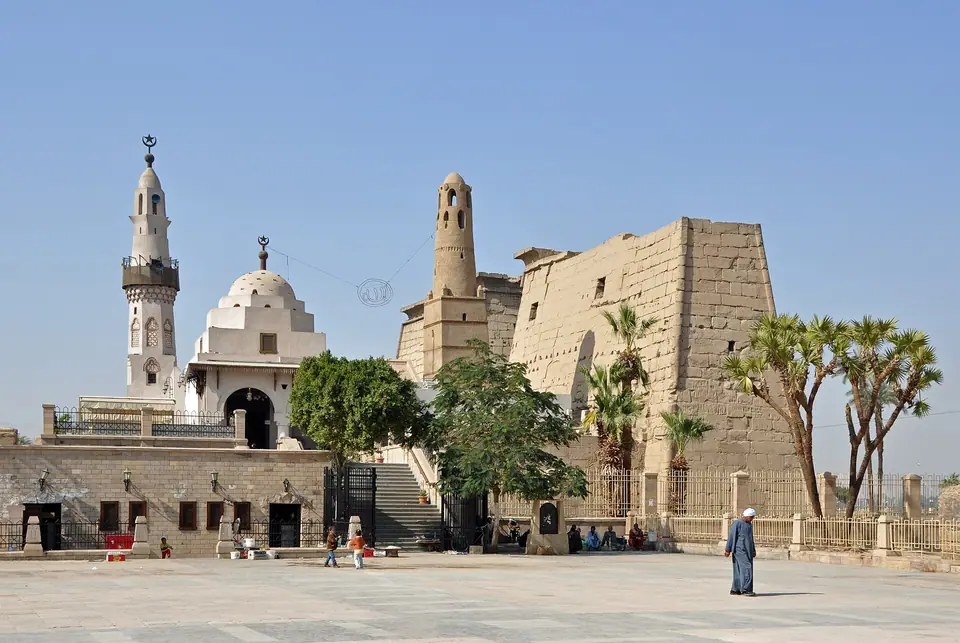
The Pylon of Ramesses II and the Twin Obelisk Story
Approaching the northern entrance of Luxor Temple from the Avenue of Sphinxes, you stand before the monumental pylon of Ramesses II. Look closely at several details on the facade before stepping through the central portal.
- The Lone Pink Granite Obelisk (and Its Sister in Paris). Originally, two red granite obelisks stood asymmetrically in front of the pylon. The eastern obelisk, with baboons carved in high relief at its base adoring the rising sun, still stands here. Its western twin was gifted by Ottoman Viceroy Muhammad Ali Pasha to France. Today that companion obelisk stands on the Place de la Concorde in Paris.
- Colossal Statues and the Battle of Kadesh. Guarding the gateway sit colossal enthroned statues of Ramesses II carved from dark grey-black granodiorite, flanked once by standing colossi. Across the face of the pylon wings, sunk reliefs depict Ramesses II charging in his war chariot during the Battle of Kadesh against the Hittites. Deep vertical slots in the masonry once anchored cedar flagstaffs tipped with electrum.
The Court of Ramesses II and the Living Mosque of Abu el-Haggag
Passing through the entrance pylon, you notice that the northern court twists slightly eastward compared to Amenhotep III's southern half. Ancient architects engineered that axis shift so the pylon would align squarely with the Avenue of Sphinxes coming from Karnak. Inside the Peristyle Court of Ramesses II, closed-bud papyrus columns surround the open plaza. Between the columns stand polished red-granite colossi of Ramesses II with delicate figures of Queen Nefertari beside his calves.
Look up at the northeastern corner of the court for a remarkable architectural layer. The whitewashed walls and minarets of the Mosque of Sheikh Yusuf Abu el-Haggag sit suspended high in the air directly atop the pharaonic columns. Centuries of Nile flood silt and village debris had buried Luxor Temple up to its column capitals. Residents built the mosque on what was then ground level. Later excavations cleared the temple down to its pharaonic pavement. The living mosque remained untouched atop its stone perch, leaving its old medieval doorway hanging high above the courtyard.
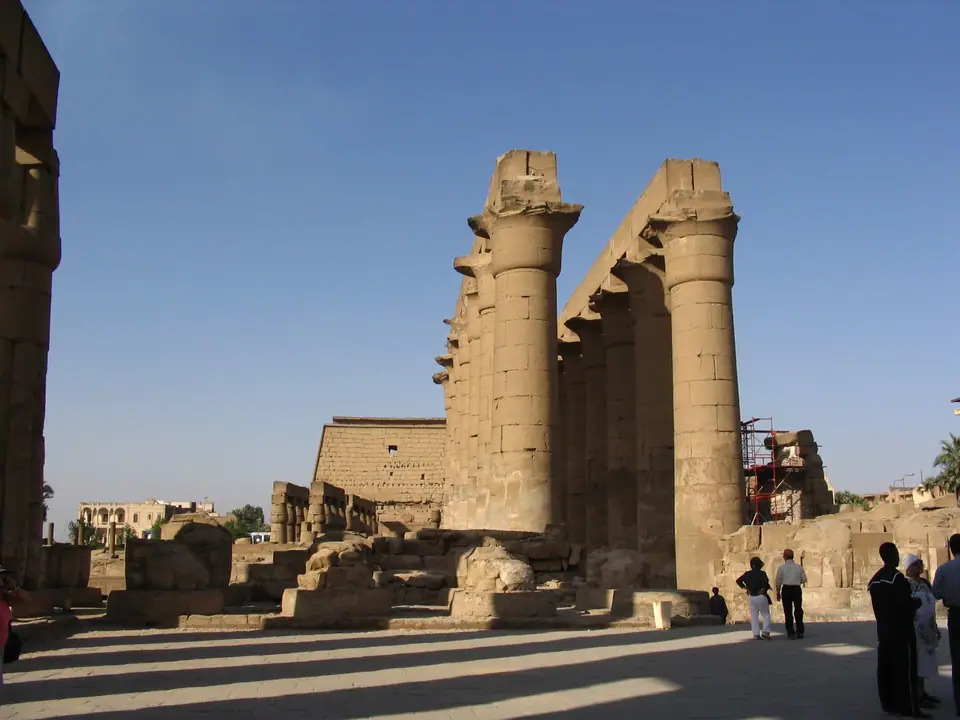
The Colonnade of Amenhotep III, Solar Court, and Roman Imperial Chapel
Walking south from Ramesses II's court, you enter the temple of Amenhotep III:
- The Processional Colonnade (Carved by Tutankhamun and Horemheb). Giant sandstone columns with open-bell papyrus capitals soar overhead along a grand corridor. The side walls preserve reliefs of the Opet Festival, carved under the boy king Tutankhamun and later usurped by Horemheb. Priests carry the sacred barques from Karnak to the Nile and tow the barges upstream while Nubian dancers, acrobats, and drummers celebrate along the bank.
- The Solar Court of Amenhotep III and the Cachette. Beyond the colonnade opens the sunlit Peristyle Court of Amenhotep III, ringed by double rows of clustered papyrus-bud columns. Workers testing soil dampness beneath this court once uncovered a deep cachette pit. Roman-era priests had buried pristine royal and divine statues there, now displayed in the Luxor Museum.
- The Roman Frescoes, Birth Room, and Alexander the Great's Sanctuary. At the southern end of the Solar Court, Roman masons walled in columns during the imperial era. The pharaonic vestibule became the imperial cult chapel of a Roman legionary fortress. Look closely at the curved apse and flanking walls where sheets of lime plaster have flaked away. Ancient Roman frescoes sit directly on top of carved hieroglyphs of Amenhotep III. Behind the apse lies the Divine Birth Room, showing the god Amun visiting Queen Mutemwiya to conceive Amenhotep III. Next door stands the inner Barque Shrine rebuilt by Alexander the Great, where Alexander wears a pharaonic kilt and double crown before Amun-Ra.
Traveller tips
Check the official site for current opening hours before your visit. You can photograph the pylon, the Mosque of Abu el-Haggag, and the Roman frescoes in warm afternoon sunlight during your visit. As dusk falls, upward amber floodlights transform the columns of Amenhotep III's Colonnade on the same admission ticket. Pair this walk with our 3-day Luxor itinerary and Corniche dining guide. Before leaving the western side of the enclosure, pause along the outer Roman fortification wall facing the Nile Corniche. There you can spot reused sandstone blocks carved with upside-down pharaonic cartouches and early Christian crosses. Walk the Avenue of Sphinxes southward from Karnak toward Luxor Temple in the late afternoon. Heading south keeps the lowering sun behind your shoulder rather than in your eyes. Keep your admission ticket in your pocket until you exit the final turnstile on the Corniche promenade.
Visitors can book Luxor Temple entry tickets online via the official Ministry ticketing website (egymonuments.com). You can also pay by bank card at the Corniche ticket window. For assistance with online bookings, official customer support is reachable by phone at +20235317344 or by email at tourism_info@efinance.com.eg.
Where it is
- 1Luxor Temple
- Luxor International Airport (LXR) · about 7 km from here in a straight line
- Directions in Google Maps
Stations and taxi ranks: OpenStreetMap. Airports: OurAirports. Distances are in a straight line.
Traveller tips
Real advice from people who have been to Luxor. Every tip is read by our team before it goes live.
No tips yet. Been here? Yours could be the first.
Thank you! Your tip will appear here after a quick review.
More in Luxor
Continue exploring Luxor with related neighbourhood, food, and planning guides

How to Get to Luxor: Airport, Nile Trains, Ferries & West Bank Taxis
Luxor, Egypt

Best Time to Visit Luxor: Desert Seasons, Winter Sun & Heat Strategy
Luxor, Egypt
What to Wear in Luxor: Temple Etiquette, Tomb Heat & Packing Tips
Luxor, Egypt

Where to Stay in Luxor: East Bank Corniche vs West Bank Villages
Luxor, Egypt
